P K O’Sullivan
P K O’Sullivan is a pseudonym.
Professor David Betz of King’s College London has done something few academics ever manage: he has got a good part of the country talking seriously about civil war in Britain. His case is about the body politic, a fragmenting society, collapsing trust in the state, and the point at which organised groups start using violence to settle what politics no longer can.
I think he’s right about the direction of travel. Where I part company with him is on the scale. Betz is thinking about organised groups and attacks on the infrastructure that keeps our cities running. I think the war has already started at the level of the individual: between brothers and sisters, between old friends, between the man in the van and the protester glued to the road in front of him. People no longer simply disagree. They regard each other as illegitimate, and in more and more everyday situations that contempt is spilling over into something physical. That, to me, is what civil war looks like before anyone hands out the guns.
The birthday party
I realised how far things had gone at a birthday party. It was for someone I’ve known since childhood, held in the basement of a bar, and the room was full of childhood friends and the people they’d collected along the way.
Even at 11 o’clock there were people wearing French berets and sunglasses. Indoors. In a basement. Perhaps that’s fashionable now, I’m prepared to accept my grasp of these things has its limits, but it set the tone for an evening among people who were very comfortable with the way they saw the world.
There were really two crowds in that room. One was the rich north London set: people who had done very well indeed and could afford their politics several times over. The other was made up of people with ordinary jobs and ordinary money worries: musicians, people who worked for Transport for London, some who’d had to move out of London to afford anything half decent. I’d be surprised if many in that second group had much in savings.
What united them was the politics. It was Ken Livingstone’s Labour, Billy Bragg’s Labour: a world where everyone knew which opinions marked you out as decent, and everyone seemed to know who the right sort of people were. I recognised it straight away, because I grew up in a version of it.
One woman summed up the mood. She worked for a green company and lobbied on environmental issues, and she had chosen to have two children without a father around – the second conceived at a fertility clinic. I asked whether the younger one ever got jealous when the older child’s father turned up, which he did now and again. She told me, more or less, that her daughter knew she didn’t need a man. It came out like a slogan. My body, my choice, I can have whatever I want, and the children will adjust.
‘Luxury beliefs’ usually describes wealthy people backing policies whose costs land on everyone else, and the rich half of that room fitted the description perfectly. What struck me was the other half. You don’t need to be wealthy to borrow the beliefs of people who are, and you can hold them while paying the price yourself. You can be priced out of your own city without ever questioning the policies that drive up demand for housing. You can watch your wages buy less without asking what happens when government promises outrun what the country can deliver. And you can be extremely generous with money somebody else has to earn.
Nobody in that room was a monster. They were people at a party, and that’s what bothered me. The gulf between us didn’t need anyone to behave badly. It was simply there.
Growing up with the Morning Star
I should say where I’m coming from, because it probably isn’t where you’d assume. My father came here from Ireland, studied, worked hard and did well as an accountant. In the ’70s we had the Morning Star delivered to the house, and my mother was a teachers’ union rep. I was taught to dislike Margaret Thatcher before I was old enough to have an opinion of my own. My disagreements with the left didn’t come from a Tory upbringing. They grew up inside it.
As I got older, my father and I argued about money endlessly. He thought the wealthy should pay more, and billionaires in particular represented something that had gone badly wrong. My question was always the same: why are we so sure the government will spend their money better than they would?
Some wealth comes from being close to power, from protected markets or from sitting on something scarce, and I’ve no interest in defending that. But the businessman who has put his house on the line, borrowed against everything and spent years trying to make something work has done rather more than wait for the state to provide. James Dyson, by his own account, built 5,127 prototypes before he had a vacuum cleaner ready for production, and then the established manufacturers turned him down. When someone like that finally succeeds, I don’t think the first question should be why he’s allowed to keep so much.
The case for enterprise was never that a billionaire spends enough to make the rest of us rich. He can only buy so many cars, and there’s a limit to what even a very determined man can spend at Tesco. What matters is investment: deciding where capital goes, employing people, developing products, losing your own money on mistakes and, every so often, producing something that makes other people’s lives better.
My father had improved his own circumstances through effort and education, and I admired him for it. I just never understood why the same process, carried far enough by somebody else, became grounds for suspicion.
A sister and the state
Politics is easy to argue about when the people involved are strangers. It’s much harder when they’re your sisters.
My younger sister has spent most of her adult life living off the state. Her answer to any need is that the state should meet it and, when it falls short, the answer is more. Upton Sinclair put it best: “It is difficult to get a man to understand something when his salary depends upon his not understanding it.”
Benefits aren’t a salary, but the principle is exactly the same.
So I’ll say plainly what I believe, because I watched it happen. My sister had her second child to keep her benefits. Support tied to children tapers away as they grow up: child-related payments stop once a child leaves education, the pressure to find work grows as the youngest gets older, and a household with fewer children is judged to need fewer bedrooms. As her eldest approached that age, the money was going to shrink and there was talk of moving her somewhere smaller. Then, after a long gap, came another baby, by the same father – a man she wasn’t really with. She’ll tell you it was her own free choice. I don’t believe it for a second. When the state becomes the centre of your security, its rules make your choices for you.
Then the school got to work on her eldest.
For years, schools up and down the country took children going through the ordinary confusion of puberty, the girl who’d rather play with the boys’ toys, the teenager uncomfortable in a changing body – and told them they might be trans or non-binary. Non-binary was in some ways the worst of it: at least a child who works out they’re gay knows what they are. It wasn’t only here – the same ideology ran through American classrooms. And it’s now accepted that it was wrong. The Cass Review found the evidence behind the way these children were treated remarkably weak and warned that social transition is not a neutral act. From September 2026, schools in England are bound by statutory guidance which says they are not responsible for starting a social transition, that parents’ views must carry great weight, and that full social transition in a primary school should be agreed upon only very rarely.
That is exactly what happened in my sister’s house. Her eldest was an ordinary, confused adolescent, and the teachers supplied the label (which made her feel special). My sister, who will fight her corner with anyone else, swallowed it whole, because the people telling her were an institution and she doesn’t question institutions that are on her side. I’m not going to pretend this is a private matter with no bearing on my argument. It is my argument. A child was steered into an identity by adults with an ideology, and the parent who should have been asking questions treated every question as an attack.
The two of us don’t talk properly any more. Trying to explain anything to her is a complete waste of time. As far as I’m concerned she believes in fairies and unicorns – it’s like talking to someone from another planet. In her world money simply falls from the sky, and somebody else – always somebody else – should pay for whatever is needed. Economics doesn’t come into it. Point out that every pound the state hands out had to be earned by someone first, and she reacts as though you’ve said something cruel.
Who paid for my father’s care?
Then my father needed a care home.
If you want somewhere that isn’t a modern version of a Victorian Bedlam, you pay, and we paid roughly £2,500 a week. The money he’d built up over a lifetime of work – the savings of exactly the kind of hard-working immigrant the left claims to champion – disappeared at a frightening rate. In England, if you have more than £23,250 in assets, you pay the full cost of your care until you’re down to that figure. If you’ve saved nothing, the state picks up the bill. Work, save and do the right thing, and you fund it yourself. Don’t, and somebody else funds it for you.
That’s when I started looking at where the money goes instead, and once you start looking you can’t stop.
The National Audit Office estimates that the Home Office and Ministry of Justice spent around £4.9 billion on the asylum system in 2024–25, about £4 billion of it on Home Office asylum support, and says the system’s own delays and failures are driving up the cost. The latest DWP figures show 4.1 million people entitled to PIP in England and Wales in July 2026. Combined PIP and DLA entitlement stood at 5.4 million in March 2026, against 3.5 million in February 2020 – a rise of more than half in six years. I’m not saying nobody needs help. I’m saying I don’t believe the nation’s health collapsed that fast.
Raise any of this and you’re told you’re a racist or that you lack compassion. But where is the compassion for the families watching a parent’s life savings drain away week by week? If we weren’t pouring billions into asylum hotels, into a disability bill that keeps climbing, into everything else that has become untouchable, there would be plenty for the people who’ve paid in all their lives. There isn’t, because ideology comes before people. And so people fall through the cracks and end up in places you wouldn’t leave a dog.
Who lives with the consequences?
My father was an immigrant, so I’ve no interest in pretending migration has contributed nothing to this country. What I want to know is why questioning its scale, its management or its cost so quickly becomes a discussion about whether you’re a bad person for asking.
The consequences don’t fall on the people who preach about them. Someone with a big house and private provision feels the pressure on housing, schools and healthcare very differently from someone renting a room and waiting for an appointment. A policy can look good on a spreadsheet and still wreck particular towns, and the people who live there should be allowed to say what has changed without first getting permission from people who don’t.
There’s no need to embellish. Baroness Casey’s national audit of group-based child sexual exploitation described persistent failures to examine the ethnicity of perpetrators, found local evidence that warranted further investigation, noted that the national data were still inadequate, and identified failures of accountability and of child protection. Those in authority let worries about how things would look get in the way of protecting children. Once people have seen that, asking them to trust the next reassurance is hopeless.
One law for them
‘Two-tier justice’ is a phrase the left loves to mock. So try giving them examples.
After the Southport murders, Lucy Connolly, a childminder, put up an ugly, angry post on X that she deleted within hours. She pleaded guilty to inciting racial hatred and was jailed for 31 months. Compare that with the nine Extinction Rebellion women who admitted taking hammers and chisels to the windows of HSBC’s London headquarters, causing a reported £500,000 of damage: a jury acquitted them in November 2023. Seven more did nearly £100,000 of damage to Barclays’ headquarters and walked away with suspended sentences. The four who pulled down Edward Colston’s statue in Bristol were cleared too.
Lay those cases side by side for a left-winger and they simply don’t compute. Connolly was ‘far right’, so she deserved whatever she got. The women with the hammers were saving the planet. In their minds you’re allowed an opinion in theory, but anyone who doesn’t share their moral high ground is, in practice, a Nazi, and Nazis don’t get the benefit of the doubt.
It isn’t just me who has noticed. In the British Social Attitudes findings published in 2025, just 12 per cent said they trusted governments to put the country first always or most of the time, while 46 per cent said they almost never did. Both were records. Once people stop seeing the system as theirs and start seeing it as a weapon belonging to the other side, a court ruling isn’t something to argue about any more. It’s proof the other lot have taken over.
Now think about who is on the receiving end of all this. The man in the van, trying to get to a job so he can look after his family, stuck on a motorway because a group of protesters has glued itself to the tarmac to shout about climate change. He’s been told for years that he’s the problem. He’s watched people like him go to prison for words while people like them walk free after smashing things up. And he’s tired.
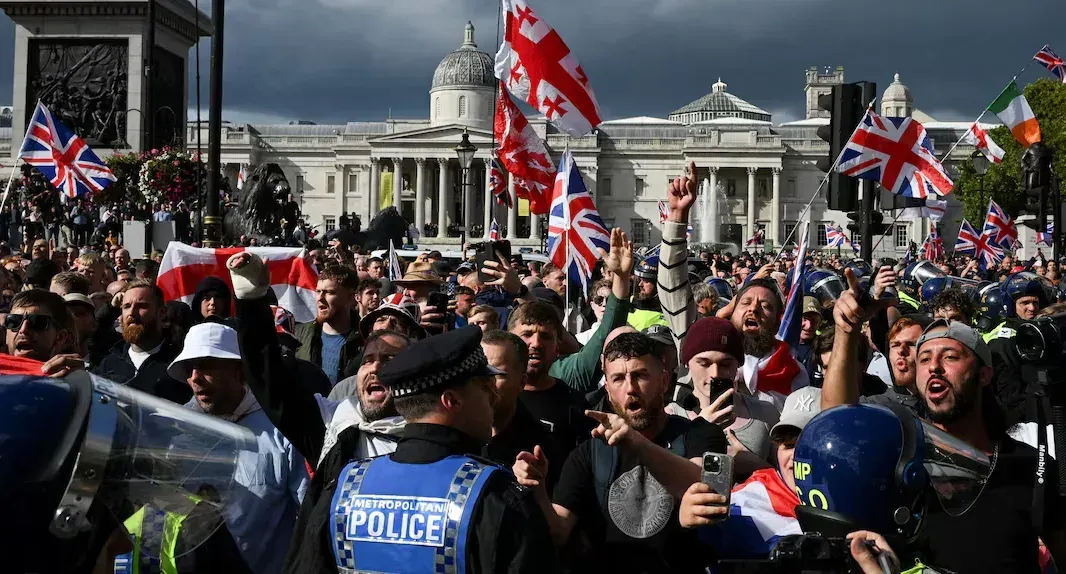
We’ve already seen what happens next. Drivers have dragged protesters off the road with their bare hands, and plenty of people cheered when they saw the footage. Nobody organised that. It isn’t Betz’s kind of violence at all. It’s what happens when ordinary people, mostly working class, mostly just wanting to be left alone to earn a living, reach the end of their tether. My fear is that it’s spreading, from the roadside to the street and to any situation where someone from that comfortable, lecturing class comes face to face with someone who has to live with the consequences of their politics.
That is the civil war I’m talking about. Not two armies, but millions of individual confrontations, each one a little closer to a punch being thrown.
The Radio 4 sister
My older sister lives in a different world from my younger one. Her dependence, as I see it, is on the institutions and social habits that make life feel orderly. The BBC belongs in that world, and so does Radio 4, with its reassuring tone in which sensible people discuss serious matters. She trusts it. I don’t, and I’ve good reasons.
In 2025 it emerged that Panorama had edited Donald Trump’s speech of January 6th 2021 in a way that, in the BBC’s own words, gave “the mistaken impression that President Trump had made a direct call for violent action”. The director-general and the head of BBC News both resigned, and Trump is now suing for up to $10 billion. This is the same organisation that employed Jimmy Savile for decades, and Dame Janet Smith’s review found it had missed chance after chance to stop him. It had Rolf Harris on our screens for years. It carried on paying Huw Edwards for months after it knew he had been arrested. And it’s the organisation whose reporter used fake bank statements to land the Diana interview.
Yet whenever I challenge an institution she trusts, the conversation becomes too uncomfortable to continue. She dislikes conflict, and her instinct is to keep things pleasant. Around her is the sort of Cotswold social world where people are lovely, charitable and well-mannered, and where a difficult opinion is more unwelcome than the problem it describes. There’s nothing wrong with baking a cake for charity. What I object to is the comfortable performance of goodness becoming a reason never to examine where your politics lead.
So I have one sister defending a system her material life depends on, and another defending a consensus that spares her any uncomfortable disagreement. Neither would accept that description, which is rather the point. We can’t even agree on what we’re arguing about.
Where I part company with Betz
In fairness to Professor Betz, he has gone further than his critics give him credit for. In an article co-written with Michael Rainsborough, he openly considered whether conflict might already have begun “in slow motion”. But his eye is on the body politic: organised groups, infrastructure, the moment the state loses control. Mine is on what happens between individuals long before any of that.
The individual civil war starts when you stop thinking the other person has reached the wrong conclusion and start thinking they have no right to a view at all. I’ve felt that coming at me, and I’ve felt it in myself. After enough arguments in which you’re deliberately misunderstood, contempt becomes very tempting. You stop explaining. And once enough people stop explaining, what comes next isn’t a debate.
It starts at home
I can’t talk to my younger sister the way I once could. With my older sister, there are subjects we can’t go near without one of us retreating or getting upset.
And it isn’t only family. I’ve lost friends, people I’ve known for years who no longer speak to me because they’re in the ‘just be kind’ camp and I’m not. Their kindness is remarkably selective. They have endless empathy for refugees from the other side of the world and none at all for the people they grew up with, living in towns dealing with grooming gangs, sexual violence and streets carved up into HMOs. They’re certain they hold the moral high ground. They want to help everybody. And all the while their luxury beliefs are condemning the very people they went to school with to a worse life.
Plenty of families have kept politics off the dinner table for generations, and I know the objection: a row over dinner isn’t the English Civil War. But it’s no longer one subject we can’t discuss. It’s tax, benefits, migration, schooling, the BBC, and disagreeing on any of them is now a verdict on whether you’re a decent human being. Civil wars have always divided families as well as territory.
What worries me most is the anger. The people living with the consequences of these luxury beliefs are furious and it’s personal now. I can hear it in conversations and I can see it at the roadside. It isn’t organised and it isn’t ideological in Betz’s sense. It’s one person coming face to face with another person who has lectured them for years, and something snapping.
I don’t want anyone on a barricade and I don’t want anyone hurt. But I’m not going to pretend I can’t see it coming, or that the people who’ve spent a decade calling everyone who disagrees with them a Nazi will bear no responsibility when it arrives.
That’s why I think the civil war has already begun.
This article was originally published by the Daily Sceptic.