Larry
Exploring New Zealand’s energy issues and energy future.
The recent announcement by Methanex that they would effectively cease operations at their Motunui methanol plant in the first quarter of 2027 is a big blow to Taranaki and ultimately the wider NZ Inc.
This is another casualty of de-industrialisation in what is becoming a persistent theme for the New Zealand economy.
Thinking big
Born out of abundance, the Motunui plant was conceived as one of the flagship Muldoon-era Think-Big projects. Construction began in 1981. In its original form, it was configured as a natural gas-to-gasoline plant, commonly known as a synthetic fuels, or synfuels, plant.
Two key events led to the development of the Motunui facility. The first was the Middle Eastern oil shocks of the 1970s and the high global oil prices that persisted into the 1980s. The second was the natural gas abundance from the recently developed Māui gas field.
At the time, around 85 per cent of New Zealand’s refined fuels were imported, and the development of the enormous offshore Māui gas field was seen as an opportunity to reduce that dependence.
The plant was mechanically complete by June of 1985 and became the world’s first commercial gas-to-gasoline plant. The engineering was impressive. The first stage used a low-pressure gas-to-methanol process, which then supplied a methanol-to-gasoline catalytic second stage. The design was capable of converting up to 55 PJ of gas into approximately 780 million litres of petrol each year.
However, entropy is a ruthless referee, and converting 55 PJ of gas into 27 PJ of petrol was never going to be economically sustainable in the long term. As global oil supplies stabilised and prices reduced through the 1980s, the plant progressively produced more methanol and eventually stopped production of synfuels altogether in 1999.
The synfuel unit was dismantled in 2008, leaving the plant largely as it is today.
Gas market implications
I have consistently predicted that our dwindling gas supplies would result in Methanex’s closure, but I fully admit I had the sequence of events wrong.
I had expected the closure of Māui gas production to lead to Methanex’s closure. Māui’s production over the last year or so has been pretty close to matching Methanex’s demand. As such, I was slightly surprised by the timing of this announcement.
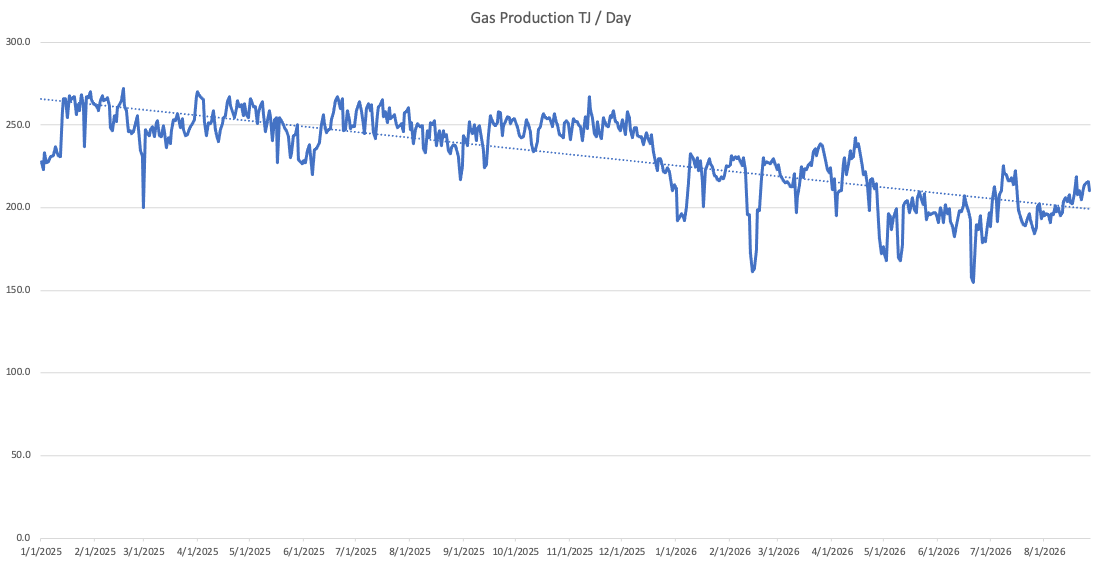
However, despite the operators of Māui doing a heroic job to reconfigure offshore and onshore facilities to keep the field producing longer than expected, Māui and our other fields continue to decline. In January this year we had a total open pipeline gas supply of around 220 TJ/day; as of the end of August, this is closer to 200 TJ/day, a 10 per cent drop in eight months.
Much is being made in the media of the gas supply that will be freed up as a result of the Methanex closure and that this means there is no longer a need for LNG importation. Some political parties have also adopted this narrative.
I would urge caution before leaping to this overly simplistic conclusion.
I say this for three reasons.
Firstly, Māui is expected to cease production sometime in the coming year, so the reprieve will be short-lived, removing around 12 PJ of annual production from the system.
Secondly, this will reduce the likelihood of further exploration as there will no longer be a significant customer to underwrite new large-scale supply coming into the market.
Thirdly, and most importantly, deliverability will likely become a constraining factor.
Deliverability
For it to be effective, an energy source must be supplied in the right amount, in the right place at the right time to produce useful work.
Methanex provides the gas market with what is essentially a big pulsation damper that smooths discrepancies between the supply that generally likes to be stable, and demand that can vary a lot seasonally.
Earlier this year in “Mature fields, fragile flows” I expanded on this issue in more detail. To quote from that piece.
The situation going forward is going to be much more dynamic. The gas market will change significantly in coming months with the expected closure of Māui production and Methanex demand.
Methanex did more than consume gas. It acted as a system stabiliser. During periods of excess supply it absorbed gas that might otherwise have forced producers to choke in wells. By doing so, it ensured that the gas wells stayed online and stable. During winter electricity shortages it could rapidly curtail demand and free gas for power generation for New Zealand’s businesses and homes. Its closure removes a major balancing mechanism from both the upstream reservoir system and the downstream electricity market simultaneously.
As Taranaki’s gas fields deplete, deliverability becomes increasingly dependent on reservoir pressure, liquids management, compression, workovers and steady demand.
Methanex helped stabilise the system by acting as a large baseload/swing customer. Without it, the demand is far more variable and the gas system will need more flexibility in terms of delivery rates just as the depleted wells themselves are becoming less flexible and more fragile.
The Gas Industry Co’s 2021 market settings report touches on this issue. It notes that technical aspects of field development, production maintenance and well/reservoir types affect deliverability; producers have only limited ability to adjust field production once operational; and it is difficult to significantly alter production rates on a short-term basis.
Liquid loading is one of the key issues driving this. Liquid loading occurs when gas velocities in the well production tubing are too low to carry liquids to surface. As gas velocity falls, or liquid content rises, the well’s ability to carry the liquid reduces. This can lead to reduced production and can eventually kill the well.
Choking a depleted well in response to lower market demand reduces gas velocity in the production tubing. In mature wells this can increase the risk of liquid loading or water breakthrough issues, potentially reducing deliverability and in some cases making wells difficult or uneconomic to restart at previous flow rates.
The seasonal variability in gas demand nearly doubles when Methanex closes.
Looking at the average figures of the past three years, with Methanex still in the picture, the total demand varies by only 30 TJ/day across a year.
Remove the Methanex demand and the remaining demand varies by ~51 TJ/day. This is a 70 per cent larger seasonal variability than what we have currently.
This is due to the non-linear nature of the demand. Fonterra’s dairy season ramps up in August–November, power generation peaks May–September, residential heating peaks June–August. None of these loads perfectly offset each other.
The mid to late summer period shows a much lower level of demand.
During these lower-demand periods, production capability may temporarily exceed market demand requirements, increasing the likelihood that some wells will need to be choked back. This is when they become vulnerable to liquid loading issues and there is a risk that they may not come back online when demand increases again.
This is a new variable that we have not had to deal with so far and it will be a delicate balancing act.
In effect, the gas system will increasingly resemble a renewable electricity system with storage. Gas production wells operate best at relatively stable flow rates, while demand is becoming increasingly variable. Ahuroa gas storage therefore becomes analogous to a grid-scale battery, absorbing excess supply during low-demand periods and releasing it during winter peaks.
This is not without challenges and risks though. Intermittent seasonal demand has always, and will always, create hidden costs, it does so in renewable system and will do so if gas becomes intermittent. Whether Ahuroa alone has sufficient capacity, injection capability and operational reliability to perform this balancing role at a national scale remains an open question.
There will undoubtedly be all sorts of systems dynamic issues that emerge as a result of the Methanex closure, but I think deliverability will be the key one.
The human cost
The methanol plant has been a big part of Taranaki for over four decades. I know people who built it, many who have worked there and several who still do.
It is a large industrial facility that has been an incubator for many businesses providing a wide range of services to support its operations. The port, NDT companies, production chemical suppliers, engineering services, logistics – the list goes on.
Inside all of these businesses are people and families who have made a life for themselves in Taranaki and now face some very difficult decisions. Decisions that will reverberate through the wider community. My thoughts are with you all during this time.
I suspect many will move out of the region and many out of the country. When they do, it’s a loss of skills and talent, it’s a loss of coaches for kids sport on Saturday, it’s a loss of people at the school working bee, it’s a loss of friends and colleagues.
No matter how aware I am that these things are going to happen, it still leaves me with a heavy heart when they eventually do.
Industry follows energy.
Originally published on New Zealand Energy and republished by RCR Media.