This is edition 2026/183 of the Ten@10 newsletter.
Hi all,
This is the Ten@10, where I collate and summarise ten news items you generally won't see in the mainstream media.
Enjoy!
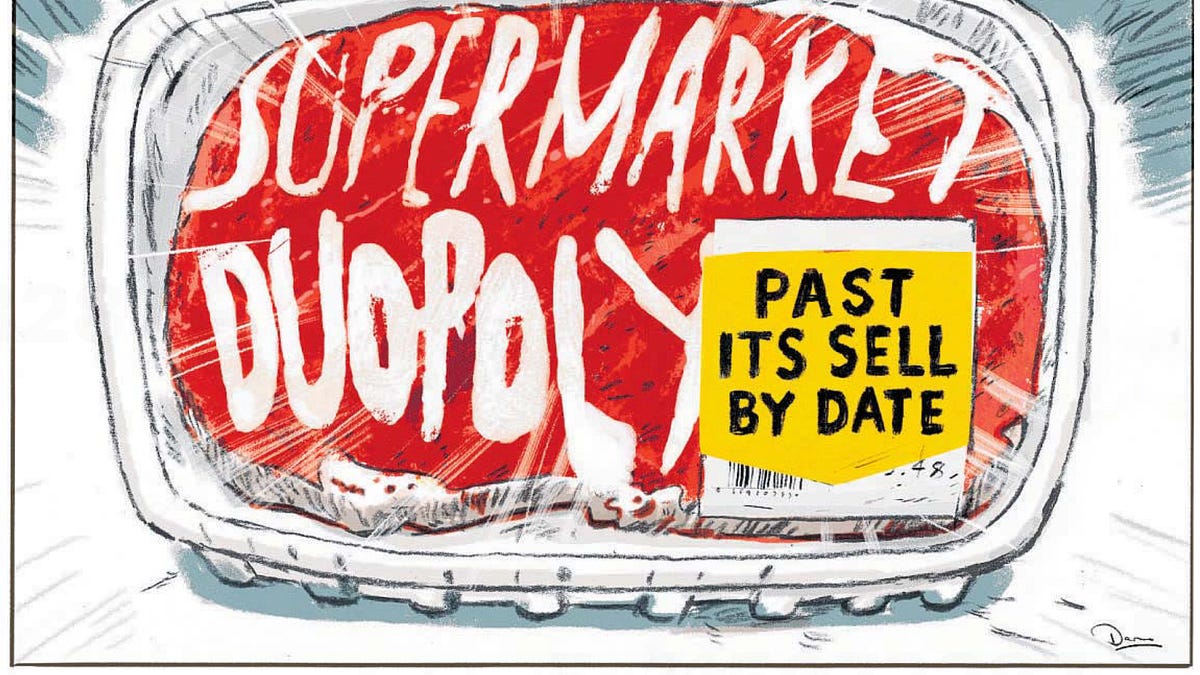
1. Democracy Briefing: The supermarket election
Bryce Edwards - The Democracy Project
- 🗳️ Edwards says supermarket reform has become the defining policy debate of this election, after he appeared on 1News on Wednesday night.
- 📊 A new Verian poll found only 32 per cent thought the proposed policies would lead to lower grocery prices within three years, while 54 per cent said no and 14 per cent did not know or preferred not to say.
- 💬 He told 1News the policy choice channels discontent in the electorate, that these sorts of policies would have looked quite fringe a few years ago, and that the public questions politicians' competence after years of no progress.
- 🏪 The Commerce Commission put the duopoly's excess profits at about $1 million a day in 2022. Its latest annual grocery report found little observable change in core competition metrics, with the two groups' combined share essentially unchanged at 82 per cent. The Warehouse ruled itself out as a third player this week.
- 📉 Consumer NZ's survey in April last year found 66 per cent had low confidence in the Government's grocery policies and only 9 per cent high confidence. Its trust tracking showed only 35 per cent of shoppers expressing high trust in supermarket pricing and promotions.
- 📋 Danyl McLauchlan's Listener cover story rates both a Foodstuffs break-up and Labour's wholesale separation as "GOOD", and warns the break-up's benefits would vanish if it raised the chains' costs by more than 2 per cent.
- 🗳️ Foodstuffs commissioned Talbot Mills to survey 1,325 people from 16 to 21 September. Leaked to Stuff's Jenna Lynch, it found 45 per cent in favour of investigating a Pak'nSave and New World split and 38 per cent opposed, but only 28 per cent thought forcing a separation would lower prices (48 per cent said no).
- 🟢 Support crossed party lines in that poll: National voters 58 to 34, a majority of Green voters in favour, Act voters 45 to 43, Labour evenly split, and New Zealand First narrowly against, 41 to 39.
- 🛒 He tracks the rush of 2026 plans: NZ First's April split of Foodstuffs, the Greens' 6 September KiwiMart proposal ($2.8 billion, at least 120 stores into public ownership), National's September Foodstuffs split subject to the Commerce Commission, and Labour's price-gouging ban plus wholesale separation. Act still wants easier entry, not a break-up. Gareth Hughes calls it the supermarket election.
- 💡 Takeaway (free preview, then a paywall): Edwards reads Verian as doubt the reforms will reach the checkout soon, not as a vote against structural fixes. Paid sections he lists, and which are not visible here, are "Broken New Zealand" at the checkout, the parties finally reading the room, and a more competitive political market.
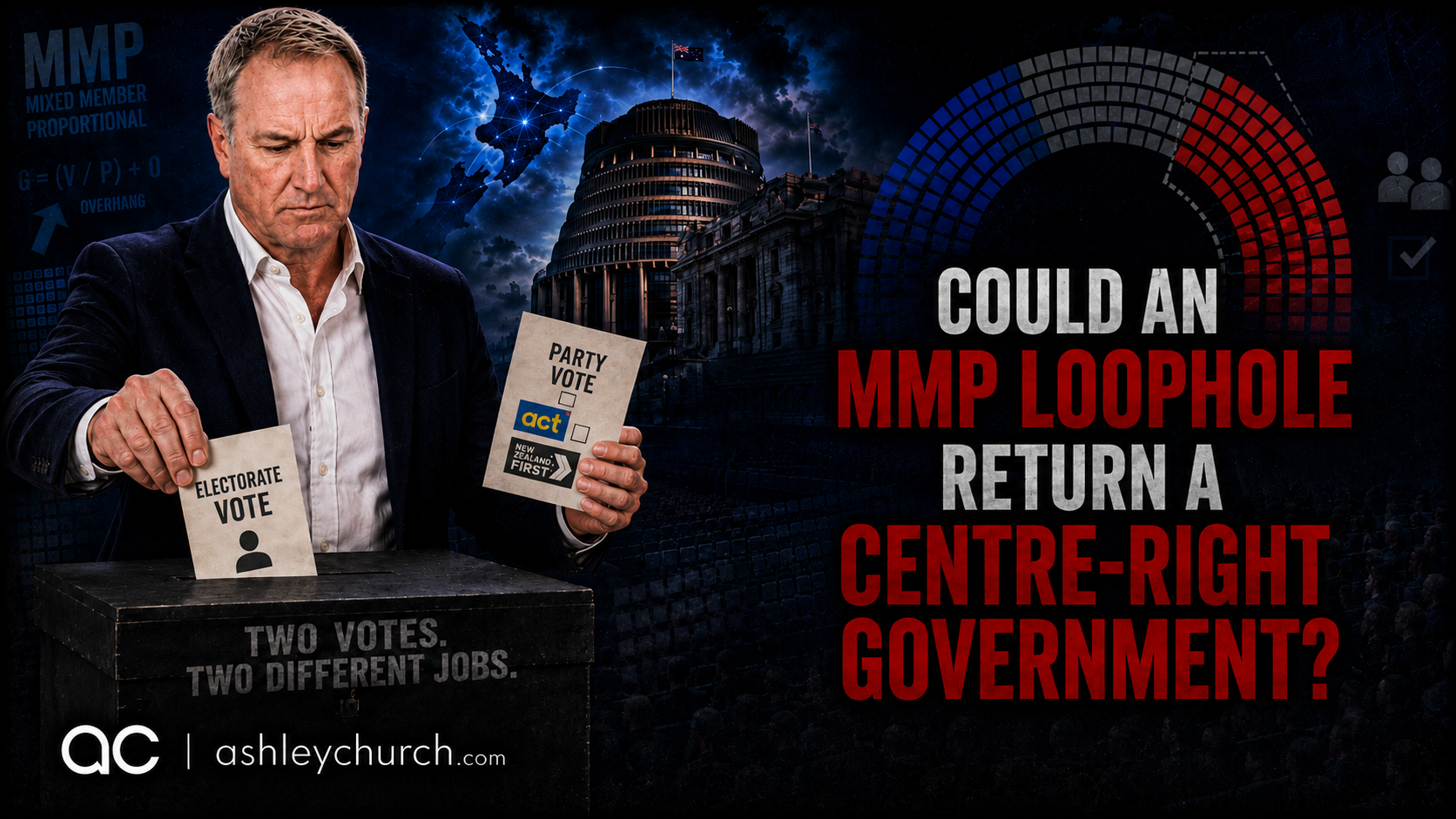
2. Could an MMP loophole return a centre-right government?
Ashley Church - ashleychurch.com
- 😬 Church says a sense of dread is settling on centre-right voters as National consumes itself, citing a second leadership challenge this year involving Chris Penk, who has lost his portfolios and will not stand at the November election.
- 📉 He argues National took office in 2023 with a mandate for a leaner state and less ideology, then morphed into what he calls Labour 2.0, while the strongest moves centre-right voters wanted often came from ACT and New Zealand First.
- ⚠️ However angry voters are, he writes, there is no plausible path back to a centre-right government without a substantial National caucus. The alternative he fears is Labour, the Greens, Te Pāti Māori and the Opportunity Party.
- 🧩 The tactic, which he says he floated months ago as a panellist on Duncan Garner's podcast, and which Don Brash, Maurice Williamson and Peter Williams have since picked up: electorate vote to National, party vote to ACT or New Zealand First.
- 📐 His overhang sketch: if the party vote entitles National to 36 MPs but it wins 40 electorates, all 40 still enter and Parliament grows. A four-seat overhang takes the House to 124 and the majority line to 63, so National gains four MPs while the finishing line moves by two.
- 🗳️ On his reading of current polling, National would be entitled to roughly 36 seats from the party vote but could still win as many as 40 electorates. Another party vote for National then adds no list MP. The same vote for ACT or New Zealand First can add list MPs.
- 🔁 If you do not like ACT, vote New Zealand First, and the reverse. Other centre-right parties that miss 5 per cent and win no electorate elect nobody, and that vote does not transfer.
- ⚠️ Caveat he includes: if National climbs far enough back into the 30s that its party-vote entitlement again exceeds the electorates it can win, party votes for National start producing list MPs and the logic has to be reconsidered.
- 💡 Takeaway: Church's pitch is to register disappointment with National without handing the government benches to the left, by using the two MMP votes for two different jobs.
3. Democracy Briefing: The rightwing “Split Your Vote” campaign
Bryce Edwards - The Democracy Project
- 📣 Edwards says Harry Mowbray, father of the Zuru siblings, has turned the overhang argument into a public Split Your Vote campaign: keep National's local candidate, give the party vote to Act or NZ First.
- 🔢 Mowbray argues the quirks of MMP could produce an overhang of up to 40 additional MPs. His website says that if voters learn to split like this, a centre-right coalition will retain the Treasury benches for the foreseeable future.
- 💬 Chris Hipkins condemned the campaign as a rort by entrenched interests, telling the Post's Henry Cooke that billionaires should not spend money to rort the electoral system.
- 🏠 On The Platform with Sean Plunket, Mowbray said he had planned to organise it with others. Plunket referred to a meeting at Mowbray's Coatesville home three weeks ago and a fundraising target of $400,000 to $500,000.
- 🧾 Ani O'Brien says she gave paid advice that a full campaign was not possible under electoral law, then ended her involvement. Mowbray named Stephen Franks among those who warned him, denied the Taxpayers' Union was involved while saying he had talked with Jordan Williams, and said he restarted alone and would spend no more than $17,000.
- ⚖️ Edwards notes that promoting an election advertisement for a party or candidate needs that party's or candidate's written authorisation. Mowbray told Plunket he has no third-party promoter approval from National, Act or New Zealand First. Seymour said Act had not been approached, and that breaking the rules would mean big trouble.
- 📊 On Facebook, Mowbray claimed that if everyone split about 870,000 votes you would get 36 extra seats plus 4 National overhang seats, and if 240,000 people split, 10 extra seats plus the 4, with "zero risk only upside". Edwards says a 40-seat overhang only arrives if virtually every National party voter abandons the party, and that a National party vote still reduces other parties' entitlements.
- 💬 Responding to the rort charge, Mowbray told Cooke: "In terms of rorting it - the rules are there. We are only just using the rules that are there." Edwards says the campaign asks voters to make Parliament less proportional on purpose.
- 💡 Takeaway (free preview, then a paywall): the visible half is who is organising Split Your Vote and what the overhang maths does and does not do. Paid sections not readable here are Act and NZ First keeping their options open, why National objects, advocates who want to punish National, and making Parliament less proportional.
4. Nicky Hager attacks right-wing lobby group
Grant Duncan - Politics Happens
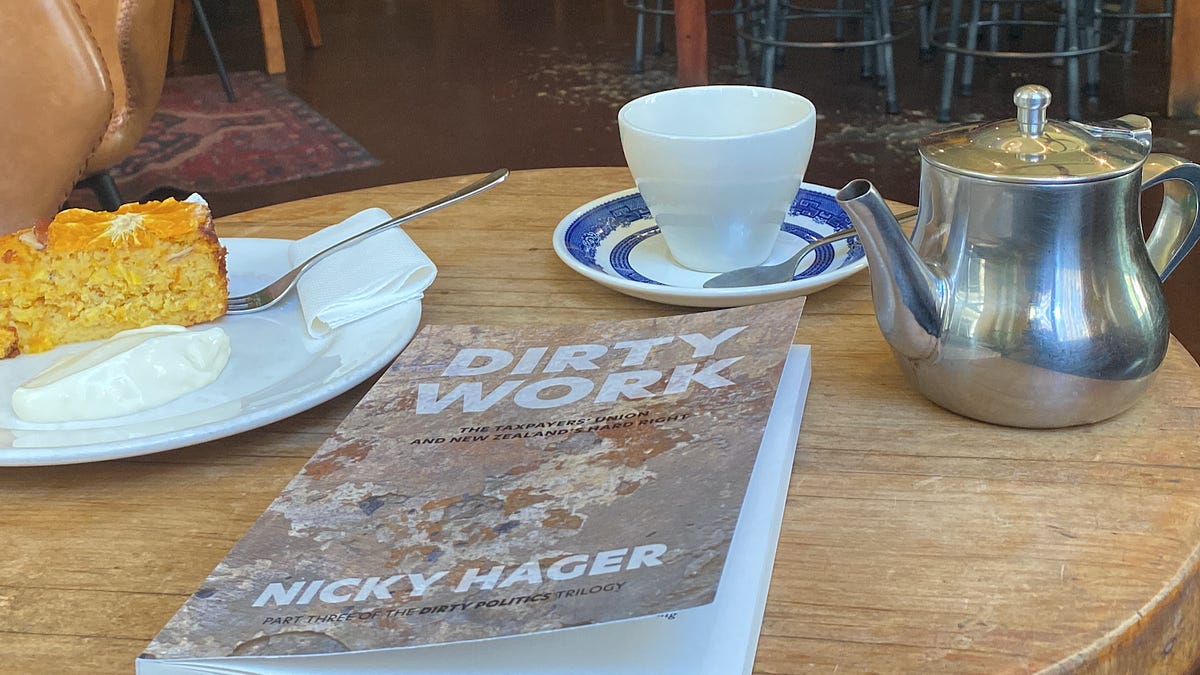
- 📚 Duncan reviews Nicky Hager's Dirty Work (Potton & Burton). He opens with 1News on 4 September 2023, when Chris Hipkins, in good humour, displayed attack ads and named National and its surrogates, including the Taxpayers' Union, Groundswell and Hobson's Pledge.
- 🔄 The prompt, Duncan notes, was NZCTU ads meant to make Christopher Luxon look spooky and out of touch. Craig Renney, now Labour's candidate for Wellington Bays, had gone on TVNZ's Breakfast to critique National's tax policy. Attack campaigns, he says, come from all directions and give parties an alibi.
- ⚖️ Hager is right, he writes, that third-party promoters are not transparent enough. But Hager only complains about the right-wing groups, and does not ask the same questions of left-wing lobby groups.
- 🚬 One concern Duncan calls valid: Chapter Six on financial support from British and American Tobacco to the Taxpayers' Union, and Casey Costello's path from Hobson's Pledge and the TU board to NZ First list MP and Associate Minister of Health responsible for tobacco policy.
- 💵 Over the three years to the 2023 election year, Hager records TU income of $7,274,459, 90 per cent from donations and 10 per cent from membership fees. Duncan quotes Hager's recommendation (p. 111) that giving private money to politicians, parties and their third-party supporters should be illegal, and notes a ban implies state funding instead.
- 💧 On Three Waters, Duncan says exaggeration and racism did underpin some of the campaign, but a thorough review would have considered the TU's reply to those accusations and the practical problems with the policy apart from co-governance, rather than leaving the impression that all opposition was racially motivated.
- 🕵️ The most widely publicised allegations, about harassment and misogyny, come from anonymous sources without documentary evidence, so Duncan says he cannot comment on them.
- 📊 On the Taxpayers' Union-Curia poll, he asks why the same transparency questions are not put to the 1News-Verian poll, The Post/Freshwater Strategy poll, the RNZ-Reid Research poll, and Talbot Mills, which has a long working relationship with Labour.
- 💡 Takeaway: Duncan's charge is that Hager digs for scandal in one corner of the garden and misses the same weeds elsewhere, turning an ordinary dirty-politics pattern into a shock.

5. The two Chris's have failed to inspire most voters
Liberty Scott - Liberty Scott
- 📊 Scott says it is tempting to borrow Jim Bolger's "bugger the pollsters", but polls do more than observe this election. Voters are reluctant to back parties that look unlikely to clear the 5 per cent threshold or win an electorate, so coverage that a party has a chance can encourage support.
- 👎 The contest is shaping up poorly for Luxon and Hipkins, he writes. Neither caucus chose a leader with the charisma, connection, conviction and communication voters want in a prime minister.
- 🗳️ Luxon is a busted flush. Rolling a first-term prime minister is not the unprecedented part, Scott says: mainstream media influence has never been weaker, support for the two major parties never lower, and a sitting prime minister never this unpopular after one term. New Zealand has not defeated a one-term prime minister since Walter Nash in 1960, when Labour still won just over 43 per cent.
- 🛒 National voters are drifting to ACT and NZ First looking for something more authentic. Luxon and Willis, he says, sound like focus groups, and the supermarket policy is desperate stuff.
- 🧳 Hipkins still carries six years of the Ardern government: a housing bubble inflated then burst, sharply higher public spending with little to show for it, and what Scott calls virtue-signalling paired with intolerance of accountability. The last recycled failed prime minister he cites is Mike Moore in 1993.
- 🟢 The Greens, having put away their keffiyehs and Palestinian flags, are pushing a large state and anger at "the rich", and attracting young voters who hear Te Pāti Māori's call to chase an overhang with electorate seats. Opportunity, he says, is a reaction to Labour's lack of inspiration and to the Greens' shift, a centre-left home close to Labour without union dominance.
- 🧮 A four-party government is a real possibility on either side, with Labour, Greens, Opportunity and Te Pāti Māori looking more likely to him. Replacing Hipkins or Luxon might have lifted their party, but he thinks both major parties now take their status for granted.
- 👩 Roy Morgan's latest poll, as he cites it: women aged 18 to 49, Labour 36 per cent, Greens 20, National 14.5, NZ First 10.5 and ACT 3.5. Men the same age: National 34.5, Labour 18, Greens 14, ACT 11.5 and NZ First 4.5. Among those over 50, National leads, more strongly among men.
- 💡 Takeaway: If neither major party reaches 30 per cent of the party vote, Scott says it will be because neither has convinced voters the offer is worth the effort, and the window to change leaders is almost shut.
6. TRAITORS IN OUR MIDST
John McLean - John's Substack
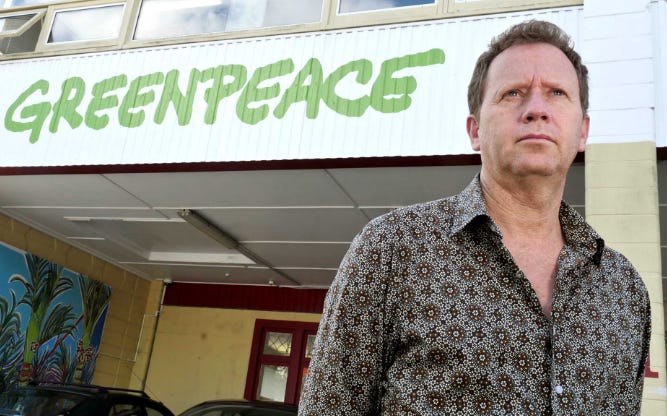
- 🇪🇺 McLean writes that on 29 September the Netherlands NGO Both ENDS lodged a complaint with the European Commission alleging New Zealand has weakened environmental protections and failed to implement its Paris climate commitments.
- 🛢️ The breaches it alleges, as he summarises them: reopening territorial waters to offshore oil and gas, missing greenhouse-gas reduction commitments, and passing legislation that extinguishes Mike Smith's climate case against seven New Zealand businesses.
- 🤝 New Zealand names he lists around the complaint: Greenpeace Aotearoa, the Environmental Law Initiative, OraTaiao, Mike Smith, Jane Kelsey, and the Ngāti Pūkenga Iwi ki Tauranga Trust.
- 💬 Both ENDS quotes Greenpeace executive director Russel Norman saying the Government spent three years undermining climate and environment laws, often to gain trade benefits, and did not listen to warnings it was breaching the EU-New Zealand free trade agreement's sustainability chapter.
- 🏥 McLean's own line is that Greenpeace's charitable status, despite overt political advocacy, shows how skewed he thinks the charities regime has become. He also names former Green Party chief of staff Eliza Prestidge-Oldfield as the Environmental Law Initiative's senior legal researcher.
- 🎓 He quotes Canterbury professor Bronwyn Hayward saying the stakes could not be higher and that the Government has put reputation and trade at risk. He replies that New Zealand produces 90 per cent of its electricity from renewable sources, and that the risk which matters is fiscal.
- 💸 On his figures, current Paris commitments mean paying $5 billion to overseas sellers of emissions credits before the end of 2030, and a further $2 billion before the end of 2035. He calls that national suicide that need not, and will not, happen.
- 🌾 What he wants immediately: exclude greenhouse gases from New Zealand food production, citing Paris Article 2(1)(b) on low-emissions development "in a manner that does not threaten food production", and the preamble on safeguarding food security.
- 🗣️ Second, reassert a line he attributes to Luxon in June 2026: "We ain't shutting down farms and we certainly aren't sending billions of dollars offshore."
- 💡 Takeaway: McLean treats the complaint as New Zealand campaigners teaming up with a European NGO to load climate costs onto the country, and he wants food emissions carved out and the offshore credit bill refused.
7. Pathological Need For Control, And Left-Wing Pseudo-Religions, Drive Efforts To Dictate Language
Michael Shellenberger - Public
- 🗣️ The free opening says progressives, liberals and leftists want to change the words people use in order to protect democracy, freedom and the vulnerable.
- 🇺🇸 Examples he lists from the United States: the CDC preferring "people with undocumented status" to "illegal immigrants"; the American Medical Association preferring "people with obesity"; Gavin Newsom's 2021 law removing "alien" from California statutes; New York in 2022 replacing "inmate" with "incarcerated individual".
- 📰 The Associated Press Stylebook, which he says most American newsrooms follow, tells reporters to avoid "the homeless" as a collective noun, and to refer to trans-identified men as "transgender women" and trans-identified women as "transgender men".
- 🇬🇧 Britain's Green Party, he writes, issued Inclusive Terminology Guidance telling members to stop using words such as "mothers and fathers", "elderly", "able-bodied", "youngster", "sexual preference", "nutter" or "lunatic".
- 🏴 A video of a parliamentary debate in Wales went viral, he says, after candidates tried and failed to use the word "blanket" when referring to a new speed-limit law.
- 🌐 He says policymakers in the United States, Britain, France, the EU and Australia are seeking new controls on what people can say online. Australia, he adds, is looking at anonymous accounts to propagate government information, and German politicians want AI to monitor X, YouTube and Instagram for ideas considered dangerous.
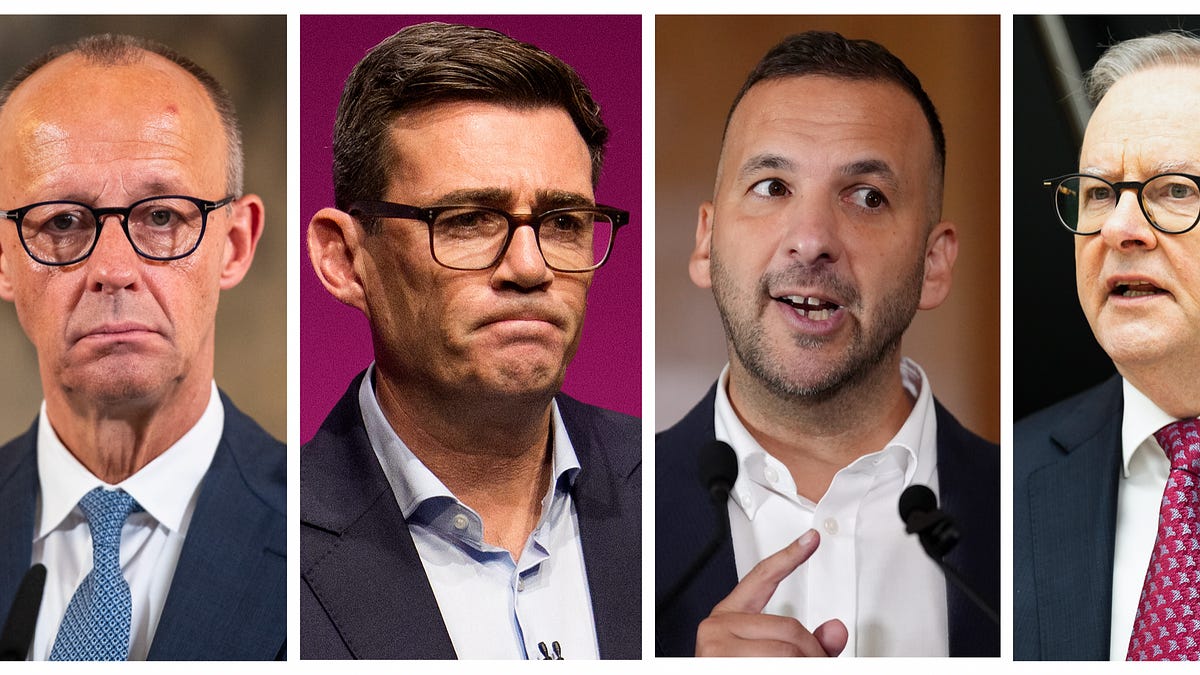
- 🔒 The readable text stops at Public's subscribe appeal. The image caption names several politicians, but the free body does not develop them.
- 💡 Takeaway (thin free preview): what you can actually read is a list of official language rules and proposed online-speech controls. The rest of the essay is behind the paywall.

8. Media Spread False Claims About Causes Of French Riots And Dismiss Left-Islamist Alliance Behind Them
Michael Shellenberger - Public
- 📰 The free preview says the news media blame French high-school protests and riots on a lack of school funding and a shortage of teachers.
- 🗞️ He cites the AP on complaints about deteriorating schools, teacher shortages and heavy class schedules; Agence France-Presse on long hours, overheated classrooms, dilapidated buildings and staff absences; and Le Monde blaming the government for not listening to the students.
- 📊 Of the French public surveyed, 62 per cent said students were justified in their protests. Protests reached more than 1,000 of France's 3,700 lycées.
- 📈 His counter, still in the free text: French schools have more money per pupil today than at any earlier time. Primary classes averaged close to 30 pupils in the 1960s and nursery classes close to 40. Public primary classes will average 21 this year, the lowest on record.
- 🎓 In 1970, 20 per cent of a generation earned the baccalauréat. Nearly 80 per cent earn it today. Spending per pupil has risen 1.6 per cent a year in constant euros since 1980. France spends 4.5 per cent of GDP on educational institutions. Germany spends 3.7 per cent.
- 🔒 Public then cuts to a subscribe line promising "the real roots of the riots in France". The headline's claim about a left-Islamist alliance, and the dek about censorship of right-wing populists, are not in the text you can read without paying.
- 💡 Takeaway (thin free preview): the visible half only disputes the funding explanation with those school figures. The causes Shellenberger says the media are dismissing sit behind the paywall.
9. Macron Attacks Free Speech and Urges the EU to Censor Online Posts Faster
Cam Wakefield - Reclaim The Net
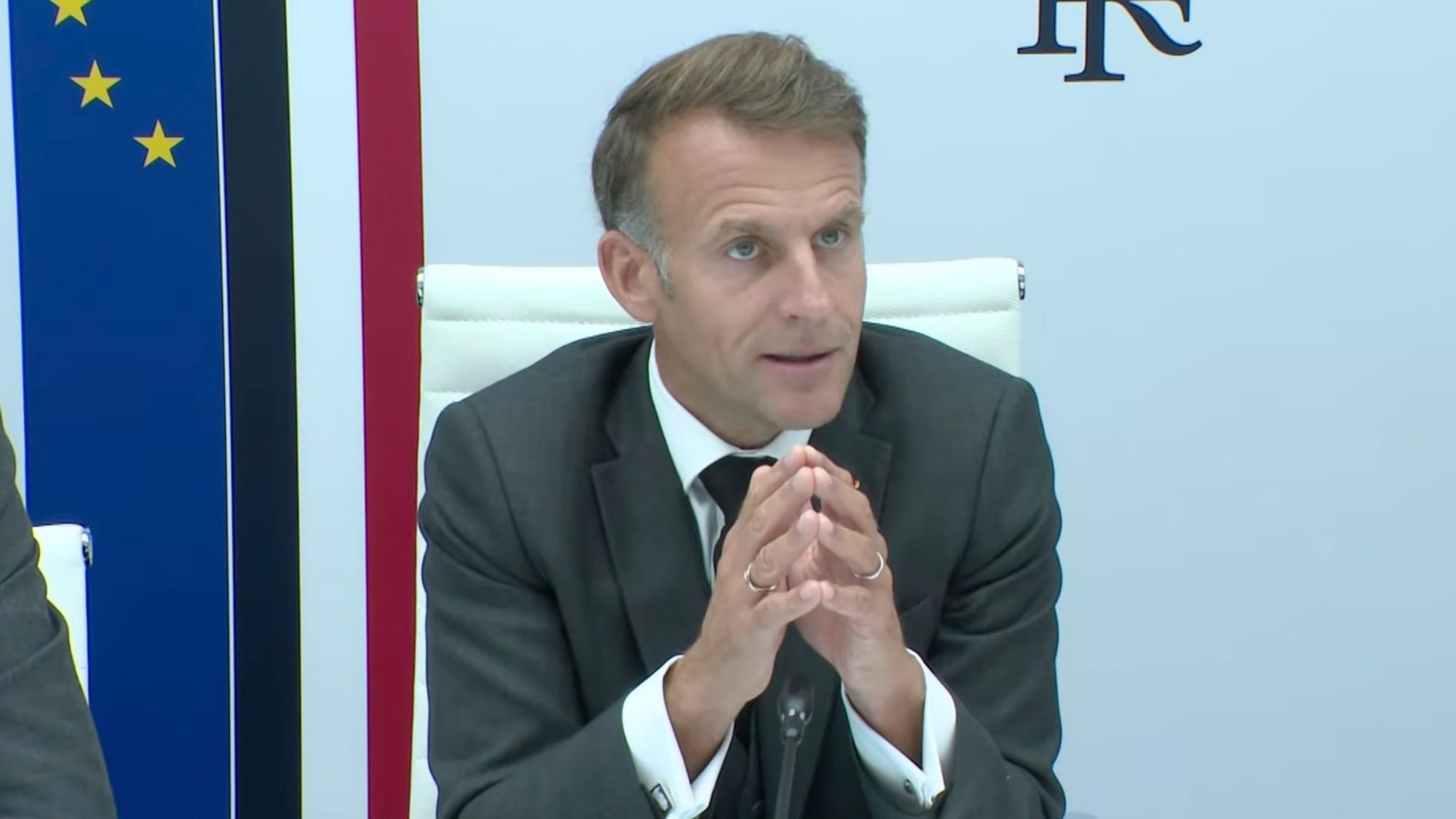
- 🇫🇷 Wakefield reports a Q&A at Complutense University in Madrid on 29 September, during Macron's state visit to Spain. The Élysée published the transcript in French. The quotes below are the site's translations.
- 🗣️ Macron called the American concept of free speech "the opposite of free speech", and said there is no freedom if there is no limit on his freedom, beginning with the freedom of others and respect for a common framework.
- 🚶 His street example: his freedom cannot be to hit you, insult you, or wreck the space everyone shares, and that is the idea some people have of free speech. Wakefield calls that a false analogy, because an insult is speech and a blow is violence.
- 🆔 Macron also wants people made to answer for "nonsense" they post, no social media accounts without a real person behind them, and age checks so children are kept off the platforms. Wakefield's point: the only people allowed to speak online would be those who have been identified.
- 🇪🇺 Macron said the EU censorship law, the DSA, is not being enforced fast enough, and that he had written to Commission President Ursula von der Leyen. His line: "We must use the DSA much more, much faster, much more forcefully."
- 📰 He compared this with the press, where a journalist who writes nonsense and an editor who publishes it can be convicted, and said that online "that is not punished". What he wants is trusted third parties and fact-checking structures "that make it possible to restore the truth".
- ⚖️ France's Constitutional Council struck down his attempt to ban under-15s from social media as a disproportionate restriction on expression that failed to protect private life. He said France would prepare a new national law, and that the EU's coming child-protection law was "the fruit of this work".
- 🤖 On age verification he promised it would protect personal data more than most things people do on the platforms, mentioning image recognition, "technology with the hand" and AI, with data not retained. He also said schools now teach children to untangle what is true from what is false.
- 💡 Takeaway: Wakefield's close is that a president whose own constitutional court has already called his age checks a threat to privacy and expression is now promising to protect personal data, while asking the EU to censor online speech faster.

10. There’s No Business Like Antisemitism Business
Roger Simon - American Refugees
- ✈️ Simon starts from online reaction after the FlyDubai rescue, which he credits to a courageous Indian pilot and Israeli passengers, and says antisemitism has turned into a business.
- 📊 He cites Combat Antisemitism Movement's report on 30 September. The first X post calling the incident an Israeli "false flag" was recorded at 2:28 ET, 67 minutes after the plane sent its first distress signal.
- 📈 Within five hours the movement's research centre documented 1,000 hostile posts. Over 12 hours it identified 2,963 posts attributing the incident to Israel, the Mossad, Netanyahu, Zionists or Jews, generating at least 30,000 likes and three million views.
- 💰 He treats that volume as money, because clicks equal money in the short term or the long term.
- 🎙️ Early names he lists, from a ChatGPT query he describes: Nick Fuentes, Jackson Hinkle, Sneako, Ana Kasparian, and Ryan Knight (the X handle "Power to the People"), who wrote "The false flags are way too easy to spot."
- 📺 Fuentes called the heroism "false flag terrorism" on Rumble. Hinkle posted that Netanyahu orchestrated it and that it was "All too predictable." Sneako said it was "looking like a psyop so far." Kasparian avoided the false-flag label and called it "fishy. Super fishy." Hasan Piker, Simon writes, called the attempted hijacking a "Red Herring" and a conspiracy on his livestream.
- 🚫 Simon says none of them provided evidence. He then extends the same business claim to Tucker Carlson, Candace Owens and sometimes Megyn Kelly, and says Qatar and others have bought vast sectors of society, while adding that how far these particular views were bought "is not yet known".
- 💡 Takeaway: Simon's argument is that the outrage is a revenue model that does not need evidence, and he closes by congratulating the FlyDubai rescuers.
What our members are saying about Ten@10
Elizabeth
These articles are compulsory reading for me and the perfect addition to the usual list of Goodoil items!
Lynne
Absolutely brilliant to receive these current and thought provoking articles.
Jonathan
Just wanted to let you know that I’m loving this new 10@10. Much appreciated from someone who chooses to read/watch almost NO mainstream media.
Murray
Cam, relish your output as the newspaper in Christchurch is so intent on non news. Thankyou
Fred
Thanks for Ten @ Ten, really enjoy reading it.Keep it up. All the best, keep healthy.
Jocko
Wonderful info not otherwise available in NZ. More power to your elbow! Thanks.