Table of Contents
Peter MacDonald
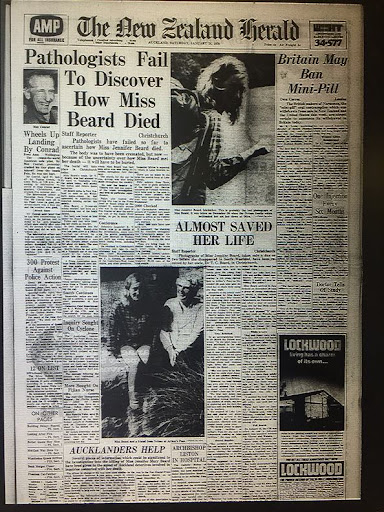
This case has bugged me since 1969. I remember it well: the way the media wildly sensationalised Jennifer Beard’s disappearance and death, fixating on the idea of murder before any facts were clear. The police hierarchy ran with the story, often overruling the detectives at the coalface of the investigation.
For weeks, the mystery focused on a Vauxhall car and a bald-headed man in his 30s who allegedly gave Jennifer her last ride. The police tracked down every male owner of that car model, an extraordinary effort for the time, but it led nowhere. Meanwhile, the fearful public scrutinised innocent men simply for owning the ‘wrong’ car.
More than 50 years later, this case still lingers, not because it was solved, but because it was never truly understood. And because it was used for something much larger than justice.
Though the Jennifer Beard case remains officially unsolved, it served a far more decisive purpose: to instill fear, reassert social control and reshape the public image of travel, youth and freedom at a time when New Zealand was struggling with the cultural tides of the late 1960s.
The Official Story: a Hitchhiker Murdered
Jennifer Beard disappeared while hitchhiking solo during the summer of 1969–70, heading through the South Island toward Wanaka and last seen hitchhiking late Dec 1969. Three weeks later, her body was discovered in scrub under the Haast River bridge, her clothing partially removed and her body decomposed.
From the moment of discovery, the public was told this was a brutal rape and murder – a young woman preyed upon while hitchhiking. A suspect was quickly unofficially identified: John Boswell, a travelling Australian man who had been seen in the area and whose car reportedly resembled one seen with Beard.
Yet no charges were ever laid. The forensics were inconclusive, the evidence circumstantial and the investigation soon stagnated. But the narrative had taken hold, driven by sensational headlines and fear-based speculation.
The Alternative View, Not a Murder at All...
Years later, the official narrative began to unravel, not through conspiracy theories, but through retired police officers and investigators willing to speak out.
Tom Lewis, a former NZ police detective sergeant, stated plainly:
There was no evidence of rape, no evidence of murder. Her body was found sitting down, her trousers around her ankles, as if she’d squatted to relieve herself and died suddenly, maybe a seizure or aneurysm.
He revealed this and other suppressed perspectives in his 1998 book, Coverups and Copouts, which detailed multiple high-profile NZ cases where the official version did not match the evidence.
Alan Gurney, another former officer turned private investigator, re-examined the Beard case decades later. He found no forensic proof of an attack:
- Her shirt had been shredded, but that damage was consistent with animal scavenging, not knife wounds or a struggle.
- There were no confirmed signs of trauma due to the advanced decomposition.
- She had likely been there three weeks before discovery, in humid, insect-heavy bush.
Despite this, the image of a murdered hitchhiker remained dominant in the public consciousness.
A Convenient Panic, Social Control Disguised as Concern
Why cling to a murder narrative if the evidence never supported it?
Because the cultural revolution was at its zenith, and Jennifer Beard, clean-cut, respectable and female, became a cautionary symbol to push back against the perceived chaos of the time.
In the 1960s and ’70s, thousands of young Australians flooded into New Zealand every summer:
- Picking fruit in Central Otago and Marlborough.
- Finding tourism jobs, wild camping and hitchhiking across the South Island.
- Living out of backpacks: chasing experience over money.
To many conservative Kiwis, this wave of ‘wayward’ youth symbolised social decay. Officials, hoteliers and tourism boards wanted ‘quality tourists’, those with money to spend in hotels, motels and guided tours, not those who camped freely and contributed little to GDP.
Just as today’s government pushes a false narrative about freedom campers, claiming they leave trails of filth and spend nothing, the youth travellers of the Beard era were painted as dangerous, dirty and economically useless.
Jennifer Beard’s death became a tool.
- Drivers were warned not to pick up hitchhikers.
- Young women were told not to travel alone.
- Media stories linked freedom travel with danger, creating an environment of fear.
- Increasing restrictions.
- Negative media campaigns.
- Bans in certain districts and punitive fines.
New laws and local by-laws gradually choked out informal, low-cost travel.
Parallels to the Present, The Ongoing War on the Free Spirit.
The legacy of the Jennifer Beard case still echoes. Today’s freedom campers, travelling all over NZ, in converted tradie vans, called sliders...and the seasonal work travellers, face the same crackdown on them by government and official tourist operators, who complain they are detrimental to NZ. The same media campaign against them is used to socially engineer distrust of them by the Kiwi public. Why? Because they do not fit the preferred economic model: a tourism sector built on profit, not independence. The young and poor have always been a threat to systems designed to reward the rich and obedient. Just like in 1970, a cultural moment was weaponised. Fear became policy. A tragedy became propaganda.
Conclusion, Truth, Fear and Whose Story Gets Told
Whether Jennifer Beard died by foul play, accident or natural causes may never be conclusively known. What is known is that some police involved in the case believe she was not murdered and yet that version of the story has been deliberately buried beneath decades of media spin and state narrative. This wasn’t just about solving a crime. It was about controlling the narrative of a changing country and rolling back the freedom that was, for a short time, bursting through its seams. In both the past and present, we must ask: Who benefits from the fear we are fed... And whose freedom is quietly being erased beneath it?