Simon O’Connor
Husband, step-father, foster dad, and longtime student of philosophy and history. Also happen to be a former politician, including chairing New Zealand’s Foreign Affairs, Defence, and Trade Committee.
Winners and losers
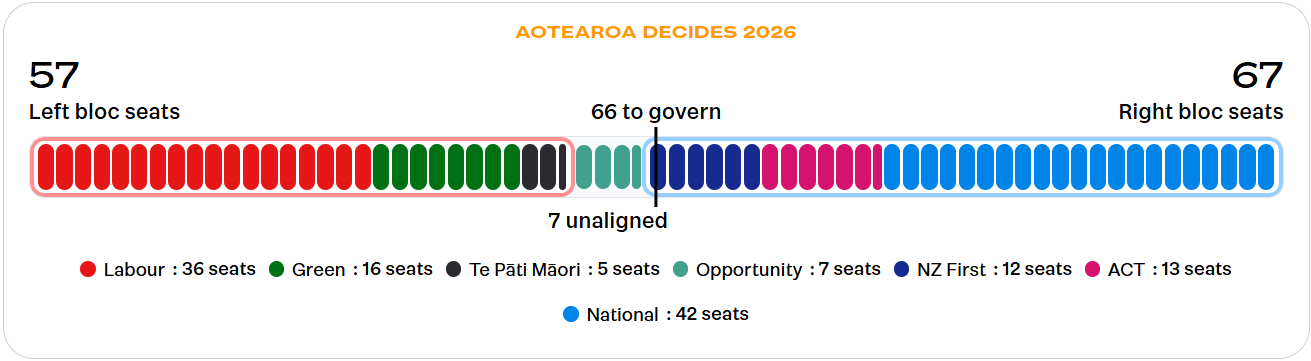
It is remarkable to go through an election and emerge with no clear sense of who has won or who will form the next government. Yet, like any election, there are clear winners and losers. The winners are the smaller parties, and certainly a strong win for the Greens who have now achieved their biggest ever result. ACT and New Zealand First will be pleased with their party vote increase, although NZ First disappointed that theirs was not higher. All responsibility for that lies with NZ First and a series of unforced errors. Te Pāti Māori Party can also be pleased, winning five seats thanks to a clear and clever strategic vote strategy.
Opportunity breaks through
And there is of course, the Opportunity party. This is a huge moment for them, having crossed the five per cent threshold and entering parliament. They will be even bigger winners if they get to decide the next government. I should acknowledge that I was wrong. I publicly argued that Opportunity would not reach five per cent, yet they have done exactly that.
Opportunity would do well to not formally join either a left- or right-leaning government but instead remain on the cross benches deciding their vote each time. While acknowledging the achievement of their win, they have a lot to learn about parliament first. The temptation to take on ministerial roles will limit their ability to be themselves and force them to sing off the same hymn sheet as the other governing parties on many issues. Opportunity is now in parliament – their focus now should be to consolidate.
National’s existential crisis
National is facing an existential challenge. It can no longer assume its status as one of New Zealand’s dominant political forces. Unless it clearly re-establishes itself as a centre-right of conviction and principle, it risks permanent decline.
To end election night under 30 per cent is appalling. There is no way to, nor should we, sugar coat this. To drop almost nine points in three years is a failure. National (and arguably the coalition) squandered their mandate from 2023. Instead of the bold changes the voters anticipated, there was tinkering. These are of course general comments, for there have been some very good ministers and MPs and some very good changes made over this term. But it was the performance of the economy that mattered most to voters. Despite some positive indicators and that many of the headwinds were caused internationally and outside of National’s control, Kiwis have not felt improvement and they have voted accordingly and grumpily.
Compounding this was a perception problem, much of which rests with Luxon himself. When the leader of a centre-right party appears uncomfortable defending wealth creation or looks to figures like Barack Obama for inspiration, voters are entitled to question what the party stands for.
Labour’s missed opportunity
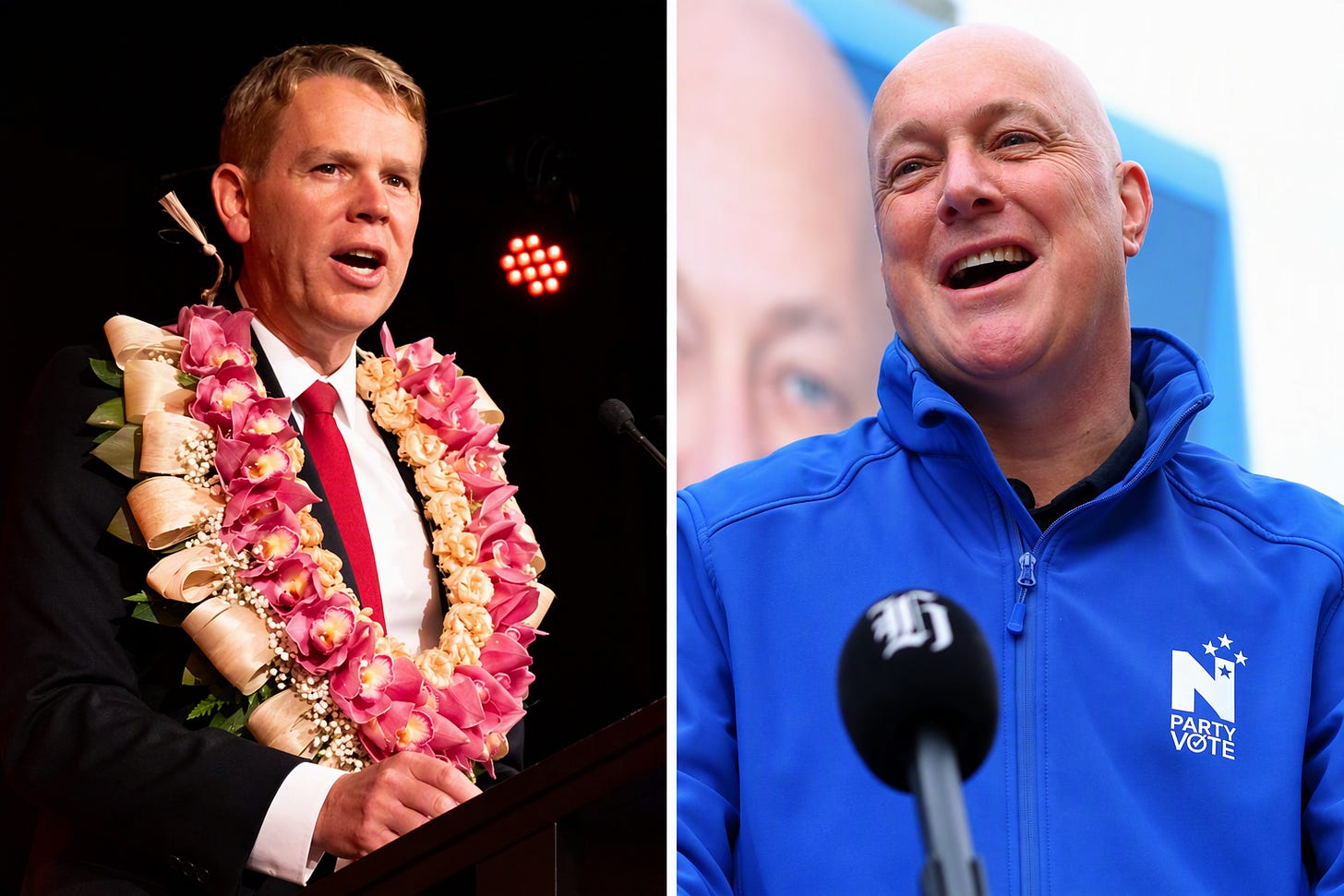
But the picture is not much better for Labour. Yes, they increased their party vote by three points but with the clear repudiation of National, they should have picked up much more. Instead, the vote has gone to the Greens and Opportunity as Labour is not seen as the solution.
Both Labour and National are now strongly dependent on their coalition parties. The Green vote is half of Labour’s and a similar picture for National if you combine ACT and NZ First. This means fewer ministerial posts, committee chairs, and so on for the two formerly large parties. This in turn will create more competition and pressure within those caucuses. Not an ideal ingredient as both parties seek to rebuild themselves.
There are naturally many other aspects to discuss, but I will just touch on several.
Did strategic voting work?
Did the right benefit from the overhang strategy? I think that answer is mixed. It did have an impact, but perhaps not as strongly as those behind it would have hoped. In some places, I think we did see more candidate vote go towards National MPs as a consequence of the push for strategic voting. But I think it should also be acknowledged that those National MPs and candidates who won their electorate seats also fought hard and ultimately successful campaigns.
Epsom is perhaps a case in point. Paul Goldsmith achieved his highest vote ever, and Seymour’s margin was reduced to two thousand votes (it was 8,000 votes last election). Nationals’ party vote declined, but then it declined across the country. ACT’s vote went up but only slightly, and NZ First’s vote declined.
Thinking about the left, the overhang worked exactly as Te Pāti Māori Party wanted. Five electorate seats and only just over 0.5 per cent of the party vote.
Many on the left are already seeking to imply a conspiracy around the overhang by highlighting how proportionality has been compromised and referencing shadowy money. I would simply note that proportionality is a key part of MMP, but it is not an absolute. What we have witnessed are popular local MPs, but within parties whose vote has tanked.
Nor is it a conspiracy for individual Kiwis, wealthy or not, to fund political campaigns any more than the workings of the unions during election time.
I think it is also important to state the splitting one’s vote strategically is a political reality. It is not a legal or even moral issue as some are trying to frame it.
Here comes the blame game
There will inevitably be a race to blame, scapegoat, and, being politics, manoeuvre for advantage. Some are already targeting the various parties campaign chairs, but this fails to understand where the power really lies. Campaign chairs are the faces and spokespeople for campaigns mostly decided by others. The direction and messaging of any campaign sits with the party leaders and those they employ to run the campaign, including the campaign manager.
What comes next?
We do have the loss of very senior National list MPs. I know most of them well and each has worked hard and sought to do the best for the country. Saturday night is simply the reality of being a List MP, dependent solely on the performance of the party, which, by the nature of their seniority, they bear some responsibility.
But no MP is bigger than the party. While the desire of Luxon, Key, and others to protect both these senior figures and friends, their messaging put individuals ahead of what was good for the party as a whole. As some other commentators have noted, their protestations about strategic voting arguably gave it more attention: the Streisand effect. And while losing such senior figures and experience is a blow, there is lots of talent in National. Just because they have not been promoted by a party leader or feted in the media doesn’t mean a lack of skills.
Nor should the idea of electorate candidates throwing their seats to allow any list MP to remain be given any credence. The irony for the right is that the only reason they may be able to keep in power for another three years is because of the performance of National’s electorate candidates.
Such a mindset would also weaken National even further. Good quality candidates are not going to put themselves forward for electorate seats if they risk being undermined to protect list favourites. There is also an unhelpful implicit two-tier thinking at play and that is electorate candidates and MPs are meant to work hard to protect the list MPs to hold senior leadership positions and ministerialships. Hardly a mindset that will encourage ambition and reward.
Some final thoughts
The biggest lesson from this election is that New Zealand politics has entered a new era. The dominance of Labour and National can no longer be taken for granted, while smaller parties have shown they can shape not only the composition of parliament but the direction of government itself.
For National and Labour, the challenge now is not simply rebuilding support. It is rediscovering a clear sense of purpose. Voters appear increasingly willing to look elsewhere when the major parties fail to offer conviction, competence, or vision.
Awaiting the final numbers and then the coalition negotiations will dominate the headlines for the coming weeks, but the deeper story is that the political landscape itself has shifted. Those who learn that lesson will prosper. Those who ignore it may find this election was not some aberration, but the beginning of a long-term realignment.
There is so much more that could be discussed from the media’s role in Opportunity’s rise to whether either Chris will be around next election. Those can wait for other Substacks.
This article was originally published by On Point.