Table of Contents
Ani O’Brien
Like good faith disagreements and principled people. Dislike disingenuousness and Foucault. Care especially about women’s rights, justice, and democracy.
The first day of a new parliamentary year is about mood, posture, and jostling for political points. It is when parties show us who they think they are, who they think they are up against, and how they intend to spend the political capital they have left. This is particularly true in an election year.
Parliament has returned as our country is coming to terms with the loss of life due to extreme weather and the Mt Maunganui landslide. The sprint out of the starting blocks at the beginning of the year was slowed down by the need to acknowledge the tragedies. Speeches like these are always tests of whether parliament can still speak in a tone that resembles a responsible, mature adult. There was restraint, sympathy, and an acknowledgment that tragedy does not belong to any party. And, then there was Rawiri Waititi…
Rawiri Waititi’s contribution on Mt Maunganui was the last of the lot and made a sharp departure from the dignity that Christopher Luxon, Chris Hipkins, Marama Davidson, Cameron Luxton, and Winston Peters had afforded the moment. Wrapped in the rhetoric of grievance and a chip on the shoulder large enough to require iwi consultation under the RMA, the speech defaulted to Te Pāti Māori’s now-standard script: Māori as uniquely selfless first responders, uniquely last and worst supported, and uniquely wronged by a faceless “capitalist” system.
There was no evidence offered of these discriminations and indignities, only assertion. He ignored that emergency responses to the weather events have been national, coordinated, and often led by the same civil defence structures he implicitly dismissed. This is not to dismiss the contribution made by Māori and in particular local marae who have opened their doors to strangers. However, it is to defend non-Māori against the indignity of having their contributions erased.
His framing also erased non-Māori communities hit just as hard by the weather. Many non-Māori lost loved ones this week due to these events. Many non-Māori had property damaged and livelihoods impacted. Those experiences are real and no less challenging simply because they are experienced by people with white skin, or Chinese or Samoan or Latino ancestry. I frankly am sick to death of this narrative.
Waititi also treated the state as simultaneously absent and omnipotent. They failed to deliver resources, yet apparently hoarded limitless “resilience funds” that could simply be “emptied” on command. Unlike the rest of the leaders, Waititi put the boot into Luxon explicitly too. Apparently it is a great affront that our prime minister dared to fly into the affected areas to assess the situation and meet with those suffering and assisting. You know, like Chris Hipkins, Jacinda Ardern, Bill English, John Key, Helen Clark, and every prime minister before has done in similar situations. Imagine if Luxon hadn’t shown up! What would Waititi have said about that?
Most bizarre was his pivot to the topic of slash and forestry that, while relevant to the weather events, turned into another game of pretending to hate capitalism while claiming to own everything. He threw out the question “who owns the trees?” as a moral accusation and I am still not sure if he meant that Māori own the trees and so should be afforded some special support or if he meant the Crown owns the trees and so are liable for the damage of slash.
There was no serious reflection or even remotely authentic empathy. Waititi seemed not to recognise that zero-risk land use is impossible, and offered no solutions beyond “send the money” and “empty the bank”. In the end, no matter which way you read it, the forestry critique functioned less as an argument and more as a familiar moral shortcut to race-based blame.
His was less a speech about the lives lost this past week than an opportunistic repackaging of grievance politics, using tragedy as moral leverage to demand money, deference, and ideological agreement. What a complete tool.
Despite this tasteless final speech, it was an appropriately sombre occasion that leaders then had to rapidly pivot out of in order to whip out the energy required to project confidence as they debated the prime minister’s statement.
What unfolded across the afternoon was a sorting of styles, a division between those interested in governing and those still performing for a past audience, and an insight into who is going to put their best foot forward this year and who is going to repeat the same mistakes as the last.
Christopher Luxon’s speech was competent, restrained, and unprovocative. He laid out the challenges his government inherited, spoke to progress on getting New Zealand “back on track”, and conspicuously avoided naming Labour or Chris Hipkins at all. This mirrors the strategy he adopted in his State of the Nation speech last week and signals a leadership style that is increasingly clear… Luxon is not interested in mud wrestling.
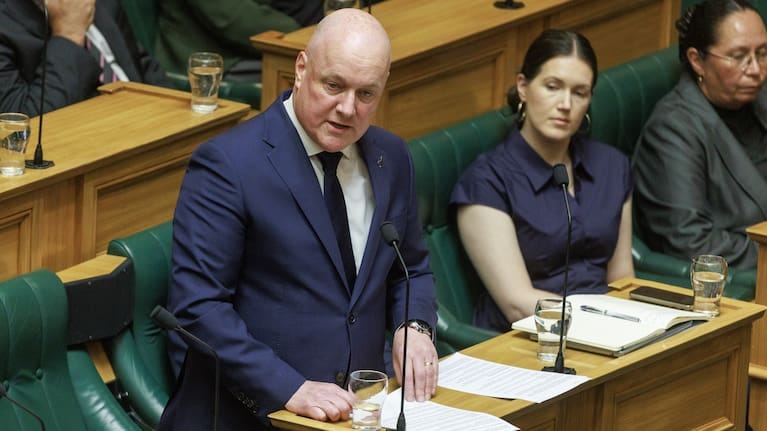
This no doubt frustrates some critics on the right who want fireworks and showmanship, but there is no point crying for a spectacular sundae with all the toppings when you have a perfectly decent vanilla ice cream. After all, sometimes the most super sweet sundaes that are delivered to your table by a tap-dancing waiter end up taking on a decidedly authoritarian flavour, destroying your economy, and doing nothing to solve child poverty.
Anyway! Luxon’s strengths do not lie in showmanship. They lie in what he painfully refers to as “hustling” for trade deals, setting direction, and letting ministers own their portfolios. He (mostly) defers foreign affairs to Winston Peters and this is a good thing. He has allowed his ministers to own their reforms. Erica Stanford and Chris Bishop have to share the stage with him for the big announcements as one would expect, but he allows them to own the wins. Ardern famously did not do the same for her ministers.
The other part of this strategy to keep Luxon out of the muck in an election year, is clearly to let Nicola Willis get stuck into it and to prosecute the case against Labour. He will rise above and she will do the job of a good deputy party leader and get the punches in.
Boring? Maybe, but he does not clutter his speeches with personal attacks or rhetorical flourishes designed to dominate the evening news. His speech “did the job”. It did not soar, but it did not wobble either.
In a political environment saturated with performance, this kind of steadiness can look underwhelming. But it can also look like governing by behaving like an adult who can be trusted to deliver. Whether that approach holds under sustained economic or social pressure remains to be seen, but as prime minister, he is playing to his strengths. And is certainly far better than our last.
Speaking of which! Chris Hipkins, by contrast, arrived determined to inject energy. And to his credit, once he got going, the energy was there. His delivery was sharper than Luxon’s and his pacing improved as the speech went on.
Hipkins’ speech delivered a coherent and consistent framing of cost of living failure plus broken promises plus economic mismanagement. Hipkins was effective in channeling economic insecurity rather than prosecuting personalities and his references to job losses, business liquidations, people leaving the country, and households struggling week to week will resonate with voters who feel bruised and impatient.
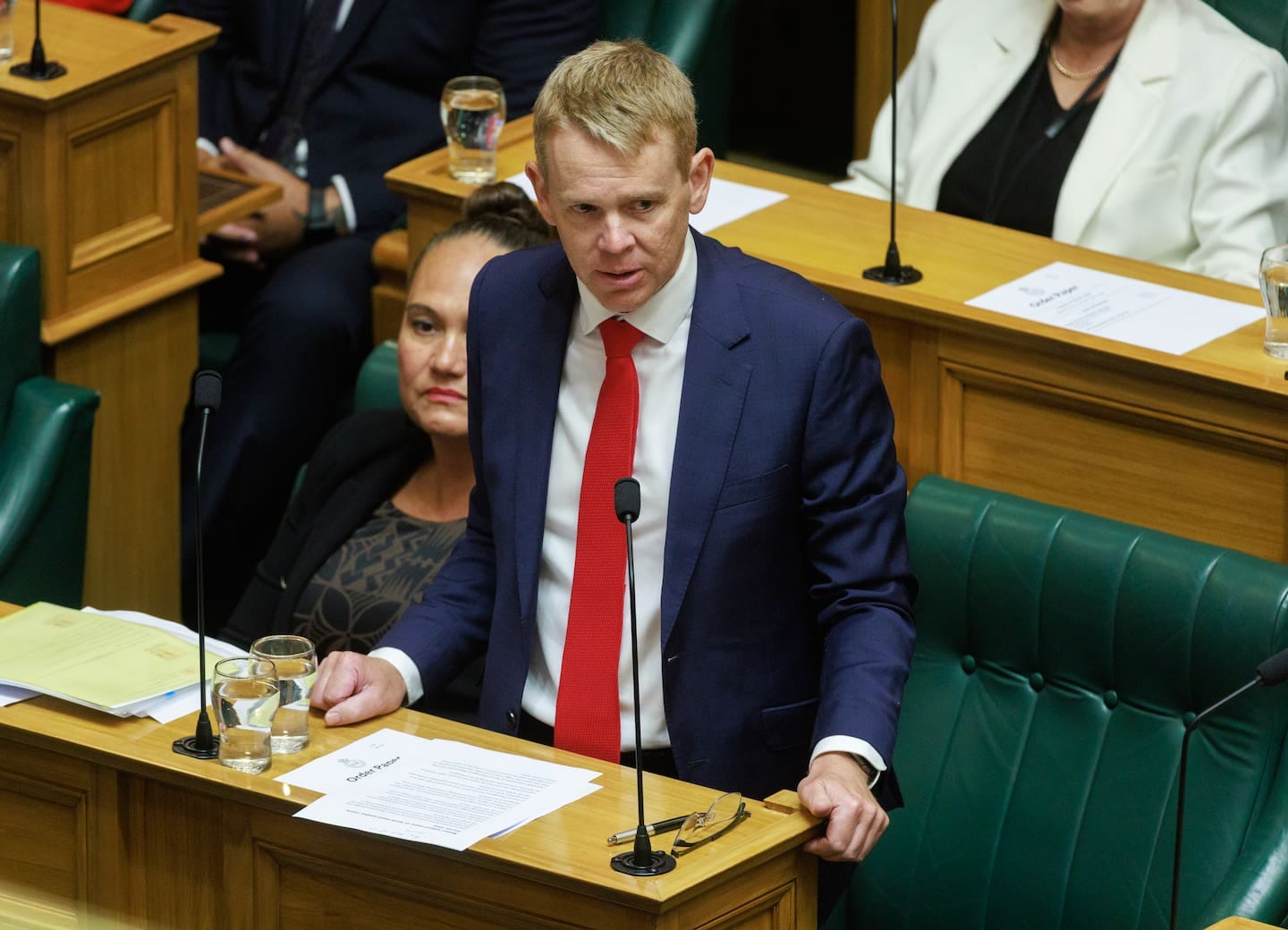
However, once again, Hipkins attempted to rewrite economic history, recycling claims from his State of the Nation speech the previous week. And again, he had to delve back a few years to find an old gaffe of Luxon’s to breathe new life into. Last week he dragged out “bottom feeders”, “wet and whiny country”, from before the 2023 election, and this time it was his “C-Listers” remark about Jacinda Ardern’s overseas travel entourage.
The recycling indicates that Luxon has not given Hipkins fresh material to work with. There have been no major scandals, catastrophic blunders, nor rhetorical own-goals. So Hipkins is bringing the ghosts of Luxon’s past into the ring to fight. He is shadowboxing with a version of the man that was less experienced and less savvy and who no longer exists.
He also reached for some very tired old political jokes:
For a moment there, I thought I had stepped out of the House and stepped into the local laundromat, such was the level of spin and dirty laundry being stuffed into the corner.
Come on, man. It is 2026. You can do better than this! You pay a guy who claims to be a comedian (but performs more of an ‘angry man’ routine on social media these days) to work in your office – get him to write your jokes.
Hipkins’ speech did, however, build to a crescendo. When he turned to Donald Trump’s comments about the role of NATO soldiers in Afghanistan, and accused Luxon and Peters of failing to defend New Zealand soldiers, Hipkins found his fire. There was righteous fury. There was indignation on behalf of our troops. He was incensed that Luxon and Peters dare call themselves patriots!
But, the problem is that no matter how much he would rather they didn’t, context and facts matter. And the facts are that Hipkins’ government systematically underfunded and demonised the military while in office, Defence Minister Judith Collins has already addressed Trump’s comments, and probably most importantly… New Zealand is not even in NATO.
In the government motion on the weather events, Marama Davidson’s contribution stood out for its restraint. She spoke about the landslide and weather events with seriousness and avoided collapsing every tragedy into an accusation against the government. And while she did delve into talking points I personally disagree with, she was diplomatic and extended a hand, rhetorically at least, to the rest of the House. This is the version of the Greens that could, theoretically, broaden its appeal and claw its way back up the polls.
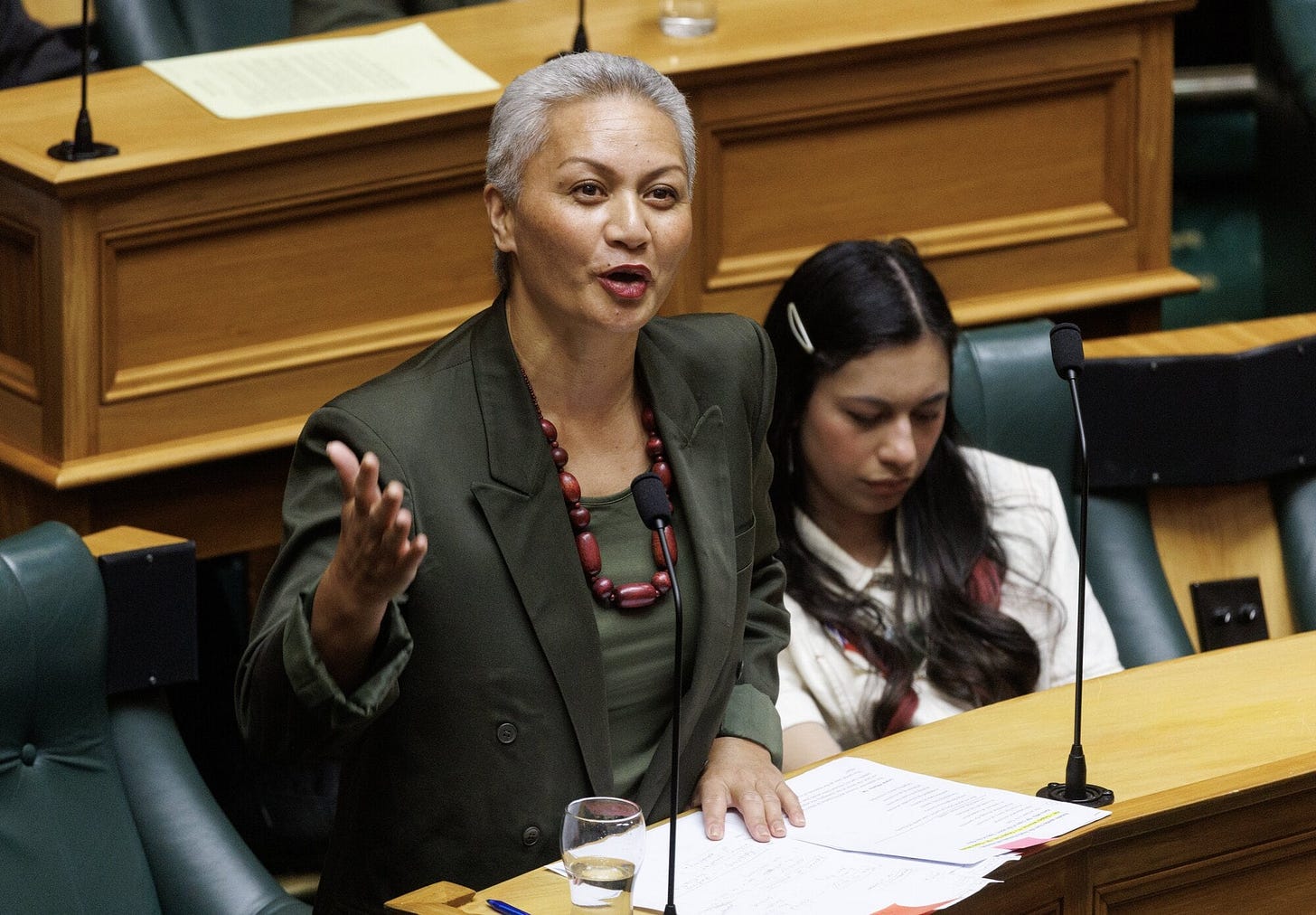
Unfortunately, it was immediately undercut by her co-leader Chloe Swarbrick, whose speech on the Prime Minister’s statement promptly sucked all the positivity and oxygen out of the room. It was a familiar diatribe delivered with no attempt to conceal the level of derision she plainly feels for more than half of New Zealand voters and the politicians they voted into government. As always, capitalism was the villain, the government was callous and evil, and all suffering was proof that only her ideological perspective is the right one. Her rhetoric was vicious, her framing absolutist, and her tone suggested not disagreement but moral disgust. She speaks not as if others are wrong, but as if they are subhuman.
This has become Swarbrick’s signature. In 2025, she underwent an ugly transformation from an idealistic, precocious, but hardworking young politician to a cynical, extremist who became distracted, by ideological warfare, from what really mattered to her constituents. Sadly, it appears the Christmas break has not been a reset. Today, she picked up where she had left off and delivered sweeping denunciations, before concluding by lecturing the House about the need to come together to save people and the planet, on her terms. Always on her terms.
She claimed the Greens are not there for “power for power’s sake”, yet insisted they are there to get stuff done. She suggested that unlike everyone else they are the party of action. But real, substantial change requires power and power requires compromise. By refusing compromise, the Greens ensure they never hold real power, only space on the stage for their moral theatre.
At one point, Swarbrick used the presence of slugs in one’s bathroom as evidence of hardship. She said young people are naming these slugs, because apparently the slippery suckers are permanent lodgers and the young people are incapable of removing them like the rest of us. We frequently get slugs in my bathroom because we leave the window open and there are slugs in our garden. When we see them, we do not call a government department nor our therapist (technically not true since my partner is a psychologist and I do call her), we relocate them back outside. We also get flies, wetas, and the occasional skink, though the cats bring those in. I digress!
David Seymour followed Chloe Swarbrick with an entertaining and ideologically coherent speech. His written speech would have been fine, but his ad-libs at Swarbrick’s expense had me laughing out loud. His amusement in the face of such a venomous speech immediately punctured the sanctimony that had settled over the chamber.
He obviously found Swarbrick’s slug analogy odd, too, as he laughed that:
There’s two kinds of people: there’s people who, when they find slugs in their bathroom, they clean their bathroom, Chlöe, and then there’s people, as she said, who start giving names to the slugs in their bathroom. At least there’s no slugs in the bathrooms on business class, is there, Chlöe?
This drew a pedantic point of order from Deborah Russell, who objected that he didn’t use Swarbrick’s full name as is required. He responded to this with humour, too, pointing out how unserious much of the opposition has become their obsession with tone policing:
Deborah Russell, I think it is, who is taking on the big issues. I mean, you can imagine the disappointment of Chris Hipkins back in his office thinking, “Oh man, I’m trying to climb Mount Everest, and this is my Tenzing.” It can’t be too encouraging, can it?
With humour and sentimentality, Seymour pivoted the vibes from seriously negative to framing New Zealand as a positive society built by risk-takers, settlers, and strivers. And he did so carefully and deliberately making the point that this applies to all of us whether our ancestors arrived on waka, ship, or plane.
He walked through ACT’s case for fiscal restraint, regulatory reform, and property rights. He reckoned his ACT ministers have saved the country an estimated $57,000 in savings per ACT voter, too. Whether one accepts the exact arithmetic or not, the broader argument he was making was clear and consistent: when government wastes less, ordinary people are materially better off.
He was unapologetic in his rejection of the moral framing that dominates the other side of the House, openly mocking, for example, the idea that kindness to criminals produces public safety. He skewered Te Pāti Māori’s pronouncement about abolishing prisons, and posed questions they studiously avoid answering about victims, violent offenders, and equal application of the law.
The overall point he conveyed was that while others speak in abstractions about systems and suffering, he speaks in terms of incentives, behaviour, and outcomes. Love him or loathe him, ACT is not in government to posture. It is there to argue, relentlessly, that responsibility still matters and to laugh at those who think naming slugs is hardship.
Winston Peters’ contribution was vintage Peters. At times rambling in structure, ruthless in substance, and delivered with the kind of confidence that only comes from having been right often enough, and around long enough, not to care who is offended.
He opened by skewering the opposition for mistaking volume for vision, likening their speeches to a Status Quo song with endless repetition, no development, and no explanation for how they managed to run the economy into the ground while they were “all by themselves”. He argued that Labour and the Greens want voters to forget Covid, forget debt, forget institutional damage, and pretend that two years is enough time to undo the consequences of the second most-rigid pandemic response on earth. He did not have to perform his incredulity because it is patently authentic.
Peters’ has long insisted that experience is a political virtue that cannot be learned in “woke sociology departments” and he repeatedly returned to question the real experience of those on the other side of the House. He asked: what have you ever actually run? What have you ever built? What have you ever risked with your own money? The silence, he described, was the point. He framed politics as a craft learned through exposure to failure, negotiation, and long timelines, not a seminar exercise in moral certainty.
He spent sometime defending New Zealand First’s role and actions in government, particularly on infrastructure. The Cook Strait ferries example was an indignant rebuke of media uselessness. He walked us through how a $401 million procurement ballooned into a $4.2 billion farce because Labour bought ferries without infrastructure. His claim of at least $2.3 billion in savings was accompanied by a challenge to journalists and opponents alike to engage with numbers rather than narratives.
Peters was equally unapologetic in foreign affairs and took great joy in pointing out Hipkins’ NATO gaffe. But his irritation was directed less at Labour than it was at the media, whom he repeatedly accused of intellectual laziness, telling them to get off their “broad half acre”.
Peters cast New Zealand First as the party of realpolitik, unromantic, practical, and focused on assets that will still be working 50 years from now. The speech meandered at times, as Peters’ speeches can do, but the messages delivered were heard loud and clear: experience matters, competence matters, and politics divorced from reality ends in fiscal and institutional wreckage. He concluded by saying the opposition’s performance made him more confident about re-election.
Nicola Willis spoke as the National Party’s chief enforcer, drawing a sharp and disciplined contrast between describing problems and actually fixing them. Chris Hipkins, she said, confuses sympathy with leadership. Labelling him “Hapless Hipkins”, she characterised his speech as one built on wishes (lower bills, nicer foreign leaders, fewer worries) without any explanation of how those outcomes would be delivered. Politics, she argued, is not a Hallmark card: it is a set of choices, trade-offs, and actions.
Willis refused to let Labour memory-hole its economic record and mocked the spectacle of a man who opposed every savings measure for two years suddenly “discovering” debt and inflation over summer.
Willis is unmatched at delivering speeches in the House and is skilled at pairing critique with substance. She showed this when she listed concrete reforms already underway including fast-track legislation, tax relief, Investment Boost, rates caps, RMA replacement, health targets, and a back-to-basics education, and declared that each one was opposed by Labour. The pattern, she argued, is unmistakeable; Hipkins claims to care about cost of living, yet resists every mechanism designed to address it.
She also ran a few lines that were noticeably more ‘based’ than usual, explicitly rejecting the idea that governing is about running endless tikanga lessons and instead talking plainly about productivity, growth, and the importance of mining rare earth minerals. An ever-so-slight shift in rhetoric that may mean nothing, but could signal a move away from some of the wokeness she has been accused of. This kind of rhetoric will win her support, but she’ll need resilience to cop the inevitable screeching from the media class and the Wellington woke set.
Her most crucial moment came when she spoke about her “normal friends”. These are the kind of people who don’t spend their evenings writing political Substacks. They watch Netflix and occasionally the news, but they are people exhausted by Covid, inflation, and economic uncertainty. She acknowledged how hard things have been without pretending hardship can be solved by kindness alone. This came with the warning not to be fooled by politicians who say “I hear you” but offer no solutions. Willis closed by arguing that New Zealand’s future depends on reform, growth, and courage, not wallowing in problems, but acting.
After Willis, Deborah Russell stood to speak. Look, I will be a hundred per cent honest… I muted it. I endured all of Chloe Swarbrick’s speech for you guys and there are only so many sermons one can endure in an afternoon.
So this is my take of the first part of the first day of Parliament in 2026. Luxon was competent. Willis prosecuted. Seymour mocked. Peters corrected. On the other side, Hipkins recycled, Swarbrick raged, and Davidson reached out. And Waititi hated.
This article was originally published by Thought Crimes.