
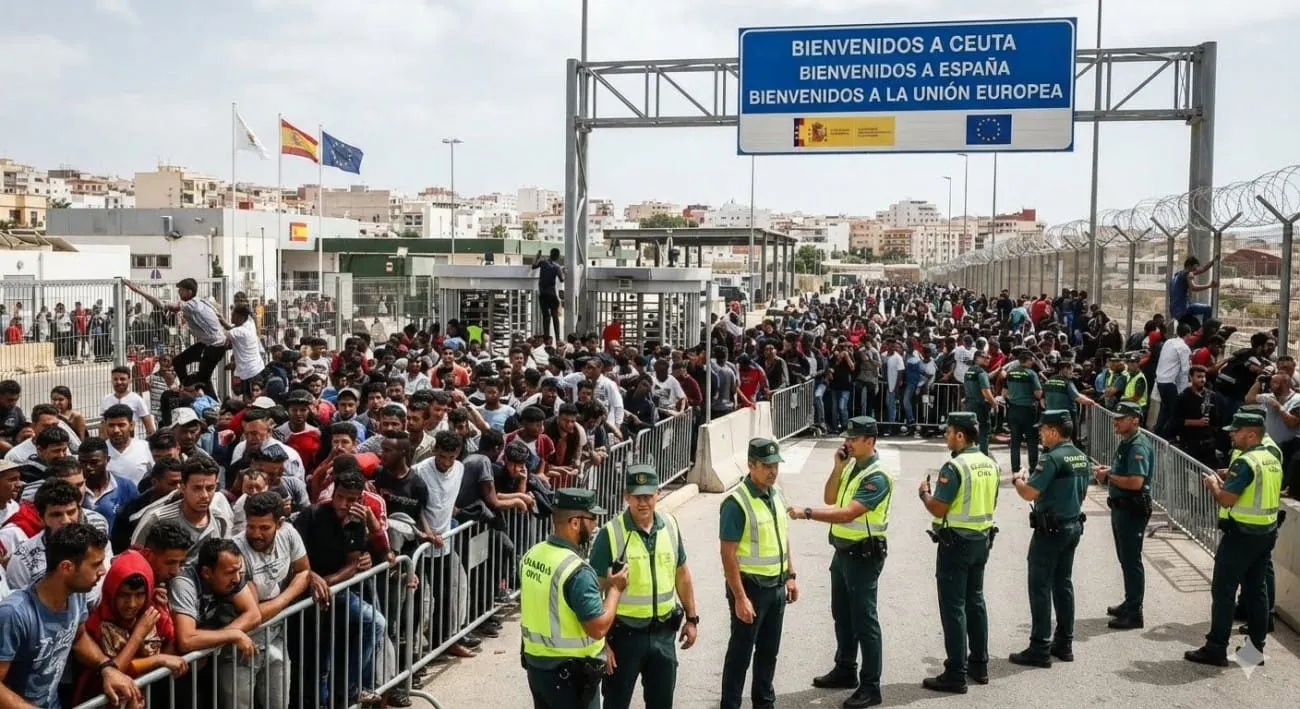
The images from Ceuta this last week should shock anyone who still believes European governments take borders seriously. Tens of thousands of illegal immigrants – around 60,000 – poured into Spain’s North African enclave in a single co-ordinated, chaotic surge from Morocco. They swam, climbed, and pushed through whatever barriers stood in their way. Spanish police, by most accounts, largely stood and watched. The territory, home to fewer than 90,000 people, was overwhelmed. Some are said to have returned. This bizarre episode itself is less a sudden crisis than the predictable outcome of policies long pursued by the European establishment and by Spain’s socialist government.
Ceuta and its sister enclave Melilla sit on the African mainland, Spanish soil for centuries. Their borders are Europe’s external frontier and when that frontier collapses the message is unmistakable. The EU talks of managed migration, external processing, and identity checks before anyone is allowed to leave the enclave for the Spanish mainland. Officials insist the new arrivals cannot simply continue into Europe until their identities have been verified. Experience suggests this is temporary theatre. Once asylum claims are lodged – and they will be – the legal machinery of the EU and the European Convention on Human Rights takes over. Refusal becomes difficult. Deportation becomes rarer still. A familiar pattern reasserts itself: arrival, claim, delay, settlement.
Spain’s domestic record does not inspire confidence that firmness will prevail. Successive socialist administrations have treated illegal entry as a problem to be regularised rather than prevented. Amnesties for those already inside the country have been offered more than once. The political signal is clear: once you reach Spanish territory, the likelihood of eventual legal status rises. Combine that with the EU’s broader reluctance to confront the incentives created by generous welfare systems, family reunification rules, and the practical impossibility of removing large numbers of failed claimants, and the result is predictable. People move towards the weakest point of the perimeter.
The numbers involved in Ceuta are not trivial. They approximate the total of small-boat arrivals across the English Channel in a typical recent year. Yet the media and political reaction have been markedly different. When similar volumes reach British beaches, the coverage is often muted, contextualised, or focused on the human stories of those making the journey. The complicity of French authorities, who for years allowed camps to form near the coast and who are more interested in facilitating onward movement to England than in stopping it, receives polite understatement. Morocco, by contrast, is swiftly accused of deliberately opening the taps as a form of diplomatic pressure. The double standard is obvious. When the pressure is directed at a southern European state whose government is already ideologically predisposed to open-border thinking, outrage is selective. When the same dynamic plays out on the Channel, the preferred target of criticism is often the British government for failing to be welcoming enough.
This is not an accident of geography or of media bias alone. It is the logical product of a governing ideology that has spent decades treating national borders as moral embarrassments rather than practical necessities. Globalist rhetoric about the free movement of people, the obsolescence of the nation-state, and the moral duty to accommodate whoever arrives has shaped policy across much of Western Europe. The result is not controlled humanitarianism. It is the progressive erosion of the state’s ability to decide who enters and who stays. National identity. The shared language, customs, legal traditions and sense of belonging that make a country more than a hotel, is treated as a threat, secondary to abstract universal rights. When those rights are invoked by large numbers of military-age men from countries with radically different social norms, the consequences for social cohesion are left for later generations to manage.
Spain’s socialist government has been particularly explicit in its preference for regularisation over enforcement. Amnesties send a powerful message to potential migrants and to the networks that organise their journeys: risk the crossing and the path to papers may open. The EU’s own institutions, while occasionally issuing stern statements about the need to secure external borders, have simultaneously expanded the legal avenues and the practical protections that make removal difficult. The combination is corrosive. It tells the world that Europe’s stated rules are negotiable once enough people ignore them.
The United Kingdom is not insulated from this dynamic. Channel crossings continue because the incentives remain intact. The boats keep coming because those who reach British soil know the probability of swift removal is low. French authorities have shown limited enthusiasm for stopping the departures at source. British governments of both parties have talked tough and delivered incremental measures that fail to alter the fundamental calculation. The Ceuta episode is a warning. What happened there can, in different form, happen anywhere the political will to maintain a border is absent.
A government serious about preserving the character of the country it governs must treat illegal entry as a problem to be prevented, not managed after the fact. That means rapid returns, deterrence that is visible and consistent, and the willingness to leave the European Convention framework if it continues to obstruct removal. It means ending the quiet assumption that asylum claims from safe third countries or from economic migrants will be indulged indefinitely. It means recognising that national identity is not a relic to be discarded but the foundation of the solidarity that makes welfare states and liberal democracies possible in the first place.
The scenes in Ceuta are not an aberration. They are the visible consequence of years of policy that prioritised open-ended mass immigration over the basic duties of the state. Spanish police standing aside while thousands entered is not an isolated failure of nerve. It is the practical expression of an ideology that finds the defence of borders distasteful. The EU’s talk of identity checks is welcome only if it is followed by actual removals. History suggests it will not be. The same numbers that provoke temporary alarm when they appear in a Spanish enclave are absorbed with relative equanimity when they arrive on English beaches. The French role is soft-pedalled; the Moroccan role is denounced. The pattern is consistent: pressure on the system is met with moralising rather than enforcement.
Britain cannot afford to treat this as someone else’s problem. The Channel is our Ceuta. Every successful crossing reinforces the message that the border is porous and that the political cost of stopping the flow is higher than the cost of managing it. That calculation must be reversed. The government should act immediately to stop the boats, to return those who arrive illegally, and to make clear that illegal entry will not be rewarded with settlement. National identity is not preserved by wishful thinking or by international statements of principle. It is preserved by the willingness to say who may enter and who may not – and to enforce the distinction. The events in Ceuta show what happens when that willingness disappears. Britain should take note and act accordingly.
This article was originally published by the Free Speech Backlash.






![[The Good Oil] Stuff Up of the Day](https://storage.ghost.io/c/31/f4/31f4e20a-0315-499e-83ff-139e8eab53bf/content/images/size/w1304/format/webp/2024/09/Stuff-up-image-1.webp)

