The tradies and other blue-collar workers building data centres to meet the AI rush must surely be enjoying a hearty dose of schadenfreude, right now. After all, for decades they’ve watched their jobs vanish overseas, while being finger-wagged by white-collar graduates that they ought to re-train, skill up, go to college, blah blah blah.
Well, now the outsourcing is swinging the other way, and the smug lanyard class are watching their jobs vanish into an AI hole. One minute, you’re working from home in your pyjamas and living the life of Riley, the next, an AI is doing your job from a data centre. And the AI doesn’t demand Mental Health Days.
For most of living memory the deal was simple. Get the degree, then sit at a desk for 40 years. Somewhere along the way university stopped being an education and became a white-collar trade school.
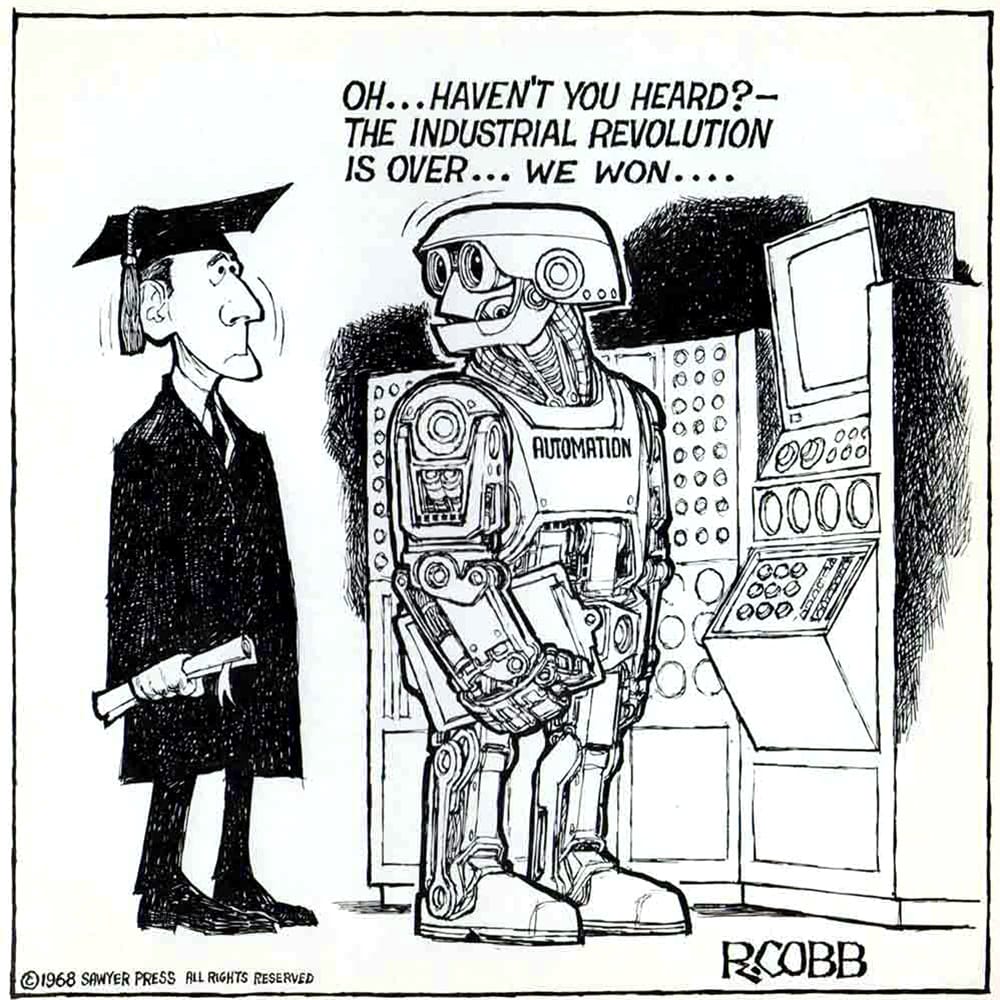
Those of us who grew up watching machines eat the assembly line understood what the degree was for. It was the exit ramp: Dad came home with no job on Monday, so the kid was pointed at a campus and told to earn a living with his mouth instead of his back. And for a long while it worked beautifully.
Then the machines learned to talk.
Earlier this week, Gallup reported that 27 per cent of American employees now fret that technology will make their jobs obsolete. That’s a record, more than double the 13 per cent of 2017 and up from 20 per cent a year ago. Non-graduates sit at 29 per cent, up eight points. Graduates are at 25 per cent, up six: and back in 2021 only eight per cent of them were worried. Now it’s their turn to wail, ‘Der terk er jerbs!’
Only, it doesn’t seem such a funny sneer when it’s your ‘jerb’ that’s being ‘terken’.
While these figures measure fear and not redundancies, they nevertheless suggest that the college degree is losing its power as insurance against economic change.
Fear isn’t quite the same as an actual redundancy letter and your stuff in a cardboard box, but that even the (formerly) most smugly secure class are feeling it, it’s quite the turn of the table.

As late as 2020 the word on everyone’s lips was not “artificial intelligence” but “automation” – something that would primarily affect physical labor. How things have changed. Professionals are now realizing that the future might happen to them as well.
Blue-collar workers know this feeling intimately. It’s been the background hum of their lives since the ’70s: plant closures, NAFTA, a China that got hungry and cheap at the same time. The message each time was brutally plain: there’s a cheaper option now and it isn’t you. When they objected, they were told they stood in the way of progress, because everyone wanted cheaper goods and more efficient factories. Then, as the towns emptied, the degree-holders offered the only advice they had: learn to code. It became a joke because it was one.
Now it’s their turn. Tradies are pouring the slabs for the data centres. The men who run the frontier labs warn their own products might finish us off. Meanwhile the lawyer, the analyst and the accountant are staring at the same question the coal miner stared at in 1985: what happens to me?
The assurance that new professions are likely to emerge, eventually, is cold comfort to a person wondering whether he can retrain himself fast enough to avoid falling into the “permanent underclass”.
Sooner or later they’ll get the same speech we got: new industries will appear, reskill, be adaptable. Just don’t ask what that pays a 50-year-old former middle manager.
What’s now dawning on tech, finance, law and medicine is the lesson the factory floor has been teaching for decades. You can do every single thing you were told to do, tick every box and still discover the market has changed its mind about what your labour is worth.
You don’t need mass unemployment for that to change politics. People accustomed to climbing get strange when they start to smell the descent. They might look at the blokes whose jobs went offshore and finally feel something like recognition. Or they might decide their own livelihoods deserve an exemption never offered to anyone in a hi-vis vest.
The Rust Belt is the exhibit. When people stop believing the system will reward effort, they stop caring what the system thinks. A professional class that feels betrayed is not going to accept decline gracefully. The next revolt against technological progress may well come from the very people who cheered it on, back when they assumed their qualifications put them out of reach.
This leaves one question worth asking now that the suits are the ones being automated out: how smart does ‘learn to code’ sound, now?