Tom Armstrong
Just an old fashioned romantic libertarian conservative at heart. Or maybe a romantic conservative libertarian, depending on the stages of the moon.
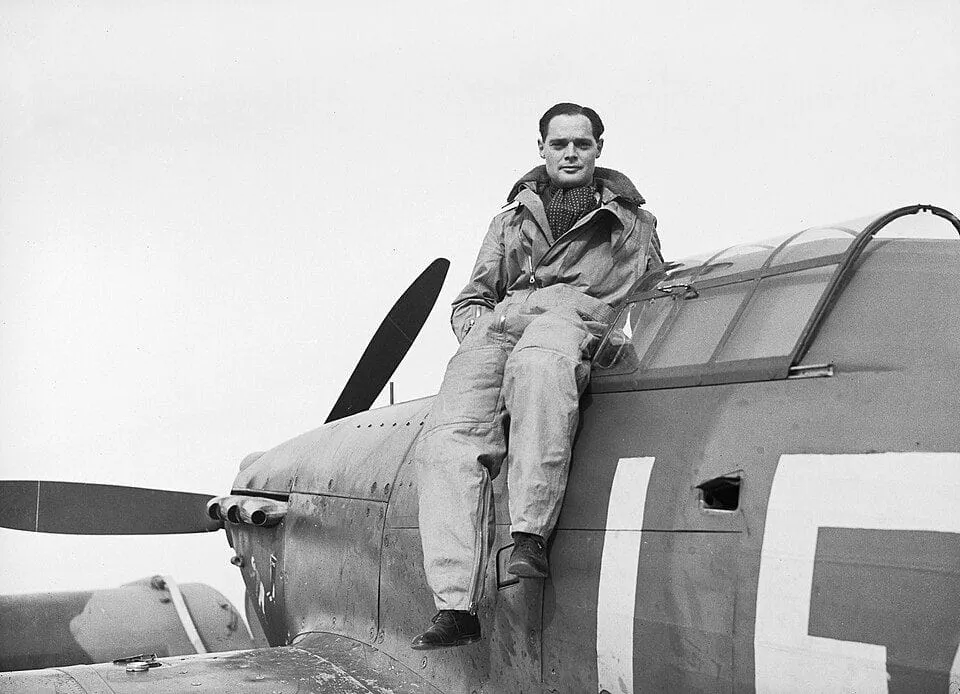
Group Captain Sir Douglas Bader was one of the most successful and famous fighter pilots of the second world war. His story is not just a tale of military strategy or wartime heroism. Instead, it is a powerful demonstration of absolute individualism, a fierce refusal to follow traditional rules, and a stubborn defiance of medical experts. After losing both of his legs in a horrific flying accident in 1931, Bader did not allow himself to be sidelined by society or military bureaucracy. By completely ignoring the pessimistic predictions of doctors and senior officers, he blazed a trail for amputees worldwide and proved that physical disability does not necessarily mean a limitation of human capability. His life showed that an individual with enough willpower can reshape reality to fit their own desires, rather than reshaping themselves to fit the rules.
Born in 1910, he was a natural athlete, excelling in rugby, cricket, and boxing. When he joined the Royal Air Force (RAF) as an officer cadet in 1928, his competitive nature and supreme self-confidence were immediately obvious. Bader was never a textbook officer. He viewed rules as mere suggestions rather than absolute laws and possessed a dangerous combination of immense talent and a total disdain for authority. For Bader, flying was not an exercise in cautious discipline: it was an art form and a test of personal courage. He frequently ignored safety regulations to perform unauthorized aerobatics, believing that his superior skill exempted him from the restrictions placed on ordinary pilots.
This refusal to follow rules led to his downfall, but it also set the stage for his greatest triumph. In December 1931, while visiting an aero club in Reading, some civilian pilots challenged his flying skills. Never one to back down from a dare or admit a limit, Bader took off in a Bristol Bulldog fighter plane. He attempted low-altitude aerobatics, a highly dangerous manoeuvre that violated strict RAF standing orders. The wingtip clipped the ground, and the aircraft crumpled into a devastating wreck. Bader survived, but his injuries were catastrophic. Surgeons had to amputate his right leg above the knee and his left leg below the knee to save his life.
At this point, the standard narrative for a disabled person in the 1930s was incredibly bleak. Medical experts of the era viewed double amputees as tragic figures who required permanent care, sheltered lives, and quiet resignation. The consensus was clear: Bader’s career was over, his athletic days were finished, and he would spend the rest of his life dependent on others. The experts told him what he could and could not do, establishing a rigid boundary around his future based on conventional medical wisdom.
Bader utterly rejected this destiny. His reaction to the experts was not one of sadness, but of pure fury and defiance. He refused to accept the identity of a victim or a patient. When he was fitted with his new aluminum artificial legs, he found the standard training methods slow and patronizing. The experts told him to use walking sticks and progress cautiously over many months. Bader threw the sticks away. He suffered countless painful falls, bruising his stumps and damaging his new mechanical joints, but he kept getting back up.
He insisted on walking without a stick, purely because the experts said it was impossible. He taught himself to walk so well that people who met him for the first time often did not realize he had no legs. Not only did he not stop walking, he drove sports cars, played golf, and even danced. By refusing to let the medical establishment define his limitations, Bader dragged himself back into active life through sheer force of personality. He proved that the human mind matters far more than flesh and bone.
However, conquering daily life was not enough for Bader’s restless ambition. He wanted his old life back, which meant flying for the RAF. Here, he ran directly into a wall of military bureaucracy. The air ministry rules were clear: a man with no legs could not fly military aircraft. It was a matter of safety and protocol. Bader campaigned relentlessly, badgering senior officers and demanding a chance to prove himself. Eventually, his persistence forced the RAF to grant him an evaluation flight. He climbed into a plane and proved he could handle it just as well as any able-bodied pilot. Despite this, the peacetime RAF still forced him out, in 1933, on medical grounds. It was only the arrival of the second world war in 1939 that gave Bader the chance to shatter the rules completely. With the nation facing an existential threat, the RAF desperately needed experienced pilots. Bader seized the moment, rejoined the service, and was quickly posted to a fighter squadron.
During the Battle of Britain in 1940, Bader’s individualism transformed from a personal trait into a vital military asset. Command structures often favour caution and uniformity, but Bader favoured aggression and innovation. He disagreed with the official RAF fighter tactics of the time, which utilised rigid, neat formations that made British pilots easy targets for the German Luftwaffe. Alongside fellow commanders, Bader championed the “Big Wing” strategy. This tactic involved massing several squadrons together to attack the enemy in huge, overwhelming numbers.
This strategy was highly controversial and went against the established defensive plans of the air ministry. A conventional officer would have followed orders and stayed quiet. Bader, however, shouted his opinions to anyone who would listen, bypassing his immediate superiors to argue his case directly to political and military leaders. He cared nothing for the chain of command if he believed the rules were wrong. His aggressive tactics and leadership of 242 Squadron proved highly successful, turning his unit into one of the most lethal fighter groups in the RAF.
Bader’s physical condition actually gave him an unusual advantage in the air, a fact that baffled the medical experts who had dismissed him. When a pilot pulls out of a sharp dive at high speed, the intense gravitational forces (G-forces) drain blood away from the brain and down into the legs, causing the pilot to black out. Because Bader had no legs for the blood to drain to, he could endure much higher G-forces than his able-bodied comrades without losing consciousness. The very trait that the experts thought would ruin him made him a deadlier predator in the sky. He shot down more than 20 enemy aircraft, becoming a national hero and an inspiration to a besieged Britain.
Even when he was shot down over France in August 1941, his defiance did not waver. As he bailed out of his damaged Spitfire, one of his artificial legs became trapped in the cockpit. He broke the leather straps to free himself, leaving the leg behind as he parachuted to earth. Captured by the Germans, he immediately demanded that they contact the British to arrange for a replacement leg to be dropped by parachute. The RAF actually flew a mission to drop a new leg to him. As soon as he received it, he used it to escape from the hospital window. He was recaptured, but his constant, troublesome escape attempts eventually forced the Germans to send him to the notorious, high-security Colditz Castle. Even behind bars, surrounded by guards, he refused to behave like a defeated prisoner.
Douglas Bader’s legacy stretches far beyond his wartime record. Perhaps his greatest achievement was the profound impact he had on the perception of disability. Before Bader, amputees were often hidden away or encouraged to accept a diminished existence. By ignoring the experts and living a life of high adventure, Bader shattered these low expectations. He showed other amputees that their boundaries were self-imposed or constructed by a cautious society, rather than fixed by reality. He spent much of his post-war life visiting hospitals, speaking to injured veterans and civilians, and giving them the same blunt, uncompromising advice that had saved him: never give up, and never let anyone tell you what you cannot do.
Douglas Bader was not a perfect man: he was arrogant, stubborn, and frequently rude to authority figures. Yet, it was precisely this difficult, individualistic nature that allowed him to achieve the impossible. A polite man who followed the rules would have stayed in his wheelchair. A cautious man who listened to the experts would have accepted early retirement. Bader’s blazing trail was built on a foundation of absolute refusal to conform. He proved that true strength does not live in our limbs, but in an unbroken human spirit that looks at a wall of rules and decides to fly right over it.
Here’s the Kenneth More film Reach For The Skies most of us enjoyed in our youth.
This articles was originally published by the Free Speech Backlash.