Table of Contents
Recently, another turgid public artwork tickled the smooth brains of the midwit crowd with its supposedly ‘powerful’ imagery. Thankfully, this time, it wasn’t some towering, lard-arsed ‘Shaniqua’ ghetto kween. Instead, “Woman with a Burden” purports to show a woman bowed down by the supposed ‘drudgery’ of modern life. Illustrating (albeit unintentionally) just how trivial first-world problems really are, sculptor Jaume Plensa put a washing machine front and centre.
One can be forgiven for suspecting that this cosseted twit has never done a load of washing in his life and certainly never without the aid of the washing machine he sneers at.
What he needs is not a holiday in Cambodia, but a sentence of the hard reality of everyday drudgery in the world of the half of the global population who still wash their clothes by hand. Compared to the bare few minutes it takes to put a load of washing in the machine and take it out again, clothes washing for women in most of sub-Saharan Africa, South Asia and Latin America is a task that requires around 20 hours of back-breaking work every week.
Women in Western countries have had generations to forget just what a labor-saving miracle the washing machine really is. Swedish statistician Hans Rosling called them “the greatest invention of the industrial revolution”.
Women in the developing world have no such luxury. Even if they could afford a washing machine, the requisite plumbing and electricity are further extravagances beyond their means.
A former engineer with appliance company Dyson, Navjot Sawhney has set up a non-profit aimed at changing all that. The Washing Machine Project, founded in 2019, aims to revolutionise housework for women in the developing world.
This is about much more than letting poor women in developing countries put their feet up in front of daytime telly. “Hours and hours of handwashing denied them opportunities to work, study and rest. It’s physically exhausting. It’s time consuming. It causes skin irritation, chronic back pain and other health problems,” Sawhney points out.
His solution is as elegant as it is practical and cost-effective.
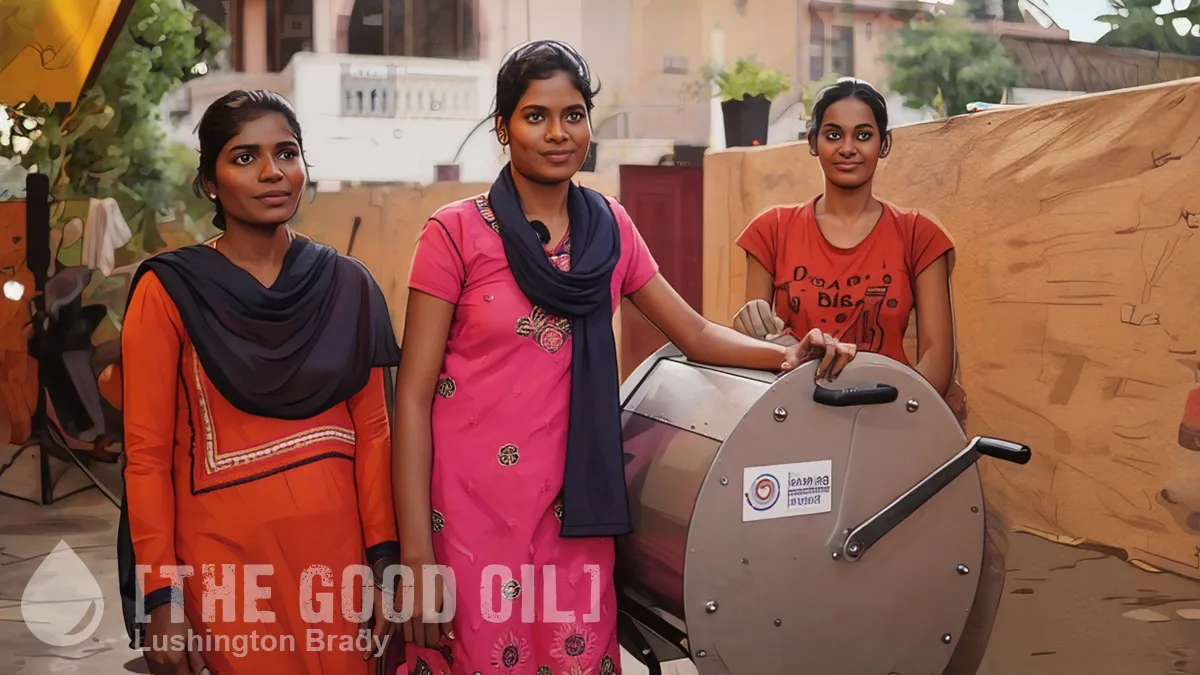
His solution: a light-weight washing machine that can be shipped anywhere in the world, is manually powered (i.e., hand-cranked), and requires no electricity or running water whatsoever to operate. It’s the world’s first flat-packable washing machine. A manual, off-the-grid washer that helps save up to 50 per cent of water and 75 per cent of the time compared to hand washing clothes.
Costing less than $200 to build, each machine is given free to its users and funded through corporate donations and grants from the British government. The machine is designed to be assembled rapidly and easily by anyone and sits on rubber wheels, meaning it can be moved around and shared between families that need it. Crucially, it only uses around 20 litres of water per load – roughly half of what is used to wash the same quantity of clothes. Apart from that, it works much like a normal washing machine.
Sawhney calls the machine ‘Divya’, after a young mother who was his neighbour for a year when he volunteered in South India. More than 50,000 have already been shipped to people in 13 countries – where it’s transforming lives, as its predecessors did in first-world countries after WWII. All that’s needed to set it up is just the included spanner and Allen key. With its low build-cost, each machine is given free to users, funded by corporate donations and UK government grants.
The effect on communities who have received a Divya is remarkable. Women using it report spending 75 per cent less time on laundry each week, and the charity estimates they’ve saved women a total of 17 million hours over the last five years. Allowing them to focus on other matters, such as growing their own businesses.
As well as eliminating nearly all of the back-breaking manual labour, the machine also saves huge amounts of water – and the requisite labour to get it.
Cutting down the amount of water required has two important benefits. Firstly, women need to carry less of it from lakes or rivers or communal taps, and the water saved in the more efficient process can instead be used for other purposes like cooking, drinking or bathing.
Operating it is a cinch.
First, the user adds water, clothes and detergent into the steel drum and closes the lid.
Using a manual hand-crank, they then rotate the drum for around two minutes. After that, they wait 15 minutes to let the clothes soak before repeating the process again.
If any stubborn stains remain, the lid can be opened and the clothes rubbed against the built-in scrubbing board attached to the top of the drum.
The water is then drained off and replaced with fresh water for rinsing, followed by another two minutes of gentle rotation.
Finally, the water is released through a small drainage tap at the front of the machine and the clean clothes removed to hang and dry.
The revolutionary effects go far beyond just saving backs and hours. Instead of walking to the local pond – where people also bathe and defecate – and scrubbing clothes for three hours in filthy water, “she can wash her clothes at home using the limited water she has because she needs so much less. She’s regained hours each week.”
In areas where security is poor and women are at heightened risk, the benefits have been felt even more acutely.
“For example in the DRC, gender-based violence as women travel and from a water source is a big worry. So if we can cut that time down spent at the water source, then we are hearing it helps to decrease rates of [sexual violence],” said Mr Sawhney.
As well as setting up a factory in India that aims to build 10,000 of the machines a year, Sawhney is turning his talents to other household items.
“Whether it’s cooking, cleaning, lighting, air conditioning, refrigeration, we see there’s a big gap in how people live in developing countries and how they can access these items,” he said.
“It’s about dignity, time, and opportunity. It frees women and girls up to pursue activities that they want to do, whether it’s education, work, studying, learning, reading, writing, or just simply resting and making choices over their own lives.”
Maybe next time you do a load, you’ll appreciate the little miracle in your laundry room a bit more.