Table of Contents
Robbie Shefford
The Gooserooter from Geraldine is a man with a plan and a caravan: a mental health advocate in the trucking, farming and rural communities, challenging the stigma around mental health one conversation at a time.
The day alcohol stopped being a bit of fun and started becoming a problem did not arrive with smashed bottles, flashing lights or the kind of chaos you hear about in movies. It did not roar into my life. It slipped in quietly, almost politely, on a day that looked exactly like every other day I had managed to drag myself through.
I was sitting in the shed, boots off, hat still on, minding my own business and quietly having a beer, because, let us be honest, no good story ever started with ‘one day I was having a salad’. I was not celebrating anything. I was not out with mates. I was not even really enjoying it. I was just there. Me, a half-warm can and the kind of silence that creeps in when you are too tired to argue with yourself anymore.
The first drink went down easy. It always did. The second softened the edges. The third made me believe, for a brief and badly lit moment, that maybe things were not as bad as they felt. That is the thing about alcohol: it dims the lights just enough that you stop noticing the cracks in the walls.
But on that day, something inside me shifted. It was not loud. It was not dramatic. It felt more like a gearbox slipping out on a climb you have done a hundred times before. One second everything is holding together: the next, you are rolling backward and you do not know how to stop it.
I tipped the can back, waited for that familiar warmth to rise and nothing happened. No relief. No quieting of the thoughts. No 10-foot-tall bulletproof moment that alcohol is so good at pretending it can give you. Just the same heaviness I had been carrying all week, wrapped in a cold, metallic aftertaste.
So I had another drink, and then another, chasing a feeling I knew deep down was not coming.
At some point, I could not tell you when, I stood up to walk back inside and my legs simply would not cooperate. Not because I was drunk, but because I was done: completely, utterly, bone-deep exhausted in a way that had nothing to do with alcohol and everything to do with depression.
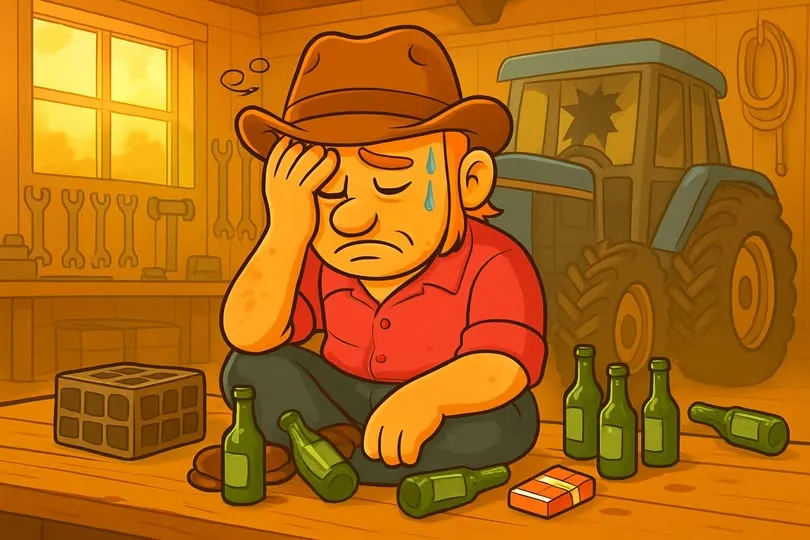
I sat down again, right there on the workshop floor, back against the bench, surrounded by empty bottles I barely remembered opening. I do not know if I cried or if I simply ran out of places inside myself to put any more pain. My head was buzzing, not from drinking, but from the realisation that I was not drinking for fun. I was drinking to escape.
And that is when it happened.
Rock bottom did not feel like an explosion. It felt like a quiet admission.
It felt like looking at a crate of empties and realising the only thing emptier was me.
The shed around me, the tools on the wall, the tractors waiting for attention, the mess I had not cleaned up, all blurred into a dull background hum as a simple truth slipped through the noise.
I was not drowning my problems. I was teaching them to swim.
When I finally stood up, head pounding, chest tight, ears ringing with that awful morning after shame, I realised something important. The drinking had not caused my depression. It had simply given it a microphone.
· Rock bottom was not the bottles.
· Rock bottom was not the hangover.
· Rock bottom was not the night before.
· Rock bottom was the moment I understood that alcohol was not helping. It had never helped. It only ever paused the pain long enough to make the return hit harder.
I did not know it at the time, but that moment on the shed floor, spinning head, sick stomach and a heart that felt like it had run out of rope, would become a hinge in my life: a turning point. A line in the sand I did not draw on purpose, but one that shaped everything that came next.
Because the truth, the one I had spent years avoiding, was painfully simple.
· I was not weak.
· I was not broken.
· I was human, and I had finally hit the limit of what a human can carry alone.
Just like that day in the paddock when the numbers did not make sense and the world shrank into a breathless tunnel, this moment in the shed became another seed. Another reminder that pretending you are fine is not the same as being fine.
I did not know it then, but that rock bottom night would eventually become part of the story I shared with strangers on the side of the road, with farmers at shows, with truckies in their cabs and with anyone who needed to hear that they were not the only one fighting a battle no one else could see.
Because sometimes the moments that break us are the moments that finally set us free.
A New Kind of Invitation
Over time, something interesting began happening during the calls I took from people who were struggling. I would finish by saying, “Next time you are passing home, call in for a beer and a yarn,” because that is how most of us were raised. A beer meant company. A beer meant connection. A beer meant someone cared enough to sit with you.
But the replies began to change.
More and more people would smile down the line and say, “I will call in for a yarn and a sarsaparilla.”
At first I thought it was just a bit of cheek, but the more calls I took, the clearer it became. People were waking up to the fact that alcohol is not the comfort blanket we once believed it was. It is a depressant and many of the people I talk to know that all too well. They are looking for conversation, not sedation: company, not escape; a safe place to land, not another hole to climb out of the next morning.
And the truth is I do not care what is in their glass – beer, sarsaparilla, tea or water – it all does the same job when the real purpose is simply to sit down, share a yarn and be human together.
People are not turning down the beer because they do not want to talk.
They are turning it down because they want to feel better tomorrow.
And that says far more about strength than any drink ever could.
What Saved Me Was Not the Bottle
In the years since that night, I have heard plenty of people say that alcohol cures depression and maybe on the surface it looks that way for a little while, but I know better now. Alcohol never cured anything in me. It simply pressed pause on the noise long enough to make the silence afterward feel sharper.
The real healing came later, through conversations, connection, honesty and finally letting myself be human instead of trying to be bulletproof.
If alcohol had truly been the cure, I would never have ended up on that workshop floor with a heart that felt too heavy to carry.
What saved me was not the bottle but the moment I realised it could not save me and the choice to reach for something real instead.



![[The Good Oil] Stuff Up of the Day](/content/images/size/w1304/format/webp/2024/09/Stuff-up-image-1.webp)