Table of Contents
One of the most hypocritical aspects of the current leftist fad for ‘de-colonisation’ is that they are so singularly obsessed with European colonisation and conveniently ignore that colonisation was the default mode of international relations, over almost the entire world and in almost every culture, for at least 6,000 years.
When the British colonised India, they didn’t colonise an indigenous vacuum – they merely replaced the Mughals who’d brutally occupied and plundered India for 300 years. When the Spanish conquered Mexico, they could only did so because the tribes who’d been so savagely colonised by the Aztecs happily joined in overthrowing the hated oppressors. Even while the British were colonising New Zealand, the Māori were horrifically genociding the Moriori.
It is frequently forgotten that other empires were engaging in control, cultural repression, and conquest long before European ships ever sailed to foreign shores. The early Arab and Islamic empires were among the most significant of them.
Indeed, the Crusades that Muslims are still whining about only happened after centuries of bloody Muslim conquest were pushing Christendom toward extinction. Islam was practically hammering its blood-drenched scimitars on the gates of the Vatican when Christians finally fought back.
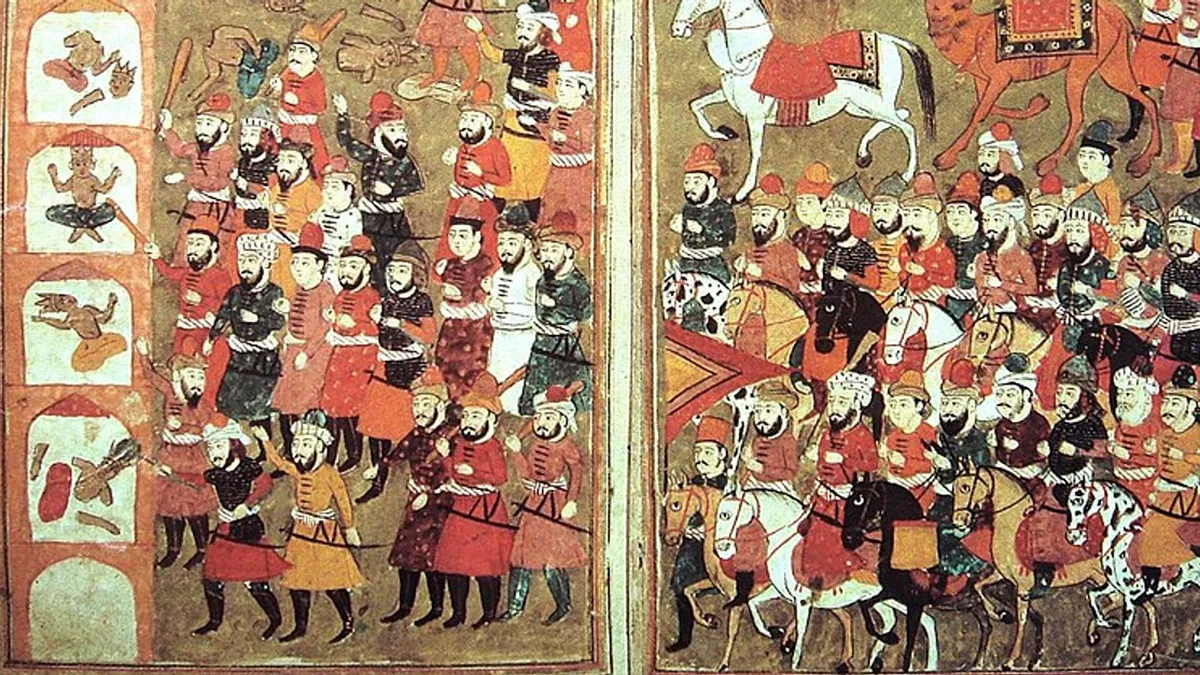
In addition to a religion, the advent of Islam in the seventh century brought about military and political conquests that altered continents. Arab forces invaded Spain, North Africa, and Persia in less than a century. These were not passive spiritual experiences; rather, they were conquests that altered civilizations, overthrew governments, and, frequently, destroyed whole cultural traditions.
Islamic colonisers were every bit as brutal as even the Belgians in the Congo.
Languages were moved. Arabic was frequently downplayed in favor of Berber and Persian dialects. New administrative systems that consolidated authority under caliphates replaced local governance institutions. Old customs and faiths were either assimilated, weakened, or completely eradicated. Centuries of cultural erasure and fusion had place in the Middle East, North Africa, and Spain (Al-Andalus).
In Malta, the Muslims genocided the indigenous population so thoroughly that not a trace of the indigenous languages remains in modern Maltese. To this day stand fortresses on the North African coast built with the looted stones of vanished Maltese cathedrals.
Why don’t the ‘decolonisation’ fanatics ever talk about any of that?
Blind spots in education and public understanding are caused by generations of people who are raised to believe that colonialism is solely a European phenomena.
Indeed, many American college students believe that America invented slavery.
Rather than being described as invasion, Islamic expansion is frequently told from a spiritual or “civilizational” perspective. The harsher realities of repression and forced absorption are less highlighted than the scientific, artistic, and architectural accomplishments of Islamic civilizations.
Scant as they often are or even more often pilfered from the civilisations they conquered and looted. Many so-called ‘Islamic inventions’ simply weren’t. Mathematics: mostly stolen from India and rebranded with Arabic words. Astronomy: likewise pilfered from the ancient Middle Eastern civilisations of Mesopotamia and Persia.
And so it went.
In fact, the ‘decolonisation’ narrative’s monomaniacal focus on European colonialism is its own form of racism.
In the West, where Europe’s empires around the world have been the main emphasis, modern colonial studies first appeared. Consequently, other colonial histories are not regarded as essential parts of world history, but rather as incidental material.
The notion of a powerful Islamic empire is associated with pride and identity in many civilizations. Because it can be awkward to acknowledge the colonial elements, the story is either romanticized, softened, or disregarded.
Not only does this narrative grotesquely ignore the savagery of Islamic colonialism (Islamic empires only gave up slavery and the brutal humiliation of dhimmitude because Europeans forced them to), it deliberately ignores that European colonialism was at the very least a mixed benefit. Indeed, in many cases it was more benevolent than pernicious. The Europeans may have been racist – as indeed were their subject races – but they also built massive public works and left behind governmental and bureaucratic structures that serve the decolonised countries that kept them to this very day.