Tom Armstrong
Just an old fashioned romantic libertarian conservative at heart. Or maybe a romantic conservative libertarian, depending on the stages of the moon
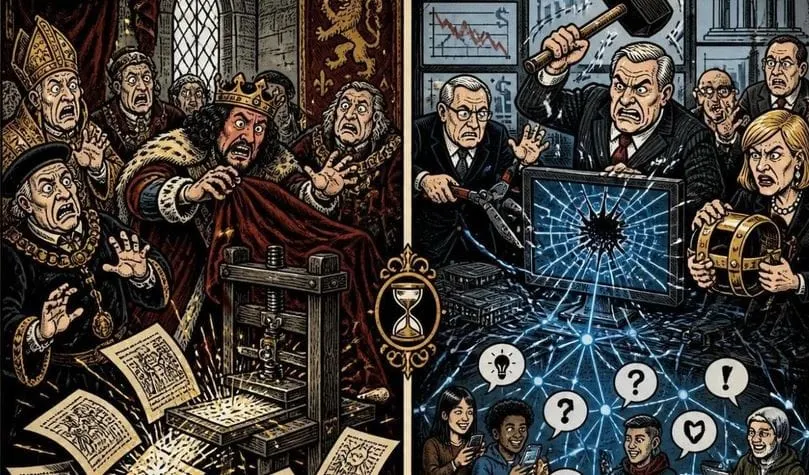
The invention of the printing press in the 15th century did not just alter how human beings shared words: it shattered the monopoly on truth. For centuries, a tiny elite of monarchs, nobles, and clerics decided what the public could know, believe, and discuss.
When Johannes Gutenberg’s moveable type suddenly allowed ideas to spread faster than the state could run, the ruling class did not celebrate a triumph of human ingenuity. They panicked. They saw the democratisation of information as an existential threat to their survival, and they deployed every weapon in their arsenal; licensing, bans, surveillance, and executions, to crush it.
Today, history is repeating itself with terrifying precision. The internet and social media have triggered a secondary information explosion, breaking the 20th-century monopoly held by state-aligned television networks and corporate newspapers. Ordinary citizens can speak directly to one another without a ruling-class gatekeeper filtering the message. And once again, the response from the political establishment is not gratitude for an informed citizenry, but a coordinated, desperate campaign of repression.
Modern governments are acting exactly like the frightened tyrannies of the past. Threatened by truths that expose their incompetence, corruption, and systemic failures, they have launched a war on free expression under the guise of public safety. The language has changed. Heresy has been rebranded as misinformation, and sedition is now called harmful content but the tyrannical impulse remains identical.
In Tudor England, the Crown realised it could not stop every printing press from being built. Instead, it created a system of total pre-emptive censorship. Through the Stationers’ Company, the state granted a monopoly to a select guild of loyal printers. In exchange for economic privileges, these printers acted as the government’s police force, vetting every manuscript before publication and smashing the illegal presses of anyone who dared publish without a royal license.
Our modern political class has resurrected this exact feudal strategy through the mechanism of digital platform capture. Governments in the West do not need to build national firewalls like those in overtly totalitarian states; instead, they pressure, bully, and collude with a tiny handful of Silicon Valley tech giants. The disclosure of routine state-sponsored digital censorship across the globe has laid bare the reality of this alliance. Intelligence agencies, health ministries, and political officials have routine, backdoor access to social media corporations. They do not request the removal of illegal content: they demand the suppression of politically inconvenient facts.
When tech platforms shadow-ban users, algorithmic down-rank specific viewpoints, or deplatform journalists, they are acting precisely like the Stationers’ Company. They are a corporate cartel executing state censorship by proxy. This allows modern politicians to pretend that they respect free speech laws while ensuring that any truth which threatens their narrative is quietly starved of oxygen.
The parallels run deeper when examining the specific excuses used to justify this tyranny. In the 16th century, the Catholic Church published the Index Librorum Prohibitorum (the Index of Forbidden Books). The justification was entirely paternalistic: the common people were deemed too uneducated, too gullible, and too easily led astray by heretical ideas. If the public were allowed to read unauthorised translations of the Bible or scientific treatises by Galileo, society would collapse into moral decay and chaos. The state presented itself as a protective shield, guarding the minds of the vulnerable from dangerous errors.
Listen to the rhetoric of modern prime ministers, presidents, and regulators today, and the echo is deafening. We are told constantly that the public cannot be trusted to digest raw information. If citizens are allowed to read unvetted data about economic policies, public health measures, or geopolitical conflicts, they might succumb to ‘radicalisation’ or believe ‘fake news.’ The modern state treats its population not as autonomous individuals capable of critical thought, but as a volatile, easily manipulated mass that must be protected from the truth for its own good.
When a government declares that it must regulate speech to protect democracy, it is engaging in the ultimate Orwellian contradiction. A democracy cannot exist without the free, unhindered exchange of ideas, arguments, and facts. A system where the state decides which arguments are legitimate is not a democracy: it is a managed oligarchy.
The ultimate proof that modern governments are acting out of fear, rather than a desire for public welfare, is how they treat the truth tellers. When the state’s official narrative is exposed as a lie, the machinery of tyranny turns vicious. Consider the treatment of modern whistleblowers and independent journalists who expose state crimes, illegal mass surveillance, or the realities of foreign wars. They are not met with open debate or legal transparency. They are hounded, exiled, and imprisoned under antiquated espionage acts.
This is the digital equivalent of burning William Tyndale at the stake for translating the New Testament into English. Tyndale’s crime was not that he wrote untruths, but that he made the truth accessible to the ordinary man, stripping the priesthood of its monopoly on interpretation. Today, when independent researchers or journalists use public data to dismantle official government statistics, they are treated as digital heretics. The state does not attempt to disprove their findings through superior evidence; it simply destroys their livelihoods, labels them as security threats, and deletes their digital existence.
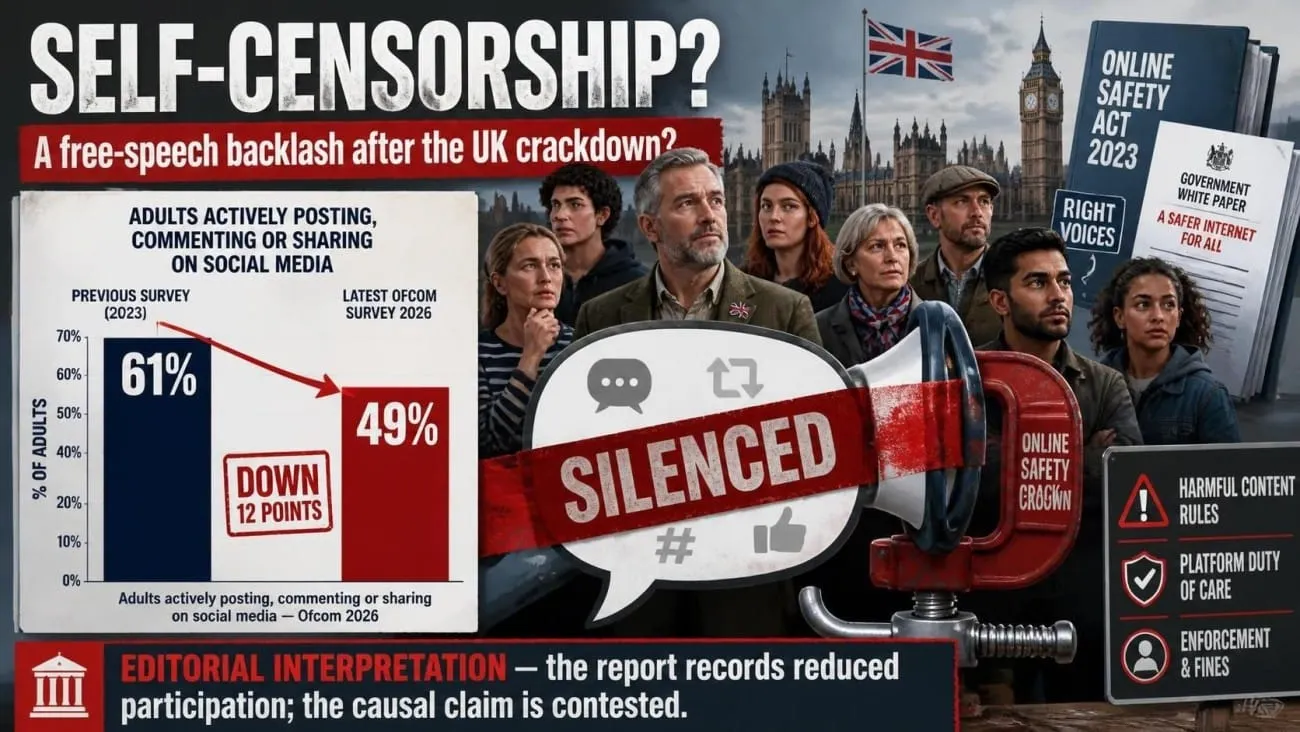
Furthermore, we are witnessing the implementation of legislative frameworks designed to codify this tyranny permanently. Across the United Kingdom, Europe, and the Commonwealth, sweeping new laws such as the UK Online Safety Act are being introduced. These laws impose staggering financial penalties on internet platforms if they fail to eradicate content that is deemed ‘harmful’ or ‘hostile,’ even if that content is completely legal to say in the street.
By threatening tech companies with corporate bankruptcy or executive imprisonment, governments have created a system of hyper-censorship. Terrified of legal liability, platforms deploy blunt artificial intelligence algorithms to pre-emptively erase any discussion that touches upon controversial topics. The result is a digital public square where conformity is enforced automatically, and dissent is suffocated before it can even be read.
Yet, the modern state has also learned that raw, violent totalitarianism is inefficient on its own. While the internet must be policed, the minds of the next generation must be molded directly. When the Tudor monarchs wished to achieve total ideological conformity, they did not stop at the printing press – they extended their reach into every parish pulpit and grammar school room. They understood that to secure permanent power, the state had to control the classroom. King Henry VIII and Queen Elizabeth I dispatched royal commissioners to conduct aggressive, unannounced ‘visitations.’ These inspectors possessed absolute authority to cross-examine teachers, audit libraries, and ruin the lives of anyone whose loyalty to the state’s official religious and political dogma was deemed insufficient.
Today, the British political establishment achieves an even more total ideological monopoly through a weaponised bureaucracy. Nowhere is this historical continuation of tyranny more blatant than in the operation of the Office for Standards in Education, better known as Ofsted. Under the deceptive banner of “raising standards” and ensuring “accountability,” Ofsted operates as the ideological enforcement arm of the contemporary regime. It is the direct psychological and structural heir to the Tudor clerical visitations.
Ofsted inspectors descend upon schools with the same inquisitorial zeal as the royal commissioners of the 16th century. They do not arrive as neutral observers of pedagogical excellence – they arrive as the guardians of state orthodoxy. Just as the Tudors demanded absolute conformity to the Acts of Uniformity and the Book of Common Prayer, the modern British state uses Ofsted to enforce compliance with a rigid, centrally mandated cultural and political curriculum. Under the guise of inspecting “Personal Development” and evaluating a school’s adherence to “Fundamental British Values,” the inspectorate cross-examines young children and teachers alike. They are looking to ensure that no heresy, no unauthorised, independent thought or traditional perspective is being whispered behind closed doors.
The punishment for heresy has simply been sanitised for a polite, bureaucratic age. The Tudors stripped non-compliant teachers of their licences and cast them into poverty or prison. Ofsted achieves the exact same execution of a career through the mechanism of the “Inadequate” rating. With a single stroke of a bureaucrat’s pen, a headteacher’s livelihood is destroyed, a school’s reputation is obliterated overnight, and the institution itself is subjected to a hostile, state-mandated corporate takeover by a Multi-Academy Trust. The sheer terror this regime inflicts has been documented in the tragic, real-world breakdowns of dedicated educators, proving that while the state no longer uses physical torture, its psychological cruelty remains profoundly tyrannical.
This is not accountability: it is a system of panoptic surveillance designed to enforce absolute intellectual docility. When a government can dictate the exact moral, social, and political boundaries of what can be taught to children, and enforces those boundaries through an unpredictable, punitive inspectorate, it is acting out of profound fear. It is the fear that if local communities, independent teachers, and parents are left to educate children freely, they will raise a generation that sees through the hollow narratives of the ruling elite.
By weaponising educational regulation alongside digital censorship, the modern state attempts to close the loop of information control. They seek a society where the internet is scrubbed of dissent by corporate proxies, and the classroom is scrubbed of independent thought by bureaucratic inquisitors.
We must see these developments for what they truly are: the desperate thrashing of an elite that has lost control of the narrative. For decades, the political establishment relied on a compliant, centralised media apparatus to manufacture consent. The internet broke that machine. Now that the public can see the staggering incompetence of their leaders, the catastrophic failures of economic printing presses, and the endless deceit of state institutions, the ruling class has panicked. They know they can no longer win the argument, so they are trying to outlaw the debate.
History, however, offers a profound crumb of comfort to those fighting for freedom. The tyrants of the printing press era failed. No matter how many books the church banned, no matter how many underground presses the Crown smashed, and no matter how many printers were locked away in dark dungeons, the truth could not be put back into the bottle. The decentralisation of technology was too powerful for the centralised structures of the state to contain. The printing press ultimately shattered the old world order, paving the way for the Enlightenment and the recognition of fundamental human rights.
The modern digital tyranny and its bureaucratic inspectorates will fail for the exact same reason. Governments can pass draconian speech laws, they can collude with multi-billion-pound tech monopolies, and they can intimidate independent voices through aggressive regulatory audits, but they cannot govern a population that has tasted the freedom of unhindered communication. The hunger for truth is an immutable trait of the human spirit.
We stand at a critical historical pivot point. We must stop treating government internet regulation and educational accountability as well-meaning attempts to make the world polite, safe, or standardised. It is a raw, cynical power grab by a ruling class that is terrified of its own people. It is time to reject the paternalistic lies of the modern state, expose their corporate censorship proxies, defy their bureaucratic inquisitors, and defend the public square with the same fierce, uncompromising radicalism that the early printers used to conquer the tyrants of old.
This article was originally published by the Free Speech Backlash.




![[The Good Oil] Stuff Up of the Day](https://storage.ghost.io/c/31/f4/31f4e20a-0315-499e-83ff-139e8eab53bf/content/images/size/w1304/format/webp/2024/09/Stuff-up-image-1.webp)