The movie Memphis Belle is a rattling good war story – and an abysmal documentary.
To take just one instance: as a crippled bomber falls from the sky, its crew can be heard on the radio screaming desperately. But, in Michael Veitch’s excellent oral history Flak, a former bomber crewmember is adamant: that would never have happened. When planes went down, the men on board went to their fate in stoic radio silence.
But that’s always the way of Hollywood’s ‘based on a true story’. They may be based on true events, but that ‘based on’ leaves a lot of leeway to just make up a whole lotta baloney.
So, what’s the real story of the Memphis Belle?
On June 14, 1943, the Memphis Belle made history. The plane became the first World War II bomber to complete 25 missions and land safely back on US soil.
Commanded by Robert Morgan, the Memphis Belle overcame all odds during its time in Europe. At the time, nearly 20 per cent of American airmen were killed in action, and statistically, a heavy bomber didn’t make it to its 20th mission before it was shot down. But the plane and its crew all returned home – and they became instant celebrities.
Not that they saw themselves as anything special. “We weren’t heroes,” Morgan later wrote in his memoir.
“We were just… us, a unit of military men who’d been given a job to do and who tried to do it well.”
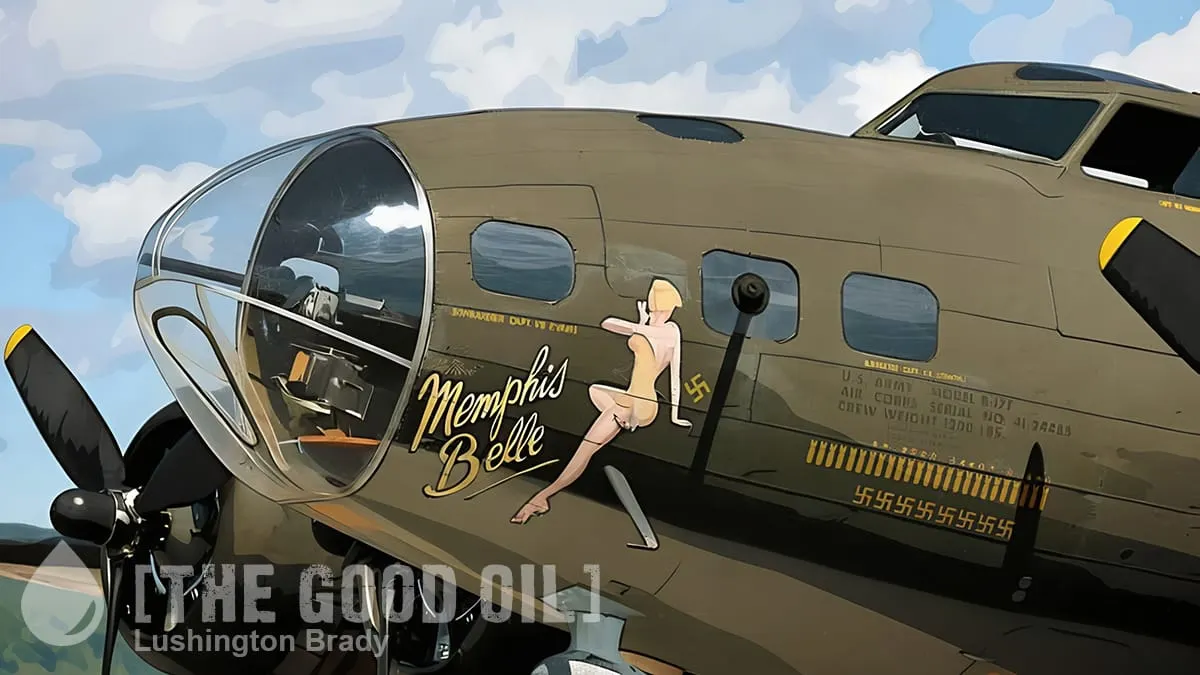
That quiet stoicism stands in stark contrast to the chest-thumping glamour Hollywood prefers. The Memphis Belle was a Boeing B-17F Flying Fortress, built in 1942. Morgan named it after his girlfriend from Memphis, Tennessee. Pin-up artist George Petty’s illustration from Esquire graced the fuselage.
The crew – Morgan, Hanson, Evans, Verinis, Leighton, Scott, Adkins, Loch, Quinlan, Winchell and others who rotated through – faced flak, fighters and freezing terror at altitude. Dozens flew aboard over time – no single airman did all 25 missions.
They had a mascot, a Scottish terrier named Stuka, who wisely skipped the combat runs. The odds were savage. The Eighth Air Force lost one bomber every 18 sorties. Roughly one in five airmen died. Yet the Belle beat the reaper. She took damage on seven missions. Tail gunner John Quinlan recalled a bullet passing through his compartment:
“A bullet from an enemy airplane went right through my little compartment [...] If I had still been leaning forward in shooting position that bullet would have gone straight through my leg.”
And radio operator Robert Hanson once said, “We have been in some pretty tight spots. There was the time that six Focke-Wulfs appeared from nowhere, and all six cut loose on us… and [we] had to slug it out with them.”
On May 17, 1943, the Belle completed her 25th mission over Lorient, France, and headed home. General Jacob Devers told the crew they were now on perhaps their most important mission: selling the war effort to a war-weary public. The subsequent bond tour, with 30 stops, turned the men and their plane into national icons. Stuka was billed as the ‘11th crew member’. A 1944 documentary captured the tension of the penultimate mission; a 1990 Hollywood film, starring Harry Connick Jr, took further liberties for drama.
“We were simply young men who flew bombing missions and played poker and looked out for each other and maybe drank too much and chased too many women sometimes, but who had dreams of coming home and resuming decent, ordinary lives.”
Morgan’s words cut through the myth-making. These weren’t superheroes. They were ordinary men doing an extraordinary and terrifying job in an age when stoicism was expected, not performed for the camera. The real Memphis Belle endured because of skill, luck and the grim professionalism of men who understood the cost.
After the war, the plane languished. Bought by Memphis, it sat exposed, vandalised and stripped of instruments. In 2005 it moved to the National Museum of the United States Air Force in Dayton, Ohio. After painstaking restoration, it stands today as a genuine relic.
The Memphis Belle’s story reminds us why the Greatest Generation earned that title: not through cinematic pyrotechnics but through quiet endurance. They faced flak and fighters knowing the odds favoured the Reaper, yet pressed on. In an era when discomfort is called trauma and every minor slight demands therapy, their matter-of-fact bravery feels almost alien.
Modern retellings prefer drama over dignity. But the real tale needs no embellishment. A battered bomber, a crew that simply got on with it and a nation that understood sacrifice. That’s the story worth remembering.
The Memphis Belle and her crew didn’t need Hollywood to make her legendary. She earned it the hard way: 25 times over.