

Simon O’Connor
Husband, step-father, foster dad, and longtime student of philosophy and history. Also happen to be a former politician, including chairing New Zealand’s Foreign Affairs, Defense, and Trade Committee.
Having recently left London, I found that much of the press coverage was consumed by the murder of former politician Ann Widdecombe. I don’t know how much coverage this has received in New Zealand, but the story is deeply shocking. What is equally disturbing – beyond her tragic death – is how the media, some politicians, and the police have chosen to respond. From blatant double standards in revealing the suspect’s identity to stern warnings against public speculation – and even outright celebrations of her death – the reactions highlight a growing cultural decay in Britain and across the broader Western world.

For context, Widdecombe is the second Catholic and conservative politician to be murdered in the United Kingdom in recent years. Her former colleague, MP Sir David Amess – also a staunch Catholic and conservative – was murdered in 2021 by yet another Islamist extremist. These killings follow the 2016 murder of Labour MP Jo Cox by a far-right extremist.
I won’t detail Ann’s life at length – a quick online search will fill in the details for anyone curious. In brief, she was 78 years old when she was killed in her home in Devon. She had a long political career: starting as a Conservative MP, serving as a minister under John Major, later becoming a member of the European Parliament, actively supporting Brexit, and eventually joining Reform UK. She was unapologetically Roman Catholic and conservative and articulate in defending her views on abortion, euthanasia, and social issues. She even appeared on Dancing with the Stars, which made her a household name.
Tragic as her murder is, the handling of the situation has been equally troubling.
Within hours of the attack, police and media outlets rapidly reported that the primary suspect was a “young, white male”. Heavy emphasis was placed on his ethnicity – presumably to head off public anxiety surrounding migration, a dominant debate in London and across Europe and very evident during my current visit. Oddly, despite the initial publicity, that suspect was released and replaced by another, whose identity as a “young, white male” was similarly plastered across headline coverage.
This stands in stark contrast to how authorities respond when a suspect belongs to a different demographic. In those instances, the public is instantly urged not to speculate. In fact, police hesitancy to release suspect details has become so predictable that delay itself signals the offender’s background to the public.
While authorities quickly publicised the suspect’s description, police and media outlets simultaneously insisted there was “no room for speculation” regarding motives. I would suggest speculation is a natural human response. Early suggestions that the murder might be politically motivated were met with official derision, yet counterterrorism police have just been called in to lead the investigation.
To be clear: baseless rumour has little value. But in a free society, citizens are entitled to ask questions, notice patterns, and consider potential motives. Police can easily conduct a thorough investigation regardless of public discourse.
The underlying double standard is what frustrates people. Consider a New Zealand example: after an arson attack on a building used by the LGBTQI+ community in Tauranga a few years ago, media and activists immediately speculated on motives, jumping to declare it a hate crime. The courts later established that the building’s occupants had nothing to do with the arsonist’s actions, yet that initial speculation was welcomed and widely amplified. Speculating on the murder of a conservative politician bludgeoned in her home is deemed unacceptable; doing so for progressive causes is actively encouraged.
Even worse than these double standards are the reactions of those celebrating Ann’s death. While mostly confined to social media, some prominent figures openly welcomed the news. Veteran gay activist, Peter Tatchell, posted on X that her death was acceptable because he viewed her as a bigot. To his credit, he later deleted the post, but the incident reveals a toxic reality: a growing subset of society believes holding opposing political views strips a person of their right to life.
We see this same mindset among those who excuse or celebrate political violence – whether justifying Antifa, condoning the murder of a health insurance executive in New York, or supporting Pro-Palestine lunatics (excuse the tautology) who broke a female police officer’s back with a sledgehammer during a protest. It remains unclear how crippling a police officer advances peace in the Middle East, but, to those driven by ideological fervour, the end justifies any means.
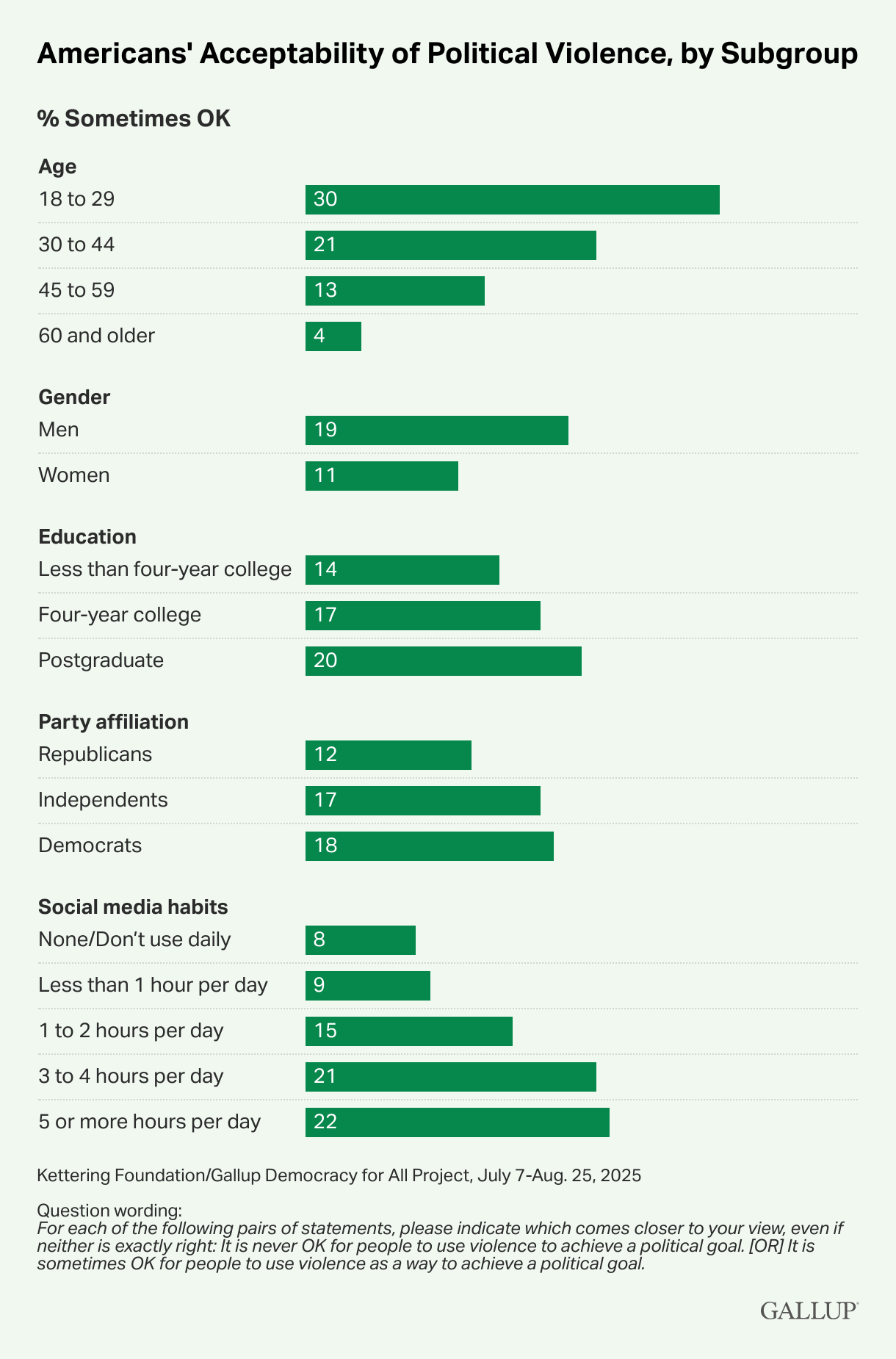
This dangerous impulse is growing across the West. Polling from organisations like Gallup and YouGov shows an increasing tolerance for political violence, particularly among younger demographics. Between 25 per cent and 30 per cent of young respondents now indicate that political violence can be justified – provided it serves their preferred causes.
As I’ve written previously, these are people from the pronoun class. They will celebrate a politician’s murder or condone violent protests – but the moment someone uses the wrong pronoun, they burst into tears (figuratively and literally).
The pronoun classSimon O’Connor 14 May 2025 Read full story
A final detail encapsulates the state of media coverage in the UK. A BBC political editor, commenting on Ann’s career, felt compelled to add: “Let’s be clear – some of her views were regarded by some as deeply offensive. It is for you as a reader to come to your own view about her views.” It seems lost on the BBC that people holding traditional beliefs might find progressive viewpoints equally offensive.
Here lies the heart of the problem: too many have forgotten that in a democratic society, debate must be settled through words – not bullets, bats, and bludgeons.
This article was originally published by On Point.






![[The Good Oil] Stuff Up of the Day](https://storage.ghost.io/c/31/f4/31f4e20a-0315-499e-83ff-139e8eab53bf/content/images/size/w1304/format/webp/2024/09/Stuff-up-image-1.webp)
