Steven Tucker
Steven Tucker is a journalist and the author of over 10 books.
What precisely is Nigel Farage supposed to have done so very wrong, financially speaking, right now? In my experience, most people, when asked, don’t really know, their answers generally falling into replies like ‘Taking bribes’, ‘Money laundering’, ‘Stealing cash’ and ‘Fiddling his expenses’. None of these assumptions are correct. The disappointingly (to some) mundane truth is that Farage is facing no criminal inquiries whatsoever.
The main accusation is that he accepted a £5 million gift from Thai-based cryptocurrency tycoon Richard Harborne, which Nigel says was intended to fund his personal security so he didn’t end up dead like Ann Widdecombe. This is not in any way illegal, even if Farage subsequently decided to spend Harborne’s cash on something else entirely, like a new house, as some allege. But, even if Farage blew it all on buying up an entire street, Harborne gifted him the £5 million with no strings attached, in gratitude for Farage’s role in Brexit, so he would have been within his rights to do so.
What is at issue is why he didn’t declare Harborne’s gift to the relevant parliamentary authorities. Farage says it is because it was intended as a personal gift, not a political one, received before he was elected as an MP, thus making it exempt from public declaration under Commons rules. This assessment is apparently correct (or at least arguably so), but Nigel still faces an investigation from the Parliamentary Commissioner for Standards because some sceptics guess he in fact pocketed some of Harborne’s cash after deciding to stand to be an MP in Clacton, which would indeed be against the rules. Even if this is so, however, the main allegation here is essentially that Nigel Farage didn’t fill in some forms properly.
Dirty laundry
If this administrative failing does turn out to be true, then Farage was stupid, because he must know perfectly well that his many political opponents would have been ready and waiting to pounce on any such error and paint it in the worst possible light.
The whole push to highlight the story has led to Farage’s popularity slumping in opinion polls, as was always the intention. The actual ‘scandal’ here, if true, seems to me to be slight. But it is very easy to present it all in far worse terms than it actually merits. Here is a July 7th headline from the Guardian, clearly designed to make Nigel sound like a criminal:

The natural assumption likely to be made by most readers would be that Farage himself is suspected of being guilty of money laundering. But, if you read down (much) further through the article, it gradually becomes clear that bankers were concerned about the ultimate source of the money from Christopher Harborne, not that Farage was consciously laundering it for him. As such, as a matter of standard procedure, they had filed a Suspicious Activity Report (SAR) with the National Crime Agency inviting them to, in the Guardian’s own words: “examine the transaction to decide whether there are grounds to investigate it further. It is not the same as a crime report.”
I’m sure it isn’t. But it does sound awfully like one, especially if you only read the misleading headline, which many readers will, because matters like these are extremely technical and very boring.
Nowhere is the anti-Farage mainstream British media stupid enough to commit an act of libel against the man by explicitly accusing him of any criminal activity; if they did, he could sue them, and spend his winnings on another new house. Instead, they imply he is guilty of criminal activities by more implicit and deniable means, as with the Guardian report above.
To show how easy this is to do, I thought it may be interesting to employ similar tactics against our new Prime Minister Andy Burnham. He’s never done anything outright criminal financially, either – but it would certainly be easy to falsely imply he has via misuse of the same kind of innuendo Farage has been facing of late. Here are four key factors which could be highlighted…
1. Associations with convicted fraudsters
Another major funder of Nigel Farage filling headlines at present is George Cottrell, also known as ‘Posh George’, as he is both very rich and an aristocrat. Cottrell is a close advisor of Farage and, in 2024, George provided Farage with certain benefits, like paying for social media experts, and allowing him to stay in luxury London accommodation. As these gifts took place fewer than 12 months before his election, a high-profile investigation by the Sunday Times scolds that Farage should have declared them in the relevant parliamentary gifts register.
But, really, the main implied scandal here is about Cottrell’s life and character: he has a 2017 conviction for wire fraud after promising to launder cash for undercover FBI agents posing as drug dealers, and has since written a related book, How To Launder Money. Although the book is intended to advise law enforcement how to combat money laundering, with all Cottrell’s royalties going to charity, many media reports do not mention these facts. Recklessly, several Reform UK figures, including Farage, ignored the obvious risk of being associated with such a provocative-sounding title and attended the book’s launch anyway.
Worse, Cottrell is now under investigation for allegedly using his mother’s bank account to channel £500,000 in cash to Reform UK bank accounts to circumvent restrictions upon political donations from foreign residents, as he happened to be living in Montenegro at the time – allegations the pair deny. Again, if this is true, it would be a crime of the Cottrells, not of Farage, but how many people are going to read closely enough to realise this is all mere guilt by association?
When it comes to employing persons with convictions for fraud as close advisors, however, Andy Burnham is equally guilty. This convicted felon would be Louise Haigh, the irritating Labour MP with dyed-red hair due to be appointed Chancellor of the Duchy of Lancaster by Burnham as a reward for having taken substantial charge of his campaign during the recent Makerfield by-election.

Haigh was forced to resign from her previous transport secretary role in 2024, after it emerged she had a prior conviction for falsely claiming her work mobile phone had been stolen during a street mugging. However, a court found she had invented this claim to nudge her employers into buying her a flashier newer model, at a cost of £1,249, albeit she now disputes some of this. So, both Farage and Burnham currently have convicted fraudsters in their retinues – but only one of them is having this fact relentlessly highlighted by the media on a daily basis.
2. Cash for influence
Christopher Harborne’s £5 million donation to Farage may well have been perfectly above board legally, but did he tacitly expect something in return for it all, such as Nigel promising to pass legislation favourable to Harborne’s own business interests? Without explicitly saying this, thereby avoiding libel prosecution, Anna Turley, chair of the Labour Party, has certainly implied so:
The facts are simple. Farage took £5 million from a crypto billionaire, tried to cover it up and bought an expensive house after taking the money. Not only that, he promised to cut taxes on crypto transactions. It’s open and shut conflict of interest.
In response, we could point to allegations made in local online news outlet the Mill (later picked up by the Spectator, but seemingly no one else) about a man named Dave Roscoe, who runs Manchester’s Planning Department, where he managed the building boom Burnham took credit for whilst mayor of the city.
One of the developers Roscoe handed out most contracts for building work to in his role was Salboy, a Manchester-based construction firm. The Mill says that, during the Covid-19 pandemic, Roscoe did a charitable sponsored workout from his living room, mostly gaining £20 here and there from friends and relatives… oh, and one slightly larger one from Salboy, for £50,000. According to the Mill, Salboy’s donation came only two weeks after it had made a planning application for a particularly controversial new skyscraper in Central Manchester called The Glassworks – an application which thereafter succeeded, thanks to a judging panel advised by Julie Roscoe, Dave Roscoe’s wife.

Maybe this was all completely innocent. Maybe Andy Burnham himself knew nothing whatsoever about any of it. Yet someone of suspicious mind like Anna Turley, but less left-wing, could surely imply that accepting this donation risked looking, in public eyes, like a “conflict of interest” too? It would be simple for a hostile media to use nudge-nudge phrasing to insinuate that Burnham’s Manchester building boom was based upon bribery and corrupt practices, even though there is no actual proof of this at all – just a charitable donation, of unfortunate timing, which could be made to look suspicious, if you really wanted it to, much as with Christopher Harborne’s own purportedly altruistic donation to Nigel Farage.
3. Expenses around housing
The Times has recently unearthed how Nigel Farage is reportedly paying himself £10,000 per year in rent for a media-studio space for broadcasting purposes, over a five-year basis, based in a room in one of his own houses. Apparently, this can have the effect of lowering his yearly tax bill – but in a perfectly legal fashion. Also according to the Times, if this rental sum had come to even a penny more, he would have had to declare it in the Parliamentary Register of Members’ Interests. But it didn’t come to a penny more. So he didn’t have to declare it. So he didn’t. Thus the headline here, rather than “Farage paying himself £50,000 in rent for studio at own property”, could actually have been “Farage does nothing legally wrong” – but that wouldn’t have sounded nearly as suggestive.
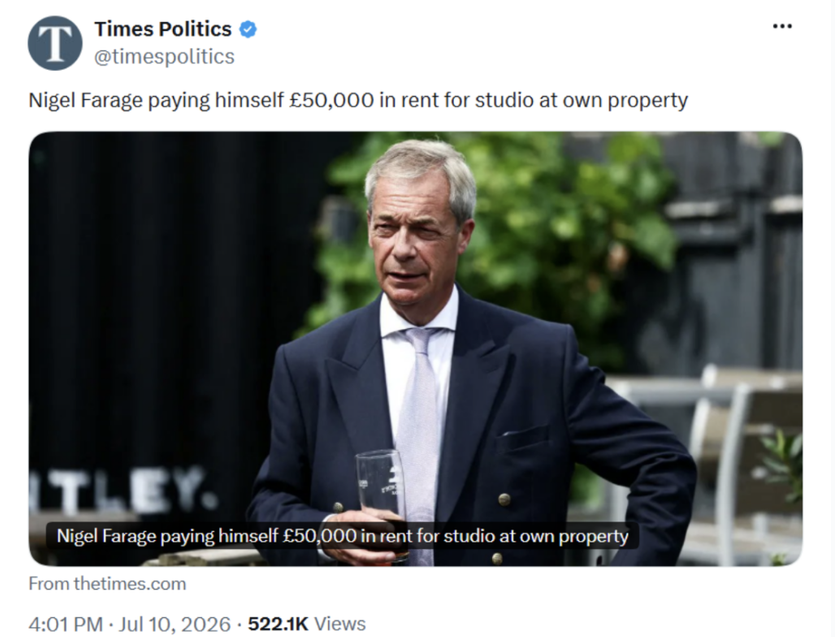
Again, Nigel is probably unwise to do this, and his own worst enemy. He is evidently a very rich man now – he has £5 million from Christopher Harborne, for instance – and doesn’t need to scrabble about to save himself a few quid like this. To ill-informed ears, it probably does make him sound like a con man. But hasn’t Andy Burnham done something similarly dodgy-sounding – though also not in any way actually illegal – regarding his own personal housing and rental arrangements?
In 2005, Burnham bought and renovated a luxury flat in South London, partly using £16,000 of taxpayers’ cash, claiming things like stamp duty payment and a new kitchen on parliamentary expenses. The expense claims were repeatedly rejected by the relevant Commons authorities, leading Andy to write them a jokey note pleading that his wife might divorce him if they continued saying no; eventually, they capitulated. In 2015, whilst still an MP, it was then revealed Andy had bought another flat, which he was charging taxpayers £17,000 in rent payments for, whilst simultaneously letting out his old property to tenants.

Staying with expenses, it seems that in 2007 Andy also tried to claim £19.99 for an IKEA bathrobe, something he apologised was a “genuine oversight” on his part. Burnham did not explain precisely how this “genuine oversight” – which must by definition have involved him deliberately writing the words “x1 IKEA bathrobe, £19.99” on a claims form and then submitting it – worked. At least Farage’s own odd rental arrangements aren’t being placed on the taxpayer’s tab.
4. False accountancy
I think the overall allegations made against Nigel Farage could be said to come under the generic heading of ‘false accounting’. But you could likewise argue Andy Burnham’s entire career as Manchester Mayor comes under this heading too. His fiscal model for running the city appears to have been based upon spending millions and racking up as much debt as possible – £1.34 billion, the most of any regional authority in the land – then getting out before payback time is due.
More specific are certain allegations from the Spectator, relating to Greater Manchester’s ostensibly spectacular economic growth figures over Burnham’s decade in charge. One third of the area’s recent output growth comes from ‘legal and accounting’ jobs, accounting for an astonishing 45 per cent of all national UK growth in that sector. Between 2019 and 2023, supposedly, this boom created 21,000 new such jobs in Altrincham alone. Looking it up, I find that in this same period Altrincham had a total population of 49,680. So, presuming for the sake of simplicity that they all live there, 42.27 per cent of the small, leafy town’s residents are lawyers or accountants. This seems somewhat unlikely.
The Spectator’s best explanation is that a specific large umbrella payroll company is based in Altrincham – one which allows self-employed workers from all over the country to technically self-identify as being ‘employees’ of this firm for (legal) tax-related purposes. However, says the Spectator, most of them actually work in London; they are merely ‘employed’ in Greater Manchester as a paper exercise for complex tax-related reasons – thereby implying that Burnham’s conjured self-image as a financial wizard is built upon a form of false accounting. This whole area of regulation is being cracked down upon by HMRC this year, once again allowing Burnham to escape the consequences just in time.
For my own money…
Neither Nigel Farage nor Andy Burnham appear to have done anything illegal. Yet the entirety of the mainstream media seems currently to be engaged in an all-consuming crusade to make the public believe that one has, whilst leaving the other fellow completely alone.
It’s all just distraction tactics. We should be voting for leaders on the chief basis of their programme, not their probity. To be honest, I couldn’t care less whether Christopher Harborne is paying Nigel Farage £5 million to have sex with him. By this late stage in our nation’s collapse, I just want someone in power who will close the borders, deport the Boriswave, fund the army, destroy DEI, scourge the civil service, scrap Net Zero, ensure free speech and de-communise education and policing. Whether or not they happen to be personally financially corrupt comes way down the list of considerations for me right now. Better a crook with good policies than a saint with terrible ones.
If, in 1940, it turned out Winston Churchill was accepting bribes from Lord Beaverbrook, would you really have wanted him sacked immediately?
This article was originally published by the Daily Sceptic.