Aspidestra
FSB
The irony is glaring, and it should make any serious observer of British politics very uncomfortable.
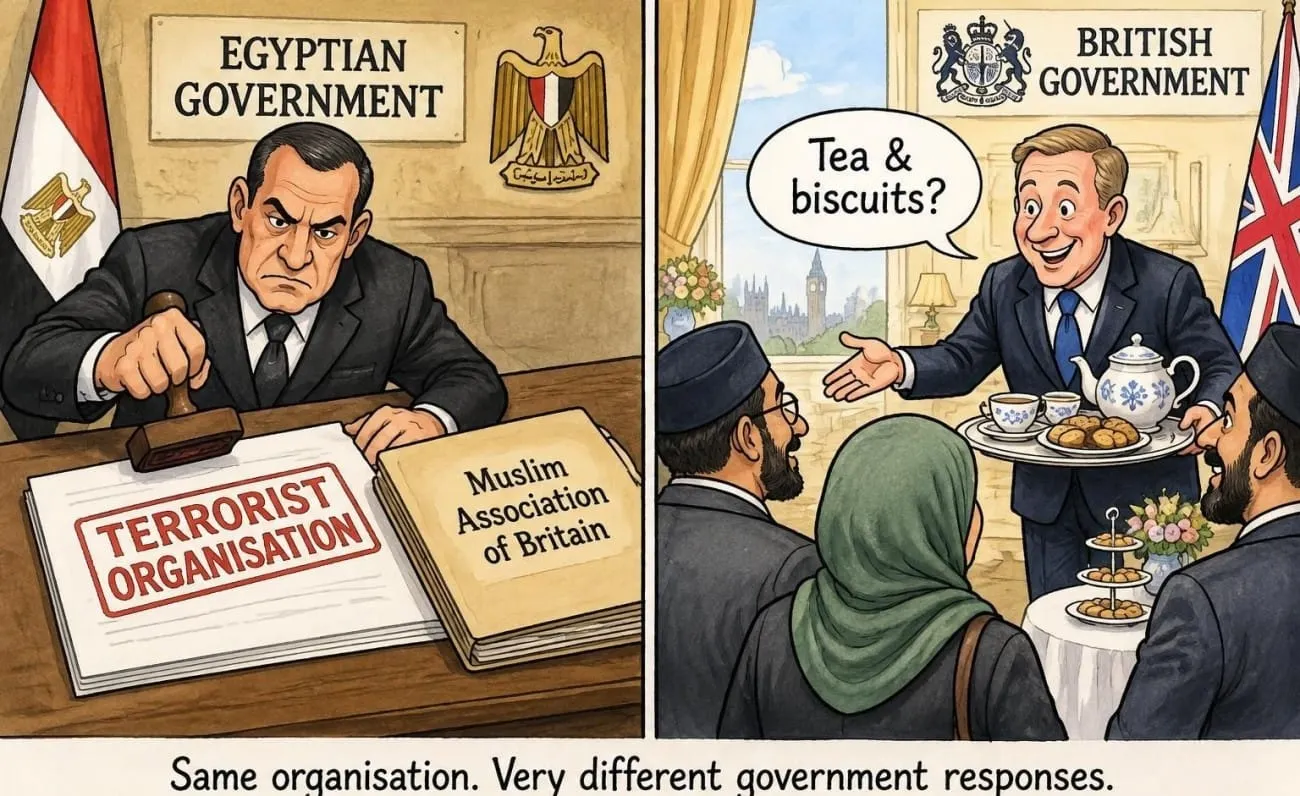
This November an Egyptian court placed the Muslim Association of Britain on its official list of terrorist entities. Thirty-five European organisations and 36 individuals joined it, many of them with documented ties to the Muslim Brotherhood networks that Cairo has spent years trying to dismantle. The UAE had already done the same to MAB years earlier. Two senior figures linked to the group were named personally. Egypt’s ruling classes the MAB as part of a transnational Islamist infrastructure that has repeatedly produced violence, subversion, and political entryism.
Britain’s response has, of course, been the opposite. MAB continues to operate here without restriction. It organises, marches, lobbies, and presents itself as a mainstream community voice. It has co-organised dozens of pro-Palestine demonstrations since the October 7 massacres by Hamas, often alongside Stop the War Coalition. Its banners appear in central London. Its spokesmen give interviews. No proscription order has been issued. No assets have been frozen. No public venues have been closed to it. The organisation that Egypt and the UAE list as terrorist is, in today’s United Kingdom, treated as a welcome participant in civic life. Of course it is.
This is not a minor bureaucratic difference. It is a choice. Successive British governments have possessed the same open-source material that Cairo and Abu Dhabi used: historical connections to Muslim Brotherhood structures in Europe, co-founding links to individuals with senior Hamas backgrounds, and a pattern of activism that consistently soft-pedals or contextualises jihadist violence while maximising political pressure on Western governments.
A 2015 UK review already flagged the Brotherhood’s influence inside MAB. In 2024 Michael Gove named the organisation in parliament as a cause for concern under the new extremism definition, describing it as the British affiliate of the Brotherhood. The designation carried no enforcement teeth. MAB denied the characterisation and carried on.
Labour’s relationship with this murky ecosystem adds another layer. The party has long cultivated organised Muslim networks for electoral advantage. Individual MPs and activists have shared platforms, attended events, and treated groups in this orbit as community partners rather than ideological adversaries. Formal membership lists are harder to nail down, and MAB itself is not the Labour Muslim Network. Yet the broader pattern is clear: engagement continues, consultation invitations still go out, and the political cost of confrontation is treated as higher than the security cost of tolerance.
When foreign governments with direct experience of Brotherhood methods designate the same organisations, British officials look the other way.
The deeper problem is selective seriousness. The British state has shown it can move decisively and ruthlessly when the target fits a preferred narrative. Allegedly far-right individuals and groups face rapid investigation, deplatforming, funding cuts, and public denunciation. Jail. “Hate speech” definitions expand elastically leftward and contract when the ideology in question is Islamist. Protests that feature open celebration of October 7, calls for intifada, or eliminationist rhetoric against Jews are policed with elaborate caution. The same state apparatus that can identify and disrupt allegedly neo-Nazi Telegram channels somehow struggles to treat an organisation already listed as terrorist by two Middle Eastern governments as anything more dangerous than a slightly awkward community association.
This is not neutrality. It is a hierarchy of threats calibrated to political comfort. Islamist networks that reject core liberal assumptions about gender, free speech, apostasy, and the legitimacy of the Jewish state are managed through endless dialogue and partnership language. Ordinary voters who notice demographic change, parallel legal norms, or the intimidation of women and gays in certain neighbourhoods are more readily classed as the problem. The result is a quiet double standard: hard-line Islamist organising is treated as identity politics that must be accommodated; resistance to it is treated as bigotry that must be ‘cracked down on.’
Egypt’s designation does not automatically become British law, and authoritarian regimes use terror lists for their own purposes. That is not an excuse for paralysis. Britain has its own evidence standards and its own history of Islamist plots, grooming scandals, and communal pressure campaigns. The refusal to apply those standards consistently to organisations that purport to sit at the respectable end of the same ideological spectrum is a policy choice, not an accident of law. Foreign partners who have paid a higher price for underestimating the Brotherhood look at Britain’s approach and draw the obvious conclusion: the United Kingdom prefers temporary social peace to long-term clarity, or it shares for some reason the Islamist agenda, in some degree.
An opinion piece cannot force a Home Secretary, an avowedly Islamic Home Secretary, to sign a proscription order. It can only state what is already visible. An organisation listed as terrorist by Egypt and the UAE walks freely in Britain, helps shape street politics, and encounters more official caution than confrontation. Labour politicians continue to navigate that world as if it were ordinary community engagement. The state that finds endless energy for policing ‘far-right’ opinion shows markedly less urgency when the ideology in question carries a theological warrant for supremacy and a track record of producing violence. That is the irony. It is also a warning.
This article was originally published by the Free Speech Backlash.