LilBaP
When will people notice the centre has moved? Both the election and prior polling showed National losing support, most of it shifting to either ACT or New Zealand First.
Outgoing National MP Chris Penk says the party faces “peril at the ballot box” if it loses sight of the centre and gets pulled further right by its coalition partners.
His advice was to stay a centrist party, hold middle New Zealand, and avoid polarisation. That may sound reasonable until you look at what actually happened.
By not really standing for anything, many of the middle-New Zealand voters left National. The proof is now on show – that strategy did not work on 7 November. Many voters thought of National as a centre-right party rather than centre-left.
Stop looking through rose-tinted glasses, look at the electorates. National’s core support sits outside the central metropolitan areas, mostly in agriculture, horticulture, industry, manufacturing and the productive workers of the country, not the students, academia, public servants or union representatives.
Their core voters are the economic backbone of the country and mostly consider themselves middle New Zealand. They are the ones disillusioned with politics and with National not delivering on what it promised in 2023.
They want a government that addresses their concerns. Maybe it’s time for the National strategists to remove their shades.
A simple counter-argument is that National’s real problem is it drifted centre-left, lost conviction on the principles that once defined it, and treated democratic equality as something to be managed rather than defended. Does anyone think voters abandoned the party because it was too conservative?
That brings us to the claim that ACT and New Zealand First are ‘too far right’ for many people. Too far right? By what standard?
Both parties argue for one rule of law that applies to every New Zealander regardless of ethnicity, sex or ancestry. They argue that opportunity should not depend on group or tribal membership and that the state should not organise citizens into racial categories for the purpose of distributing rights, resources or political power.
Thirty years ago those positions sat comfortably inside both Labour and National to one degree or another. They were treated as ordinary democratic assumptions. Now the same positions are routinely described as ‘too far right’.
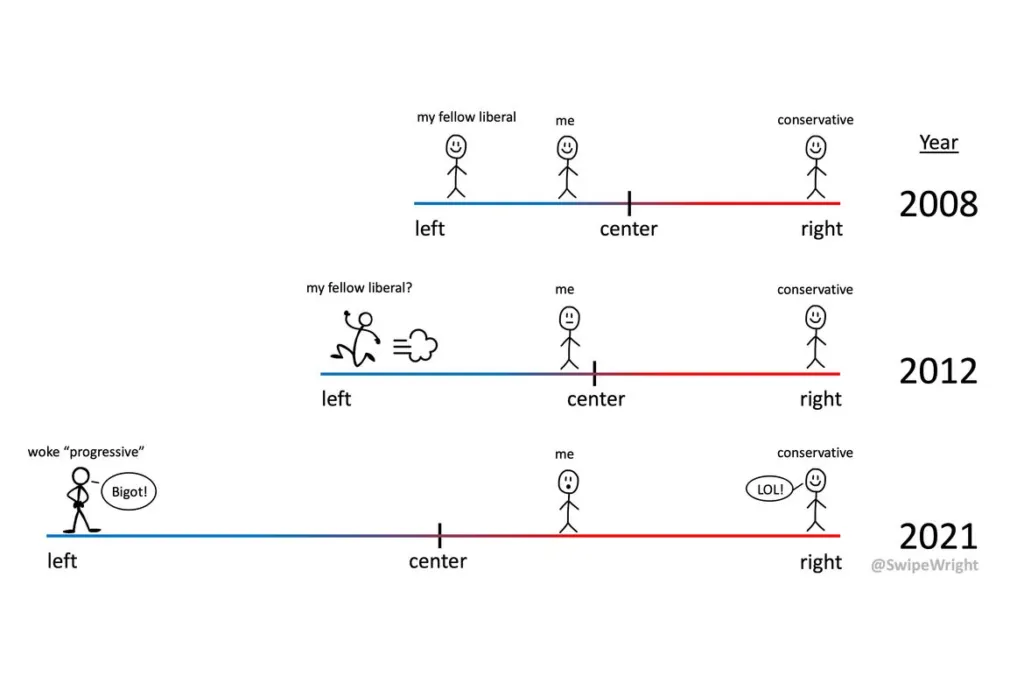
Elon Musk showed this in a simple meme years ago. He stands in the same place while the left end of the spectrum keeps shifting further left. The old centre is then re-labelled as right-wing. The figure has not moved. The positioning has.
This is not an accident. This is how the Overton window moves. Politicians mainly support policies that fall inside this ‘window of political possibility’. The question then is – who keeps moving the window?
Academia and mainstream media have redrawn it, and the political class and their ‘lackeys’ have swallowed it hook, line and sinker.
Now don’t get me wrong. I’m not saying every teacher, journalist, academic or public servant spends every working hour indoctrinating their students or colleagues. But there is an undercurrent that is quietly and steadily working through these institutions.
Courses, reports, news framing and language guides have steadily treated equal citizenship as suspect and group-based preferences as compassionate.
A once-fringe academic idea – something to be discussed as an historical event, such as reviewing Marxism – is now the default vocabulary in many universities. It flows through their students into the media. The nudge has become a solid push and the centre has now moved left.
The general public, middle NZ, has been slower to notice. Many people remain apathetic, don’t like politics, or are simply too busy. They still assume the centre is where it used to be and never notice the nudge.
They have not changed, so they do not consider that the map or centre point may have.
They hear click-bait that parties wanting colour-blind laws are ‘far right’ and accept the description because the people doing the describing sound confident and institutional.
Many voters in the middle are also worried about being labelled – and the stigma today is ‘far-right’. You’re racist, a colonialist, too wealthy, a bigot, a misogynist – any name-calling will do to avoid arguing the facts of the matter.
So the result becomes a quiet redefinition. Positions that used to be ordinary liberal democracy are now cast as the outer edge. Parties that refuse to accept the new map are then treated as the problem.
History offers useful, but uncomfortable parallels. In the 1930s the slide into authoritarian rule in Germany did not begin with tanks and camps.
It began with the gradual normalisation of ideas once treated as marginal, subordinating individual rights to collective racial destiny, capturing institutions for a single ideology, and steadily pressuring anyone who still argued for equal citizenship under law. Early steps were small – the nudge.
Many dismissed them as fringe or temporary. Momentum built and by the time the direction was clear, reversing it required a world war.
The point is not that New Zealand is heading for war. The point highlights how institutional and cultural shifts are easy to ignore while they are happening and difficult and expensive to correct once they have settled in.
A more recent example is Venezuela. In the late 1990s and early 2000s it moved steadily toward socialist policies under Hugo Chávez – nationalisations, price controls, heavy state direction of the economy, and redistribution, framed as fairness – does that have a familiar ring to it?
The language was equity and social justice. The practical result, accelerated under Maduro, was economic collapse: hyperinflation that destroyed savings, mass emigration of millions, shortages of basic goods, and a sharp drop in living standards.
Once one of the wealthiest countries in Latin America, it now sits near the bottom on most measures of prosperity. The people who championed the shift rarely lived the full consequences in the same way ordinary citizens did.
Equal rules for all citizens are being recast as radical by media and academic voices that have moved left, then reported the new location as if it were fixed and neutral.
The voters who still want one law and equal rights for everyone have gone to the parties prepared to say so – is that so radical?
Yet some media and academia champion the narrative that socialism is now the middle ground we should be aiming for – preach it here, but they won’t be here to live it.
They keep the word-salad speak of fairness and equity while the practical effect is to sort citizens by group and treat dissent from that sorting as dangerous.
That is the mechanism. It has worked before – it is working now, at our peril.
The only open question is how many people notice the centre point has shifted before the cost of correcting it becomes much higher.
I will say it again: If you think socialism is so damn good, go and live in Venezuela or Cuba for a few years.