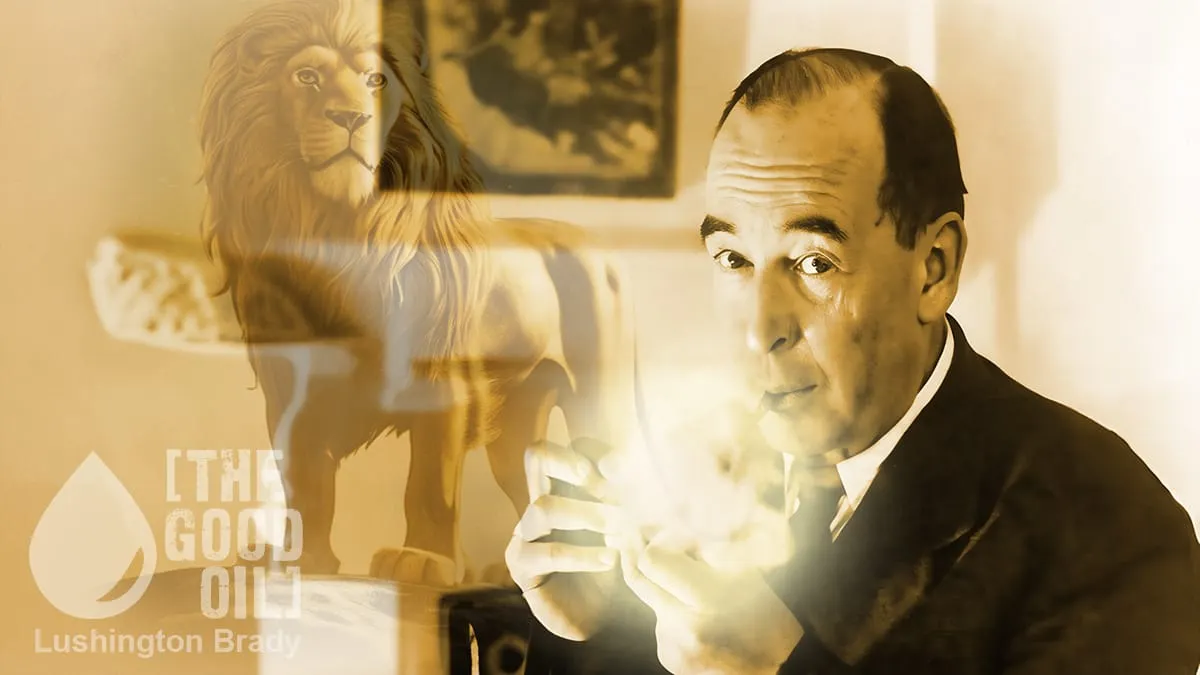
C S Lewis was undoubtedly one of the most popular Christian writers, both in fiction and lay theology, of the 20th century. In the former category, his most famous works are the heptateuch, The Chronicles of Narnia, with the Space Trilogy (Out of the Silent Planet, Perelandra and That Hideous Strength) following somewhat distantly. In both these works, and in many of his other novels, essays and short stories, light often plays a prominent metaphorical role.
For Lewis, light is far more than just the purely mundane phenomena of photons bouncing off objects and impacting retinas. In a repeated and consistent metaphorical device, Lewis uses light to represent inner peace, joy and the profound wisdom that comes from the worship of Jesus Christ, illuminating the world for believers. For Lewis, Jesus is not just the Son, he is the Sun. It’s no coincidence, surely, that the form Lewis took for Jesus to manifest in Narnia, a world of talking animals, was a lion. Lewis wrote, certainly, that the ‘King of Beasts’ was the natural choice for Aslan, but the identification of the lion with the Sun, most notably in the astrological sign of Leo, is also deeply rooted in Western culture.
In the first of the Space Trilogy, Out of the Silent Planet, Lewis depicted outer space as, not cold and dark, but “flooded with a dazzling golden light”. Space, Lewis’s hero Ransom finds, is an “empyrean ocean of radiance”. That radiance is no mere atmospheric effect.
Ransom discovers that the brightness of space is the light of “Maleldil”, God himself, experienced directly and unfiltered. What modern science had taught him to expect as empty void turns out to be the very presence of the divine, unmediated by atmosphere or the veil of the terrestrial. The metaphor is already at work: the further one travels from the fallen world, the more one sees by the light that was always there.
When Ransom lands on Mars, the eldila, those angelic intelligences who govern the planets, are at first invisible to him. Gradually, he begins to see them as like ‘tricks of the eye’, faintly shimmering mirages. As he shrugs off the stultifying effects of Earth (the titular Silent Planet), he begins to see them as “the merest whisper of light… too slight to be to be named in the language of the five senses”. But his companions (or kidnappers, rather), Devine and Weston (surely there’s a pun in there), react to the light of outer space with indifference, even hostility, insisting on wearing dark glasses. Unlike Ransom, they cannot see the eldila at all, insisting that their voices are mere ventriloquism by the ‘native witch doctors’.
But it was in the Narnia books that Lewis used the metaphor of light to its fullest effect, and the strongest and most sustained use of the light metaphor in the Narnia books comes in The Voyage of the Dawn Treader. As the titular ship sails ever eastward toward the edge of the world and Aslan’s country, the Sun grows larger, brighter and more dazzling.
As the characters leave the last islands of mortal lands behind, light ceases to be merely something that falls upon objects. It becomes a physical, tangible thing. The very sea turns into “liquid light”. In echoes of Exodus, where Moses’s face becomes “radiant from speaking with the LORD”, when the young King Caspian drinks the waters:
The King took the bucket in both hands, raised it to his lips, sipped, then drank deeply and raised his head. His face was changed. Not only his eyes, but everything about him seemed to be brightness.
‘Yes,’ he said, ‘it is sweet… it – it’s like light more than anything else,’ said Caspian.
‘That is what it is,’ said Reepicheep. ‘Drinkable light. We must be very near the end of the world now.’
As the other characters drink the ‘drinkable light’, they find their very perception changed. “They could look straight up at the sun without blinking. They could see more light than they had ever seen before.” They find even their appetites changed: none of them feel the need to eat: the liquid water suffices. Nor do they need to sleep. The older members of the company become younger.
Everyone on board was filled with joy and excitement, but not an excitement that made one talk. The further they sailed the less they spoke, and then almost in a whisper.
At last they reach the borders of Aslan’s Country, beyond the edge of the world, a huge, green, perfectly level plain, with the tallest mountains (yet free of snow) they had ever seen, where “at last the sky did really come down and join the earth – a blue wall, very bright, but real and solid”. Here Aslan himself appears to them, as a Lamb. A Lamb so white “that even with their eagles’ eyes they could hardly look at it”.
Elsewhere in the Chronicles of Narnia the same device recurs with deliberate variation. There is the lamp-post of The Magician’s Nephew and The Lion, the Witch and the Wardrobe. Planted by the boy Digory in the newly created world, grown from the remnant of an ordinary London lamp-post wielded by the White Witch as a weapon, it stands as a living, fuelless flame: an undying light that no one lights and no one extinguishes. It is both a signpost between worlds and a promise that order will outlast chaos.
In The Horse and his Boy, Aslan appears to the lost Shasta out of what seems the rising sun. Shasta sees “a golden light” and assumes it is the sun, only to realise “it was from the Lion that the light came. No one ever saw anything more terrible or beautiful.” The light is inseparable from the person of Aslan; it does not merely illuminate, it confronts.
In The Silver Chair, it is the remembered light of the Sun (dismissed by the Green Witch as a lamp grown in a child’s story-telling) that enables the glum but stubborn Puddleglum to break the Witch’s spell. He declares his preference for the dream or make-believe, if it is that, to the supposed dark dreariness of the Witch’s ‘reality’.
“Suppose we have only dreamed, or made up, all those things… then all I can say is that, in that case, the made-up things seem a good deal more important than the real ones. Suppose this black pit of a kingdom of yours is the only world. Well, it strikes me as a pretty poor one.”
Conversely, in The Last Battle, the recalcitrant dwarves sit inside the stable and refuse to see the light and beauty on the other side of the door. They insist they are still in a dark and dingy stable. In an extension of Plato’s ‘Cave’ metaphor, they see only the shadows and refuse to acknowledge the light which casts the shadows. Their blindness is not a failure of eyesight but a refusal of will. Aslan’s followers try to show them the reality around them; the dwarves prefer the darkness they have chosen.
Lewis’s short story sometimes titled “Light” or “The Man Born Blind” turns the same idea into a parable. A man who has gained sight cannot comprehend the concept of light itself. He longs for something he cannot name, a bright shadow drawn into the real world. The story is less about vision than about the human longing for the transcendent God. In the essay “Meditation in a Toolshed”, Lewis draws a sharper epistemological distinction. One can look at a beam of light – analyse its wavelengths, measure its intensity – or one can look along it, and see what it reveals. The first is the posture of detached reason; the second is the posture of experience and imagination.
Aslan’s light is always the second kind. In The Voyage of the Dawn Treader, the voyagers are trapped in the shadows of the Dark Island. It is only when Lucy ‘prays’, by calling on the name of Aslan to help them, that they are at last guided out of the darkness. What first appears as a beam of light resolves into a cross, then into an albatross (speaking softly with Aslan’s voice). The light is a guide and a salvation.
In Mere Christianity, Lewis turns to a secular children’s book to make a related point. He uses the chapter “The Piper at the Gates of Dawn” from Kenneth Grahame’s The Wind in the Willows to illustrate the experience of the numinous. There, the god Pan (in an echo of Aslan, manifesting to animals as the god of nature) appears at dawn, nursing a lost child, and dazzles Rat and Mole as the sun rises. At the moment of greatest intensity he suffuses with the sun and disappears. The animals are left with the sense of having encountered something holy, something that cannot be reduced to the ordinary. Lewis’s point is that such moments are not rare poetic flourishes; they are recognitions of a reality that the everyday world only partially discloses.
What distinguishes Aslan’s light from ordinary physical light is not merely degree of brightness. Physical light in Narnia is created; Aslan’s light is uncreated. The sun, moon and stars illuminate but do not reveal. When Aslan appears, everything else looks pale and shadowy by comparison: not because his light is stronger in a measurable sense, but because it is the source by which other things become real. This is the Platonic move again: Aslan functions as the Sun in the Allegory of the Cave. Physical light is impersonal; Aslan’s light is personal. It comes from a being who speaks, breathes and sacrifices.
In The Voyage of the Dawn Treader, the children do not merely see the light; they drink it, and it becomes sustenance. That is a spiritual act, not an optical one. In The Last Battle, the refusal to see the light condemns the dwarves to not “go further up, further in” and leave the “Shadowlands” behind, for Aslan’s Country.
Light is life-giving and transformative rather than merely revealing. Physical light shows what already exists. Aslan’s light makes things exist or restores them. It is the visible expression of what Lewis calls the Deeper Magic from Before the Dawn of Time: and that Deeper Magic is grace.
The Lion, the Witch, and the Wardrobe relates that the Deep Magic (Narnia’s law of retributive justice, carved on the Stone Table) was set at the Dawn of Time. The Deeper Magic was written before the Dawn, in the stillness and the darkness before Time dawned, before God moved upon the chaotic waters of the primal sea. Grace is not an add-on to the moral order; it is the ground of it. Aslan’s light, when it appears, is the light of that older reality breaking through the created order. It does not compete with the Deep Magic; it contains it.
The light that follows Aslan’s resurrection is inseparable from his willing sacrifice. It breaks law from within, not from outside. The Stone Table cracks when the sun rises after the night of Aslan’s death. The light does not destroy the Deep Magic; it reveals that the Deep Magic was always a shadow of the Deeper one. In Miracles, Lewis insists that grace does not violate the natural order but fulfils and overcomes it from within, the way light passes through a prism without destroying the glass.
Because Narnia is a supposal rather than a strict allegory, Aslan’s light is sacramental rather than merely symbolic. It is a real event in that world’s physical order, just as Christ’s presence is genuinely physical in ours. The light from his mane does something; it does not merely mean something. Darkness in Narnia is a privation, the absence of that light, not a rival power with independent existence. This mirrors the Johannine claim that the light shines in the darkness and the darkness has not overcome it. The White Witch’s winter is the withdrawal of Aslan’s light, not the triumph of another source.
That is the consistent claim across the Narnia books, the Space Trilogy, the short stories and the essays: light is more than mere light.
Physical light can be studied as an object. Aslan’s light leads the eye onward. It is eschatological: it points forward. The children’s journey toward Aslan’s Country is a journey toward more light, not merely brighter light. In the end, the light is not something one looks at in order to master; it is something one looks along in order to see.