One of the most memorable scenes in the movie Jaws is Robert Shaw’s Indianapolis monologue. In the first case, it’s a riveting performance by Shaw: his character’s dislike of Hooper (Richard Dreyfuss) was intensified by Shaw’s personal loathing of Dreyfuss, off-screen. Secondly, it introduced many of us to a real-life horror story that had been all-but forgotten after WWII: the sinking of the USS Indianapolis.
In 1945, the USS Indianapolis completed its top secret mission of delivering atomic bomb components to Tinian Island in the Pacific Theater of World War II. The heavy cruiser was sunk on its way to join a task force near Okinawa. Of the ship’s 1195 crewmembers, only 316 survived the sinking and the subsequent time adrift at sea in the middle of nowhere. Among the survivors was the captain of the Indianapolis, Charles B McVay III.
The story of what happened to those survivors over the days following the sinking is the stuff of nightmares.
Three and a half days later, the survivors were rescued from the open water, suffering from salt water poisoning, exposure, hypothermia, and the largest case of shark attacks ever recorded. It was truly a horrifying scene.
For McVay, though, what followed was in many ways even worse.
The horror is what led to McVay’s court martial, one of very few commanders to face such a trial concerning the loss of a ship. Even though the Japanese commander of I-58, the man who actually destroyed the Indianapolis, told the US Navy that standard Navy evasion techniques would not have worked – Indianapolis was doomed from the get-go. Even that didn’t satisfy McVay’s critics […]
McVay would be charged with negligence in the loss of the ship. Even though he was restored to active duty after his court-martial and retired a rear admiral, the guilt of the loss haunted him for the rest of his life. He committed suicide with his Navy revolver on his own front lawn with a toy sailor in his hand.
Among the millions of kids who packed theatres in 1975 to see the movie that would define the ‘summer blockbuster’ for decades to come, was 12-year-old Hunter Scott. Scott was, like all of us, haunted by the story. So much so that he began a school history project about the sinking.
His, though, was no ordinary sixth-grader’s history project.
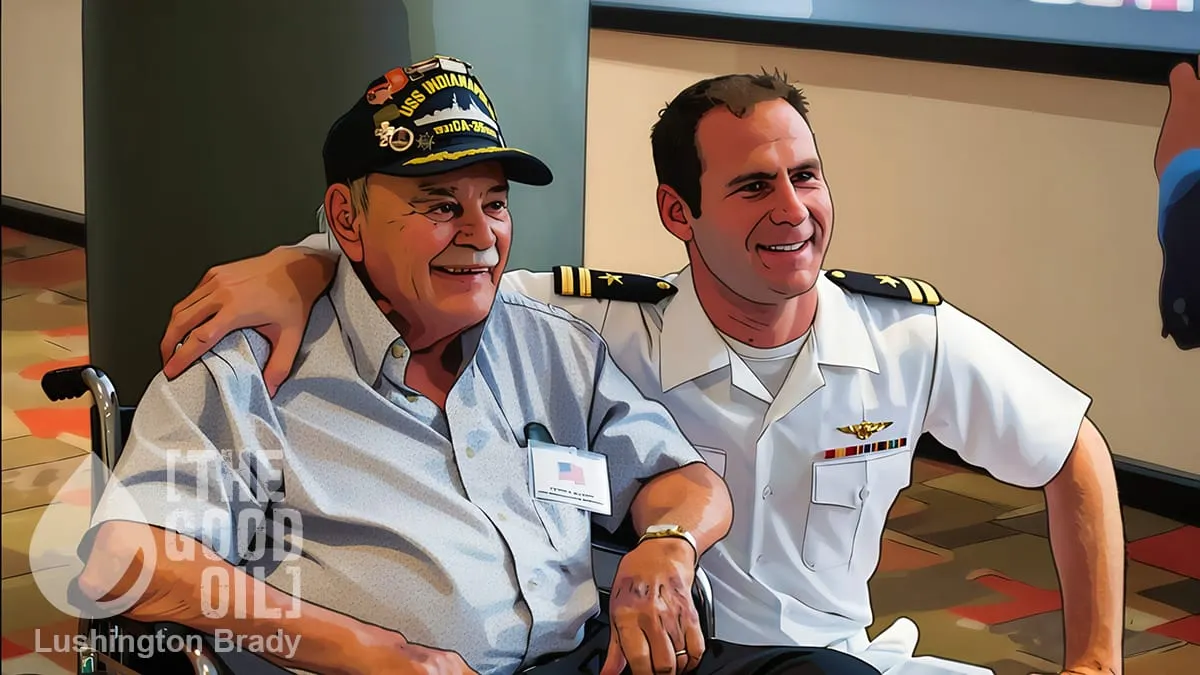
Scott, inspired by the Jaws monologue, turned his National History Day project into a crusade for truth. He interviewed nearly 150 survivors, pored over more than 800 documents and built an airtight case that Captain McVay was not to blame. His school project caught the eye of Congressman Joe Scarborough and Speaker Newt Gingrich. Legislation followed. In 2000, President Bill Clinton signed a resolution exonerating McVay.
Hunter Scott went on to study economics and physics at the University of North Carolina at Chapel Hill, on a Naval ROTC scholarship. After graduating in 2007, he became a naval aviator and served as a flight deck officer and executive officer.
Bonnie Exner, one of Scott’s teachers back in the mid-’70s, later commented:
He was a dedicated student who was on a mission to right a wrong […] I even called my congressman and asked him to help Hunter prove his case. Hunter is to be commended for his determination to continue his mission in spite of some drawbacks and this is part of the reason why he is the leader he is today… THANK YOU FOR YOUR DEDICATION TO TRUTH. JUSTICE AND THE AMERICAN WAY, HUNTER SCOTT.