Table of Contents
Dave Summers
Dave Summers is a sixth form teacher and his name is a pseudonym.
You know who wrote To Kill A Mockingbird, don’t you? Tell me you do. And up to this year the majority of my sixth form students taking part in my Christmas quiz would have done so, also. It was always a nailed on gimme in a test of general knowledge with which – alongside munching our way through a tin of Celebrations – I’ve traditionally finished the year.
Let me be clear here: this is no head scratcher of a King William College Christmas Quiz, that beast of a challenge that the Guardian publishes each year; there is no “Where was the Lionheart incarcerated by der Tugendhafte, whom he had earlier insulted?” in my quiz. No, “What is the capital of India?” is more my level of interrogation in a hastily composed ragbag of questions on geography, history, literature, film and sport. And let me also be clear that I know teenagers have been daft since they first began to pustulate.
I still wince with embarrassment when I recall the time I told my English teacher that in Thomas Hardy’s “The Convergence of the Twain” – his poem about the sinking of the Titanic – he had got it completely wrong: “How could it be an ‘august night’,” I told him, “when the ship sank in April?” Like I say, daft. But something has changed in the general knowledge of our youth, or certainly what they consider to be important or not.
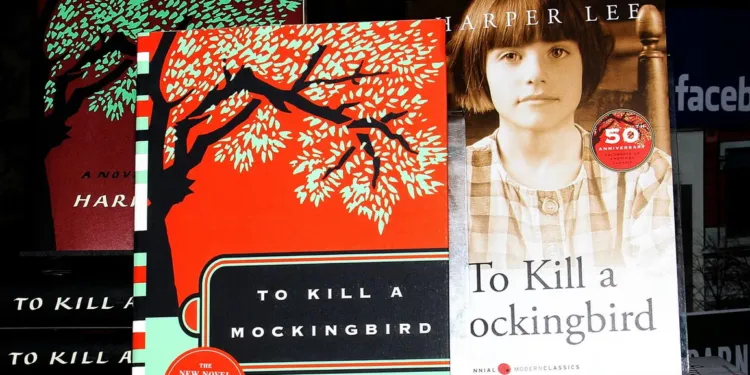
Take To Kill A Mockingbird, for example. Over the years many GCSE students have studied Harper Lee’s coming-of-age novel about Scout, the child narrator, who gradually awakens to the horrors of racial injustice in early 20th century Alabama. Even those who didn’t study it have absorbed its themes and characters through the cosmic resonance of the half of the country that were reading it in their lessons. Over the years, hundreds of students’ faces have lit up when this staple of a quiz question appears, reminding them of the profundity of their first reading. This year, however, only a handful of students across my five groups could name the author. Okay, the syllabus moves on – I get it – but when I read that some educationalists have decreed the novel is now considered ‘problematic’ with its ‘white saviour’ narrative and use of racial slurs, then I can’t but help but despair at how quickly something so culturally significant can be memory holed in the pursuit of progressive ideals.
The history and geography rounds are equally dispiriting. “Who was the prime minister at the beginning of World War II?” fares better than the Mockingbird question, but there are enough blank stares in the room to suggest that what I would consider to be essential historical knowledge is missing. I suspect that if I asked them to name a black nurse from history, they’d all shout, “Mary Seacole!” in unison. The same goes for geography: while my students are no doubt familiar with the looming (for the past 30 years) threat of ice cap collapse and the ‘settled science’ of rising sea levels, few could tell me that the Indian Ocean is located to the east of Africa and west of Australia. There’s an irony here: Ofsted frameworks over recent years have laudably emphasised the primacy of knowledge and ‘retrieval practice’ in the classroom; the problem is, to an ageing educator such as myself, the knowledge our children are being asked to retrieve is banal at best, useless at worst.
A round on film is also revealing of how quickly what was once a shared body of cultural knowledge can disappear over a historical horizon. As a child, as well as queuing round the cinema block to watch Jaws and Star Wars, I spent hours glued to the flickering cathode ray telly in my sitting room, devouring The Third Man, Some Like It Hot, Whisky Galore!, The Best Years of Our Lives, Hobson’s Choice, old films even then, but which still bring me huge pleasure today. These are films that earned their place in the pantheon of brilliance through a shared cultural memory to be passed on to the next generation.
Laurel and Hardy were from the Mesozoic era, but by imbibing the joy of older relatives on the sofa, I felt I was present at some significant cultural event. This was important, I suspected. But ask most teenagers today to recognise anything filmic from before 2020, and their eyes begin to swivel. Anything black and white might as well be the Dead Sea scrolls, inducing near apoplexy. My question, “Who directed Psycho?” is met with universal consternation, and there is much relief at the next question when all can name Olaf as the snowman in Frozen. I tease them by declaring that their holiday homework needs to be to “get a real education” by working through some black and white classics with a large plate of ham and pickle sandwiches on their lap. My class of 2025 has more access to art and culture than I ever did, and this is its problem: in a world where all art is easily accessible on phones or the click of a remote, then nothing is truly valued, nor remembered. I find myself thanking those meagre three TV channels of the ’70s for curating my film education.
Yes, yes – bah, humbug! But I want our kids to know that the Pyrenees separate France from Spain, that Shakespeare left his second best bed to Anne Hathaway in his will, that the capital of Ethiopia is Addis Ababa, that Uruguay won the first World Cup, that those wispy high clouds are called cirrus, and that Great Expectations is the greatest British film. Don’t you?
This article was originally published by the Daily Sceptic.