Table of Contents
Tom Valcanis
Life-long politics tragic, digital marketer and writer. Articles in the Age/SMH, the Big Issue, the Spectator, and editor of alt lifestyle mag Hysteria from 2014–2020.
They say that history doesn’t repeat – it rhymes.
When I was a kid, my old man was really into computers.
That meant we’d putz around with a Commodore 64 (which I may have stomped on), do actual work on a 386SX, then upgraded to an Internet-enabled 486DX a couple of years later. I absolutely loved it.
Before the New Tax System, computers were subject to some hefty levies. Thanks to economies of scale prices plummeted and stabilised. Ten per cent GST on the whole kit and kaboodle, not 48 per cent on, hell, I don’t know, silicon.
Back then, if your brand spanking new PC could play Doom, one of the early first-person shooter video games (if you’re too much of a boomer to understand, it’s the game you all pinned Columbine on) there was no chance in hell it would play Quake, a giant leap for graphics just two years later.
In the ’90s, obsolescence didn’t need planning. It was a natural consequence of Moore’s Law, named for Intel engineer Gordon Moore. He said that transistor counts in central processing units doubled every 18–24 months. In between Rachel and Ross debating whether they were on a break, the blazing fast superchip powering your beige box might have turned into a Dorito.
The government keeps distorting the market, data centres will become wholesalers of graphics cards and RAM
Malcolm Turnbull knew how money worked, investing in one of our first ever internet service providers, OzEmail, which sold internet access by the hour. It set you back $5 an hour (or $2.50 after 12am.) In today’s money, that’s $10.69. Logging on at 28.8kbps, it meant 10 minutes checking your email and another 45 downloading a thumbnail sized, minute-long video of Pamela Anderson and Tommy Lee enjoying a pleasant sun-kissed boat ride. Surfing the net was prohibitively expensive.
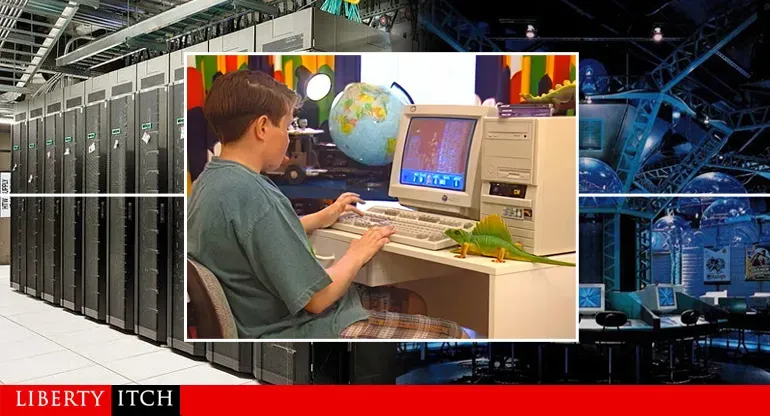
But we could avail ourselves of net cafes. These were businesses that invested in computer and coffee hardware in bulk, and sold internet access by the hour or half-hour. It was cheaper than sinking money into your own setup, especially when its depreciation schedule was just a big ‘yes’.
Somehow, I think in the age of “you’ll own nothing and be happy”, this will all make a comeback. Not in a pleasant, coloured-squiggle décor and big mug of latte kind of way either.
Hapless PC gamers like me have been subject to price slings and arrows for the last decade, despite mere incremental gains in computing power. Moore’s Law is dead. Remember that two-year obsolescence gap? My ten year old CPU can still play AAA games at 1440p (just pretend you know what that is and gasp.) We were subject to the cryptomining squeeze in 2018, the semi-conductor shortage during 2020–2022, and now we’re battling AI slop merchants to procure two crucial computing components: RAM and graphics cards.
Graphics cards mean rendering scenes of space aliens getting their heads blown off with lasers in photorealistic detail becomes possible in real time. It also powers Large Language Models and Stable Diffusion – the computing that powers Generative AI and machine learning.
Of course, those billions of parameters need storage. Hence, they’re stored in RAM. They need lots of it. With data centres hoovering up all the RAM they can slot, prices for consumers have soared – up 171 per cent year on year. One of the world’s leading manufacturers, Micron Technologies, has pulled out of the consumer market altogether, chasing those venture capital and government megabucks before it all evaporates.
The Australian Government, in its infinite stupidity, is also looking to dump money into AI data centres through its National AI Plan. “The government is backing local capability through significant investment in sovereign AI for the public service,” it says.
Is this how the real robot apocalypse begins? A Centerlink clanker issuing grants to NDIS “Learing” Centres in my name, forever? Naturally, the government is handing over billions of our cash to something that’s yet to return any investment, anywhere, ever.
It was cheaper than sinking money into your own setup, especially when its depreciation schedule was just a big ‘yes’.
They also need to pick a lane. Do y’all want Net Zero or data centres? I’ll break it down for the cabinet in terms they can understand: Those data centres you want – they use lots of electricity. Either you build nuclear or you keep hoping the sun shines at night. I know which option they’ll pick, of course.
I’m not saying AI is a massive grift – but I’d hope any money I put into it at the start will make more at the end of it. The 1960s saw a massive AI boom, then a 1980s ‘winter’, and now we’re having another ‘boom’. If there’s a winter, it might resemble the one at the start of The Terminator. Oh man, how far away IS 2029 again?
If the government keeps distorting the market, data centres will become wholesalers of graphics cards and RAM, renting it out to us by the hour just like they used to with internet. Computing as a subscription service – you know they all want it. Hell, it fulfills their dual-pronged authoritarian fever dream of monitoring our thoughts as well as our wallets.
The superhighway to serfdom terminates at the Comrade Albanese Information Commune, where we’re allocated three hours of Sims 4 gameplay per month provided our player characters all look different and earn the same salary.
My old man? He hung up his BASIC chops a long time ago. He’s content watching YouTube on his iPad while MasterChef plays on TV. It must be bliss.
This article was originally published by Liberty Itch.