Table of Contents
Everyone is grimly familiar with the tiresome ritual of so-called ‘Welcome to Country’. Just as tediously annoying is the endlessly-repeated, fatuous claim of ‘World’s Oldest Living Culture’. It’s yet another a load of bollocks. Ignoring the continuing African peoples who long pre-date the Aborigines’ claimed arrival in Australia (another claim that is more and more loaded with towering bullshit), the fact is that not a single Aboriginal Australian today lives an authentically pre-1788 culture. Not even close.
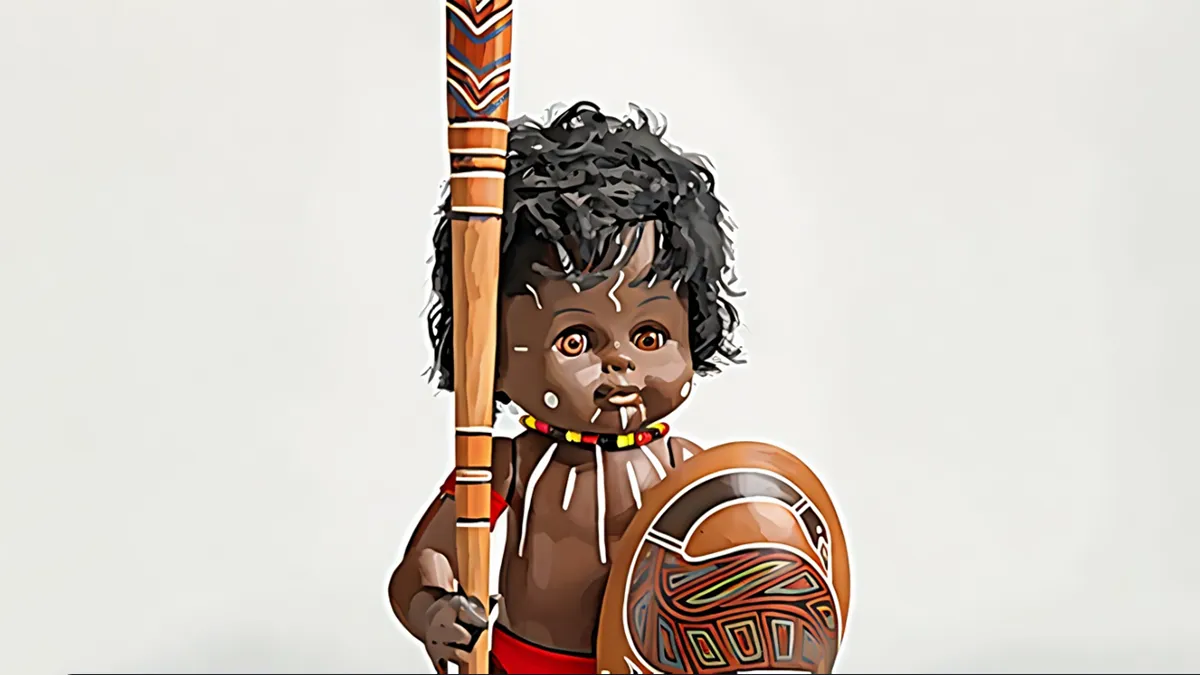
Like ‘Welcome to Country’, what’s passed off today as ‘Aboriginal culture’, from dot paintings to paleface ‘aunties’ and ‘uncles’ waving gum leaves around, is a modern sham. Cultural kitsch that’s about as authentic as Elizabeth Warren’s Native American ancestry.
For all the blatherskite about ‘truth-telling’, the last thing the Aboriginal Industry really wants is the truth.
Why is the Aboriginal industry so determined to hide the truth? Why are they so eager to fabricate the past, as well as present, losing all credibility in the process?
It comes down to guilt-driven Australian politics. By way of justifying the destruction of archaeological material and reinventing the past, the Aboriginal industry offers reasons such as that the truth is “offensive to Aborigines”.
Mostly because the truth is that genuinely traditional Aboriginal culture was shockingly violent, which should be no more offensive to Aboriginal Australians than the plain fact that some of my distant ancestors were cattle-stealing savages who decorated their wattle-and-daub huts with the heads of their enemies. The past is what it was and can’t be changed.
One of the books deemed as offensive for containing accurate information about Australian prehistory is Cape York: The Savage Frontier by Rodney Liddell. It was self-published in 1996 when political correctness was on the rise. The book was the author’s response to academics who were “deliberately lying and distorting the truth on Australian history in the name of political correctness”. Attempts to ban the book failed, and according to Liddell, The Savage Frontier is now more popular than ever. Political attempts to censor books and similar forms of research or other publications often have that effect.
Liddell was attacked for almost every chapter in the book. Speaking about the Aboriginal invasion of Australia, about the “sacred customs” of infanticide and cannibalism performed openly until just a few decades ago, or about morphological analysis of skeletal remains was deemed unacceptable under the new political regime.
What is notably different between Aboriginal Industry troughers and left-wing academic historians, and the work of historians like Rodney Liddle and Ted Strehlow, as well as verboten figures from the past like Daisy Bates and George Grey, is that they were intimately familiar with real traditional Aboriginal culture for decades. Much later, the sense that this was a fast-vanishing culture moved them to document what they could, while they could. And they did so with unflinching honesty.
What the authors have in common is that they acted out of love for Aboriginal people, dedicated their lives to examining and recording the Stone Age culture as they witnessed it, kept helping the tribes and advocating for them, and urging the government of the day to treat the tribes with more compassion.
Ted Strehlow, born on an Aboriginal mission in 1907, learned to speak Aranda before he learned English. He was loved and embraced by the tribe as being an Aranda man himself. Seeing the tribal customs dying out, Strehlow documented Aranda tribal life for 40 years. Along the way he amassed – with the elders’ blessings – “what is possibly the greatest collection of Aboriginal artefacts and other items ever”.
Much like Grahame Walsh, who documented pre-Aboriginal rock art and was attacked by the Aboriginal industry for his findings including that there was a more technologically advanced people inhabiting Australia long before the arrival of the Aboriginal tribes, Strehlow too fell out of favor when he asserted that ‘real’ ancient culture was well and truly extinct and was replaced with a fake culture as devised by the Aboriginal industry […]
Strehlow started recording the Aranda language in 1932. This was the first methodical study of any Aboriginal language ever undertaken. He recorded the customs, ceremonies, thoughts and attitudes of the Aranda people – paying equal attention to the good and the bad, the positive and the negative, and accurately described the lives of the Central Desert tribes. The book was considered to be a brilliant work, and a pioneering study that provided a great insight into a dying culture.
The Aranda elders were appreciative of his work to the extent they said he was the only man they can fully trust with their important tribal objects. They kept bringing him archaeological and ethnographic items, and explained that the old customs were dying and the new generation of tribal men can no longer be trusted. Over forty years, on top of recording images, songs, and stories, Strehlow kept building his collection of sacred ceremonial objects and artistic items given to him by the tribal chiefs […]
The collection consisted of the photos, songs and stories he gathered, as well as the archaeological and ethnographic items entrusted to him by the Aboriginal elders.
But in the final years of his life, Strehlow came up against the rise of a radicalised, mostly city-based ‘Aboriginal Industry’. Exactly the people the elders had warned him against. When these ‘nouveaux Aborigines’, as Strehlow’s wife called them, began to demand the ‘return’ of his collection, he dismissed them as fake pretenders.
Strehlow refused, saying that to do so would be contrary to the promise he had given the real Aranda chiefs. Also, he pointed out that by the 1970s the Aranda culture was extinct, with all spirituality evaporated and customs forgotten. He enraged the Aboriginal industry even further with his objections to what had become known as “Aboriginal art,” claiming that genuine ancient art had turned into national kitsch, with all authenticity gone.
Seeing the Aboriginal industry aggressively promoting an invented culture, Strehlow simply said it’s all a lie, and started publishing his own records of tribal customs. For this defiance, Strehlow – who was until the 1970s regarded as the ‘last Aranda man,’ the last person knowledgeable about real Stone Age tribal culture – fell into disgrace. When he decided to publish some of the photographs from his personal collection, under the title “Secrets of the Aranda” in two issues of People magazine in 1978 and provided the German magazine, Stern, with 211 color slides and 78 black and white photographs – he became the enemy of the state. The Aboriginal industry was enraged and People magazine which published his material was banned.
Strehlow willed the entire collection to his wife, Kathleen Stuart Strehlow. The modern Aborigines, he stated, “no longer have any knowledge of the authentic tribal culture, since the elders and guardians of the secrets were all dead and that whole world is finished and will never come back”.
While Strehlow, and Kathleen succeeding him, set up a museum, the Strehlow Research Foundation, which opened just hours after his death in 1978. Strehlow’s last words were said to be Aranda. Kathleen took over the stewardship of the centre, but the persistence of the ‘nouveaux Aborigines’ was such that a government act was passed in 1984 that effectively gave bureaucrats the power to impound what was rightly private property. In 1991, the South Australian government seized most of the collection. At the same time, Kathleen Strehlow was sacked from the foundation her husband had founded.
And so, a bowdlerised culture of romanticised primitive-kitsch is passed off as ‘the world’s oldest living culture’.