
Table of Contents
Greg Bouwer
IINZ
In 2005, Israel withdrew from Gaza completely.
Every soldier left. Every settlement was dismantled. Even Jewish cemeteries were exhumed and removed – an act with no strategic value, undertaken solely to ensure that Gaza would be free not only of Israeli rule, but of all Jews, alive or dead.
That withdrawal was meant to end the conflict. It did not.
Nor were these years devoid of alternative pathways. Prior to Hamas’s takeover – and intermittently even after – Gaza participated in shared economic initiatives, cross-border employment arrangements, and internationally supported infrastructure projects intended to reduce dependency and stabilise civilian life. Tens of thousands of Gazans held permits to work inside Israel as late as 2023. These frameworks were not abandoned out of ideological hostility, but progressively curtailed as violence, tunnel construction, and organised attacks rendered them untenable.
What followed matters. Initially, Gaza’s borders were relatively open. Restrictions tightened later, in response to events that cannot be erased from the record: Hamas’s electoral victory in 2006; its violent coup against the Palestinian Authority in 2007; thousands of rockets fired at Israeli cities; and the discovery of extensive tunnel networks built for cross-border attacks. Egypt imposed parallel, and often harsher, restrictions on its border for the same reasons. These measures were not acts of punishment or colonial control, but reactive security responses to documented and escalating threats.
Nearly two decades later, for the first time since 2014, there are no Israeli hostages left in Gaza. The final unresolved case was not a living captive, but a body: Police Officer Ran Gvili, murdered during the October 7 massacre and taken into Gaza.
His remains have now been recovered and positively identified.
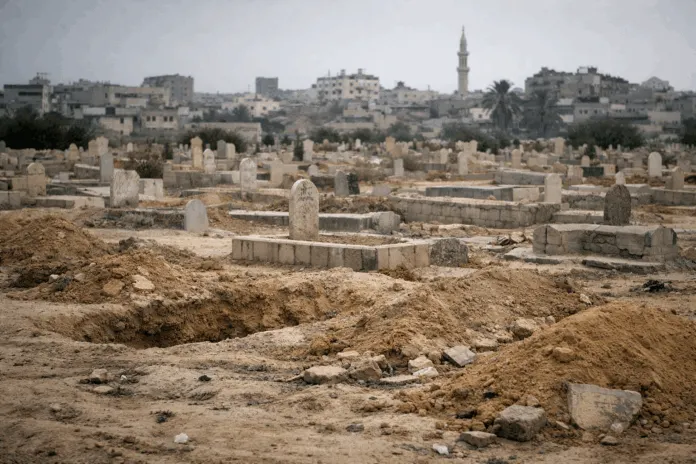
They were found in a cemetery in eastern Gaza City.
This was not a chance discovery. Israeli intelligence had long indicated that Gvili was buried at that site. When new intelligence last week reinforced that assessment, IDF forces launched a focused search operation. Over a weekend, hundreds of graves were exhumed at a Muslim cemetery. By the conclusion of the operation, approximately 250 bodies had been examined.
Military dentists confirmed Gvili’s identity using dental records. Fingerprints and additional forensic testing removed any remaining doubt.
What follows from this is precise — not rhetorical.
Hamas knew. Those who buried him knew. Those who maintained the cemetery and processed subsequent burials in close proximity knew.
This does not require the claim that every Gazan knew. Gaza is an authoritarian enclave where information is tightly controlled and dissent is lethal. But bodies do not bury themselves. Graves are not dug unknowingly. Cemeteries do not become hiding places by accident. Knowledge of this burial was necessarily shared among those who carried it out and those who facilitated or enabled it.
The question is not whether all Gazans knew – but how many knew, suspected, or chose not to ask, and why silence was enforced or accepted.
Hamas now claims it “provided information” that enabled the recovery. Regardless of how that information was obtained, the claim itself establishes that Hamas or its agents had knowledge of the location of Gvili’s remains and exercised control over their concealment. Under international humanitarian law, the obligation to respect and return the dead is continuous. Withholding the location of a body, denying timely recovery, and concealing human remains in a civilian cemetery constitute grave breaches of the duty to ensure dignified treatment of the dead and to facilitate their return. This was not cooperation: it was the belated acknowledgement of an unlawful act already complete.
That claim confirms that the location was known, that the concealment was deliberate, and that the body was withheld until it no longer served strategic or propagandistic value. The burial was not an act of dignity. It was an act of desecration layered atop murder – the theft, concealment, and exploitation of the dead.
International law is unambiguous. The mistreatment of bodies, the denial of proper burial, and the use of human remains as leverage constitute war crimes and crimes against humanity. The use of a cemetery — a place meant for mourning and dignity – as a tool of concealment represents a profound moral inversion.
This is not an aberration: it fits a pattern.
In October 2023, Hamas Political Bureau member Ghazi Hamad stated publicly that October 7 would be repeated “again and again” until Israel is destroyed. This was not rhetorical excess: it is consistent with Hamas’s founding charter, its operational doctrine, and its conduct over nearly two decades. Genocidal intent here is not implied – it is declared.
Yet the international response is revealing. There has been no emergency UN session on the concealment of Israeli bodies. No cascade of NGO reports. No campus encampments. No urgent calls for ICC investigations. By contrast, Israeli military actions – often preceded by warnings, evacuations, and humanitarian corridors – have triggered near-immediate legal and political campaigns. Within weeks of Israel’s temporary Gaza pier operation, international bodies and activists were calling for investigations of Israeli commanders. The deliberate concealment of an Israeli officer’s body in a civilian cemetery has generated no comparable outcry.
This is what false moral equivalence looks like in practice.
The strongest evidence that Gaza’s tragedy is not rooted in deprivation but in prioritisation lies in a simple counterfactual: What would Gaza look like if its leadership had chosen state-building over annihilation?
Singapore in 1965 was poorer than Gaza and had no natural resources. South Korea in 1953 was devastated by war. Post-war Europe lay in ruins. All chose development over revanchism.
Gaza, by contrast, received billions of dollars in international aid, amounting to more per capita than Western Europe received under the Marshall Plan (based on World Bank, OECD, and UN aid figures). That aid built tunnels, not universities. Rockets, not civilian infrastructure. Hospitals where tunnel networks and weapons stockpiles have been documented by multiple sources, including international journalists.
Scarcity is not the problem. Choice is.
The usual objections collapse under scrutiny.
‘But the blockade creates desperation.’ Desperation does not explain diverting cement to tunnels or converting humanitarian aid into weapons. Nor does it explain the widespread refusal to provide information in exchange for a NIS 5 million reward per hostage – alongside guarantees of safe passage out of Gaza.
When extreme hardship is genuinely the primary driver of behaviour, people respond to credible incentives that offer safety, mobility, and financial security. The near-total absence of such cooperation is not evidence of fear alone: it is evidence of ideological alignment, social enforcement, or both.
‘But there are no elections.’ Polling by Palestinian research organisations in late 2023 and early 2024 showed majority support for the October 7 attacks, including a December 2023 AWRAD poll indicating approximately 72 per cent support, and a March 2024 Palestinian Center for Policy and Survey Research (PSR) poll showing roughly 70 per cent support. Lack of elections does not equal lack of agency or ideological consent.
‘But civilians are suffering.’ Yes – and that suffering is deliberately instrumentalised by Hamas as a weapon of war, designed to generate international pressure while ensuring the cycle continues.
History offers no indulgence for this logic. Allied bombing did not absolve Germany of responsibility for Nazi crimes. Japanese civilian hardship did not erase accountability for Pearl Harbor. Civilian suffering is tragic – but it does not negate culpability for aggression or excuse societies that embed war crimes into civilian life.
The hardest question must be faced directly: What about the children born into this?
Yes, children in Gaza did not choose Hamas. Neither did German children choose Nazism. Generational consequences are tragic – but unavoidable – when societies embrace ideologies of destruction. Innocence does not obligate the world to perpetuate systems that guarantee another generation of death. Real compassion means dismantling those systems entirely.
Does this mean there is no path forward? No – but it requires abandoning pretence.
It requires recognising that UNRWA – unique among refugee agencies in passing refugee status through generations, creating a population that grows rather than shrinks – perpetuates refugee status rather than resolving it. That educational systems teaching martyrdom must be fundamentally reformed. That no sustainable political arrangement is possible while Hamas governs. And that the international community has not merely failed to resolve the conflict – it has often enabled its continuation.
Israel withdrew. Israel warned civilians. Israel facilitates aid. Israel even removed its own dead.
The question is no longer what Israel must do differently.
The question is what the world will finally demand of those who turn cemeteries into concealment, children into soldiers, humanitarian aid into weapons – and death itself into strategy.
Ran Gvili’s body was buried in plain sight. So is the truth.
FACT vs NARRATIVEGaza, Hamas, and the Concealment of Ran Gvili | |
NARRATIVE | FACT |
| Israel still occupies Gaza. | Israel fully withdrew from Gaza in 2005. Every soldier left. Every settlement was dismantled. Even Jewish cemeteries were exhumed so Gaza would be free of Israeli presence—living or dead. |
| The blockade is collective punishment. | Border
restrictions followed Hamas’s violent takeover in 2007, thousands of
rocket attacks, and the construction of terror tunnels. Egypt imposed similar restrictions for the same security reasons. |
| Hamas violence is reactive. | Hamas
Political Bureau member Ghazi Hamad stated in October 2023 that October
7 would be repeated “again and again” until Israel is destroyed. This aligns with Hamas’s charter and long-standing doctrine. |
| Israel commits war crimes; Gaza is the victim. | Police Officer Ran Gvili’s body was deliberately concealed in a civilian cemetery in Gaza. Recovering it required exhuming hundreds of graves, with approximately 250 bodies examined. The concealment and exploitation of bodies are war crimes under international law. |
| No one in Gaza knew where he was. | Hamas knew. Those who buried him knew. Those who maintained the cemetery and handled later burials knew.Gaza’s authoritarian control explains enforced silence—not innocence. |
| Gaza is poor because Israel starves it of resources. | Gaza
received billions of dollars in international aid—more per capita than
Europe received under the Marshall Plan (World Bank, OECD, UN data). The issue was not scarcity, but prioritisation. |
| Aid was used for civilian development. | Aid funded tunnels, rockets, and militarised civilian infrastructure. Tunnel networks and weapons have been documented beneath hospitals and schools by multiple sources, including international journalists. |
| Hamas doesn’t represent the people. | Polling by Palestinian research organisations showed majority support for the October 7 attacks: • ~72% (AWRAD, Dec 2023) • ~70% (PSR, Mar 2024)The absence of elections does not equal absence of ideological consent. |
| International law is applied evenly. | Israeli actions trigger immediate investigations and global outrage. The concealment of Israeli bodies and other clear Hamas war crimes have generated no comparable response. |
| There is no alternative to the current approach. | UNRWA uniquely passes refugee status through generations, entrenching conflict rather than resolving it. No sustainable future is possible while Hamas governs and education glorifies martyrdom. |
BOTTOM LINENarratives obscure. Facts clarify. Ran Gvili’s body was buried in plain sight. | |
This article was originally published by the Israel Institute of New Zealand.





![[The Good Oil] Stuff Up of the Day](https://storage.ghost.io/c/31/f4/31f4e20a-0315-499e-83ff-139e8eab53bf/content/images/size/w1304/format/webp/2024/09/Stuff-up-image-1.webp)
