Ani O’Brien
Like good faith disagreements and principled people. Dislike disingenuousness and Foucault. Care especially about women’s rights, justice, and democracy.
Animals often become most erratic in their final moments. Wounded, they lash out indiscriminately. Having lost the battle for survival, creatures frequently become more aggressive, more irrational, and more dangerous as the end draws near.
The Broadcasting Standards Authority appears to be experiencing a similar phenomenon. Although they are certainly less rabid dog and more deceptively friendly looking otter. Already sentenced to extinction by the government, the BSA has spent its final months behaving like an activist pressure group with a shrinking window of relevance. Its chief executive has been touring the media warning that New Zealand will descend into misinformation-fuelled racist chaos without a state-backed referee and the authority itself has continued to stretch its mandate into increasingly political territory.

Now, in one of its final major rulings, it has decided to give itself the power to settle a contested question of gender identity in law that parliament itself is yet to resolve. A fitting epitaph for an organisation corrupted by its own self-importance.
The government’s case for scrapping the BSA was that it had become an anachronism. A regulator built for a broadcasting environment that no longer exists. Yet rather than quietly winding down, the authority seems determined to demonstrate exactly why it lost political support in the first place. Like many bureaucracies facing abolition, it has responded not with humility or restraint, but with a last burst of institutional overreach.
This particular piece of grandiose work the BSA has undertaken may actually serve an important higher purpose, however. It has neatly illuminated the way activists are using ambiguity in our law to serve their ideological purposes. To decide that sex is this unknowable thing that only the opinions of the sufficiently woke can define rather than the most obvious piece of knowledge our species has possessed since before we started walking upright. I tell you what, if Jenny Marcroft needed an additional argument for her Legislation (Definitions of Woman and Man) Amendment Bill, the BSA has just handed her one on a silver platter.
The BSA ruling concerns a September 2025 segment on Newstalk ZB’s Heather du Plessis-Allan Drive in which Barry Soper stumbled through former Green MP Benjamin Doyle’s pronouns, at one point saying “he”, then “she”, then “it”, before correcting himself to “they”. His wife Heather du Plessis-Allan immediately pushed back, joking that he was “literally just being a boomer right now” and warning him “just before the BSA comes in” that it was a “senior moment”. Nine months later, sure enough the BSA has concluded that this exchange constituted unlawful discrimination and denigration of non-binary people and has ordered Newstalk ZB to broadcast a censuring statement approved by the authority itself.
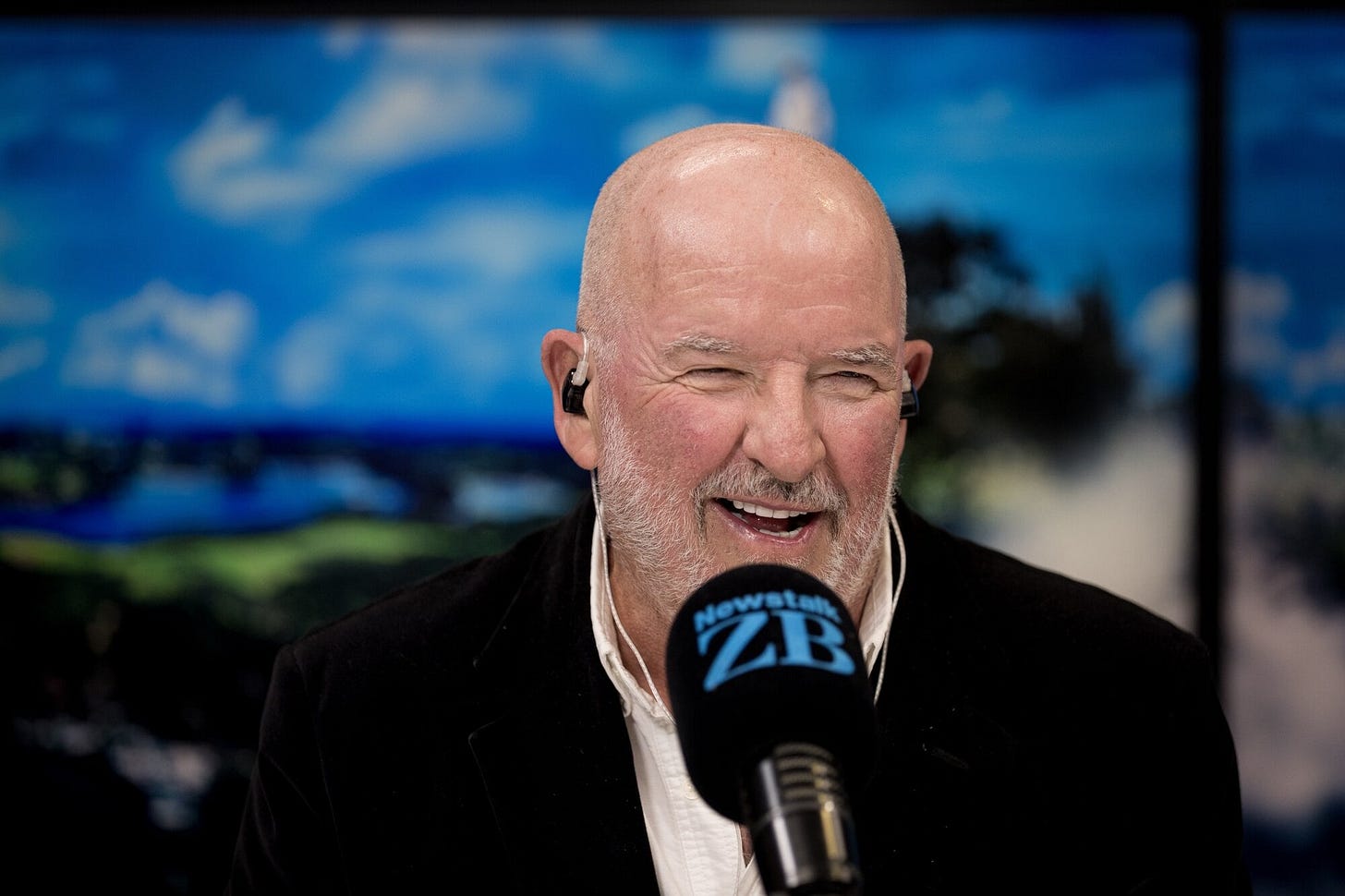
Newstalk ZB, du Plessis-Allan, and Soper should laugh and then ignore them completely. Who are they beyond a defunct group whose authority relies on voluntary acceptance? Nothing will happen if the radio station declines to take part in their humiliation ritual. They won’t be hauled off to prison or fined. The otter might be vicious, but it is toothless and its claws are blunt. The worst it might do is whip up an outraged press release or use rival media to condemn them.
It is no wonder Barry Soper was confused in any case. For a start, he is 75 years old and the idea that a person can somehow become neither male nor female is one of the strangest ideological fads of these bonkers times. A few years ago, nobody had heard of “non-binary” identities because they had yet to be made up. Today we are expected to believe that someone can transcend biological reality through a declaration of personal identity and that everyone else must adjust their language accordingly lest they be socially castigated or their employer contacted.
Most people are perfectly happy for people to dress however they like, behave however they like, and live however they like. What they object to is being told that they must participate in somebody else’s bizarre belief system or risk being labelled hateful, discriminatory, or bigoted. It’s insane how quickly society went from gender stereotypes are limiting and every should just do their own thing to if a man likes knitting and power tools he is actually neither male nor female.
Winston Peters put it spectacularly well in a post on X addressing the mob of unwell types who gathered in central Auckland to protest his party’s Definitions Bill.
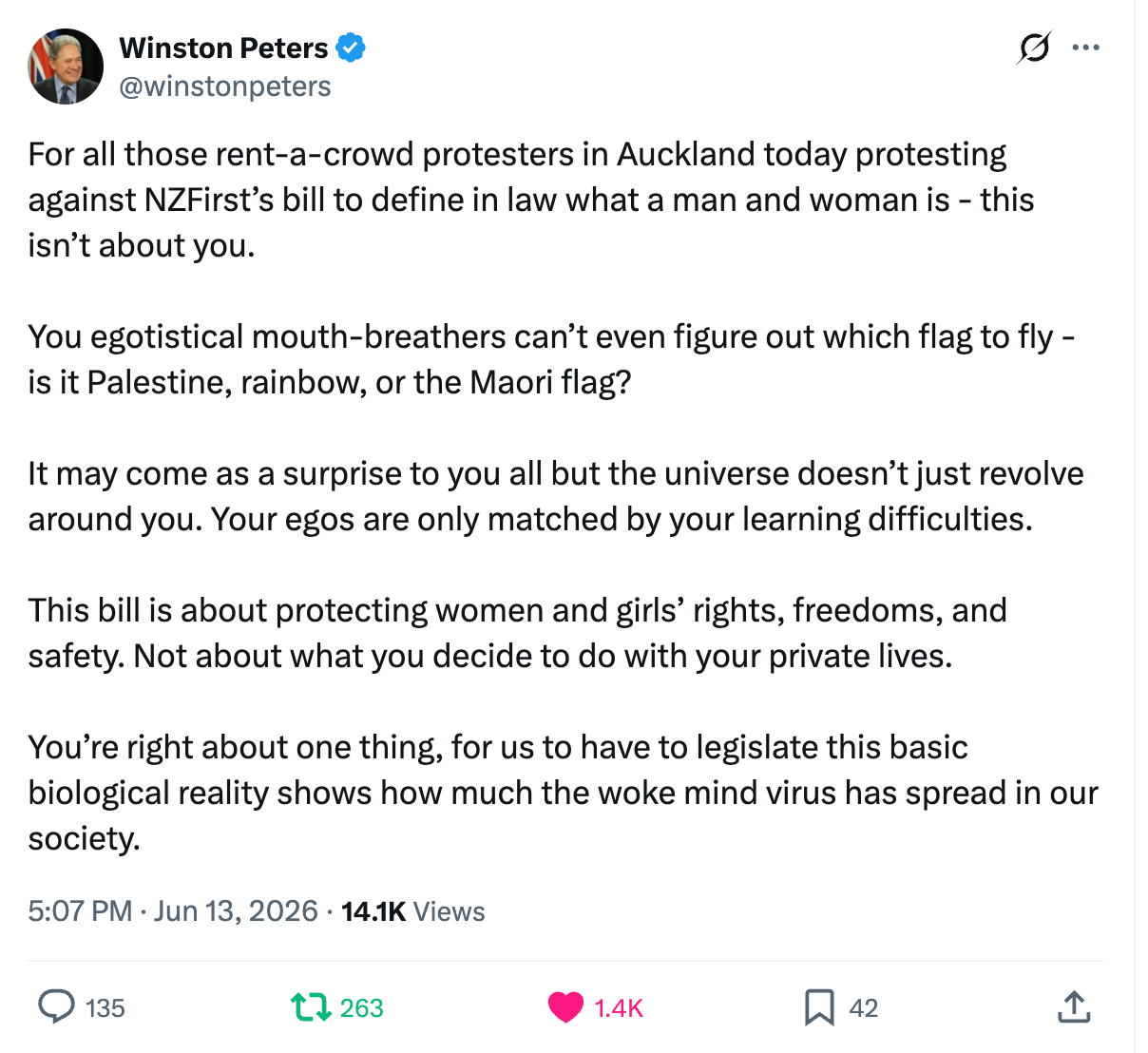
Perfection. Poetry. Tattoo it on my skin.
Anyway, I object to Barry Soper’s comments being condemned. Even if someone does find them rude or ill-mannered, do we really need the BSA to canter in on their white horse of wokery to condemn it? Bad manners aren’t a crime and we all need to toughen up a bit if we cannot withstand a bit of rudeness from time to time. It is the price of living in society. Alternatively, they can lock themselves in their computer dungeons and only use BlueSky and Reddit to communicate with the outside world.
The real issue though, is that four unelected appointees of an industry-body have decided that scepticism, mockery, or even confusion about one of the most contested social theories of our time can amount to unlawful discrimination just because they say so.
The irony in the “ruling” is nearly as perfect as Winston’s X post. Mere weeks after the government said ‘time’s up’, the authority has delivered this decision that demonstrates why so many people want it gone. The decision repeatedly insists that freedom of expression is the starting point but then demonstrates that is has little regard for it. It acknowledges that talkback radio is designed to be robust, provocative, and opinionated and that politicians are legitimate subjects of criticism, ridicule, and scrutiny. But now punishes broadcasters for just that. It also acknowledges that intervention is supposed to be reserved for a high threshold of harm. If only you could see my face right now.
The BSA no longer sees itself as merely enforcing broadcasting standards. It has grown to see itself as an arbiter of acceptable opinion, empowered to decide which beliefs about sex and gender, in this case, are legitimate and which are beyond the pale. It is the same affliction that much of our public service suffer from. They cannot stick to their remit and serve the government of the day because they fundamentally believe they have a divinely imposed duty to fight for their version of ‘good’. Neutrality is not a virtue any longer. No matter that it is written in contracts and legislation, they will choose to forgo neutrality in pursuit of the higher goal of fighting the evil centrists who are ordering them to provide services based on need rather than identity.
The entire conclusion of the BSA’s decision rests upon a legal proposition that remains unresolved in New Zealand law. Namely, that discrimination on the basis of “sex” under the Human Rights Act includes gender identity and non-binary status. That proposition has never been tested in court. It is a mere opinion. But that doesn’t matter because they think that it should be resolved and their ideological allies have attempted to ram it into every corner of our bureaucracy.
The authority insists that since the Human Rights Commission believes it, Crown Law once expressed that view, and it reflects the worldview of its ideological staff and board, the authority is entitled adopt the same position.
The Crown Law opinion in question dates from 2006. It was written by then Acting Solicitor-General Cheryl Gwyn in response to a proposed Human Rights (Gender Identity) Amendment Bill. The opinion concluded that courts would likely interpret “sex” broadly enough to encompass gender identity discrimination so there was no need to amend the Human Rights Act. But that is all it was. An opinion. A legal argument. It was never legislation nor was it a court ruling.
Over the past two decades the Crown Law opinion has been treated by various institutions as though it settled the matter. But the Ombudsman noted just last year that ambiguity remains and that the Human Rights Commission’s position is merely an interpretation of the legislation rather than an established legal fact. The Ombudsman did not endorse the interpretation as correct. He merely found that it was not unreasonable for the commission to hold that view.
Even worse than relying on an untested opinion from 20 years ago, the BSA also leans heavily on the Law Commission’s recent Ia Tangata report. Their decision repeatedly references the report’s discussion of gender identity and non-binary protections. There are two problems with that. First of all, the Law Commission’s conclusion was actually that the law is unclear and insufficient and legislative change is required. Secondly, and most importantly for these purposes, the government considered Ia Tangata’s recommendations and declined to proceed with them. The report was not adopted or implemented. It was binned.
Lucky the BSA had a spare copy or they sent the intern dumpster diving, because they have dusted it off and are giving it the reverence of the Magna Carta.
It is difficult to imagine a better example of why New Zealand First’s Legislation (Definitions of Woman and Man) Amendment Bill exists. When parliament leaves key terms undefined, regulatory bodies like the BSA inevitably begin filling the vacuum themselves.
Over time, interpretations then harden into a kind of de facto law as it has done so here. An opinion becomes guidance, which becomes policy, which becomes training material and then it is simply the way things are done. Before long, everybody is behaving as though a proposition has been democratically settled, despite nobody ever voting for it and no court ever ruling on it. That is what has happened with gender identity in New Zealand.
A Crown Law opinion from 2006 became an article of faith within the bureaucracy. The Human Rights Commission legitimised it, government departments and councils adopted it. Schools. HR departments. The fact that parliament never amended the Human Rights Act to explicitly include gender identity and the courts never tested the opinion somehow became less important than the fact that a sufficient number of officials decided what the law should be.
The question of whether “sex” includes gender identity has huge implications for sport, prisons, changing rooms, women’s spaces, data collection, language, employment law, education policy, and now apparently broadcasting standards. That is why the Definitions Bill is necessary, never mind that it shouldn’t have to be.
Critics insist the bill is unnecessary because everyone already knows what a woman is. But the BSA has just demonstrated that is not true. It is trying to punish radio journalists for using the ‘wrong’ pronouns. The definitions legislation would go some way to preventing that sort of institutional freelancing, providing certainty where activists prefer ambiguity, because, if words remain undefined, they can be stretched and repurposed.
And that is exactly what has happened. A term, woman, that every New Zealander thought they understood has been transformed into a vehicle for an entirely different ideological project. The definitions bill will not end the debate about sex and gender. But what it could do is ensure that those debates are resolved openly through parliament rather than stealthily through regulatory interpretation and bureaucratic activism.
If this issue matters to you, please do not just grumble about it. Make a submission in support of the Legislation (Definitions of Woman and Man) Amendment Bill. The select committee is currently accepting public submissions and will do so until 2 July. Politicians and officials need to hear from ordinary New Zealanders who are tired of watching basic words become ideological battlegrounds and who believe laws should say what they mean and mean what they say.
One of the great advantages activists have enjoyed over the past decade is that most normal people have assumed commonsense would eventually prevail. Unfortunately, while sensible people were getting on with their lives, activists were writing submissions, filing complaints, lobbying officials, influencing policy, and gradually embedding their worldview throughout institutions. If supporters of legal clarity remain silent, they should not be surprised when ambiguity continues to be exploited by people with a very different agenda.
I will have my own submission completed shortly and will publish it for anyone who wishes to borrow from it, adapt it, or use it as a starting point for their own. You do not need to be a lawyer, an academic, or a policy wonk to have your say. Parliament is asking what New Zealanders think. It is an opportunity to put your views directly on the public record. Use it.
I also wrote this open letter to the minister for women about a month ago about the bill:
Open Letter to Minister for Women Nicola GriggAni O’Brien 21 May
This article was originally published by Thought Crimes.