

Greg Bouwer
IINZ
Helen Clark presents herself as a defender of international law, the rules-based order, human rights, and the protection of women. For years, that has been central to her public identity: principled multilateralism, humanitarianism, accountability, and moral consistency.
Until the subject becomes Israel.
Then the standards collapse.
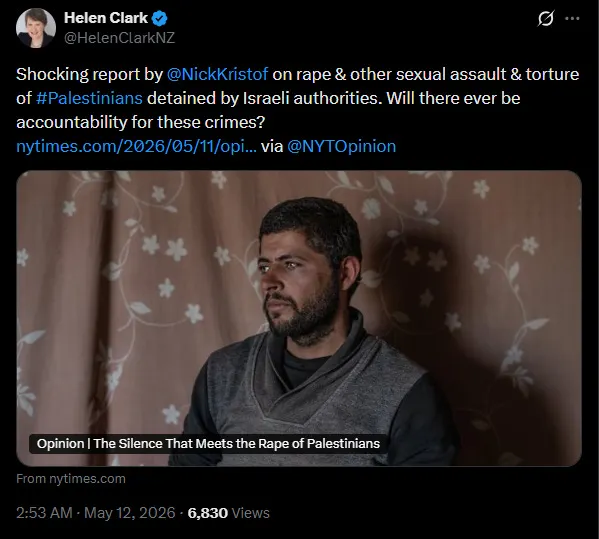
One day she circulates a New York Times opinion piece built substantially on allegations and testimonial claims, calling it a “report” despite the absence of independently verified forensic evidence, transparent methodology, or the evidentiary rigour she would almost certainly demand in any other international context.
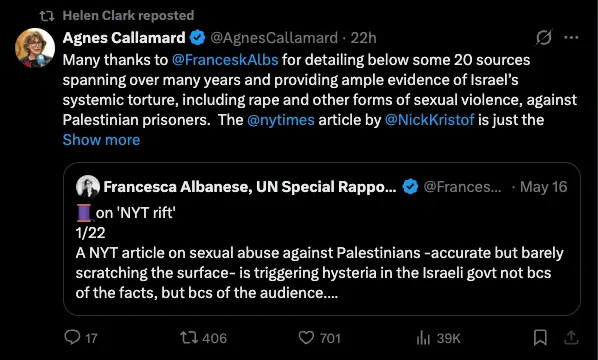
The next day she is silent about an actual investigative report – compiled over two years by legal experts, researchers, and human rights specialists – documenting systematic sexual violence, torture, mutilation, execution of families, and atrocities committed on October 7. A report so disturbing that investigators concluded existing legal terminology was insufficient to fully describe parts of what occurred.
No amplification. No urgency. No moral outrage. No thread demanding accountability.
Nothing.
Then almost immediately afterward, she amplifies claims that Israel is deliberately starving Gaza by restricting humanitarian aid – despite the enormous body of evidence surrounding Hamas’s theft of aid, diversion networks, intimidation of civilians, exploitation of humanitarian infrastructure, and the ongoing dispute surrounding these claims by COGAT and other parties involved in aid coordination.


Again: no caution. No visible skepticism. No insistence on evidentiary thresholds. No concern about propaganda incentives in wartime.
And this is the pattern that has become impossible to ignore.
For some reason, when the accused party is Israel, Helen Clark’s normal standards appear to vanish. Allegations are elevated rapidly. Context disappears. Complexity evaporates. Claims are treated as presumptively true. Israeli denials are treated as morally suspect before evidence is even fully examined.
But when Israelis – especially Jewish Israelis – are the victims of atrocities, the instinct toward moral urgency seems to recede into silence, hesitation, or abstraction.
That asymmetry matters because Helen Clark is not an anonymous activist screaming into the void online. She is a former prime minister of New Zealand and former administrator of the UNDP. Her words carry institutional weight. They contribute to international narratives. They help shape what the public believes deserves outrage – and what does not.
And increasingly, many people are beginning to notice something deeply uncomfortable: the universalism being claimed is not being applied universally.
Human rights apparently matter – except when Jews are involved. Women’s rights apparently matter – except when Jewish women are raped by Hamas. International law apparently matters – except when terrorism against Israelis complicates the preferred narrative. Civilian suffering apparently matters – except when Israeli civilians are butchered in their homes. Disinformation is apparently dangerous – except when the target is the Jewish state.
At some point, people are entitled to ask whether this is genuinely about universal human rights at all, or whether Israel has simply been placed outside the moral protections routinely extended to every other nation on earth.
Because what is being displayed is not principled consistency. It is selective morality. And selective morality corrodes the credibility of every institution that claims to defend universal values.
Critics of Israel often insist that opposition to Zionism is not opposition to Jews. Fine. That distinction can exist in theory. But when a public figure applies radically different evidentiary standards, moral language, and humanitarian concern to the world’s only Jewish state – and repeatedly minimises, ignores, or contextualises atrocities against Jews while rapidly amplifying accusations against Israel – people are also entitled to ask difficult questions about prejudice, bias, and ideological fixation.
Not every critic of Israel is antisemitic.
But when Israel alone appears excluded from the presumption of legitimacy routinely granted to every other nation; when Jewish suffering repeatedly fails to trigger the same moral instincts afforded to others; when accusations against the Jewish state are embraced with extraordinary credulity while evidence of atrocities against Jews is met with comparative silence – it becomes increasingly difficult to pretend this is merely neutral human-rights advocacy.
At minimum, it resembles a form of ideological obsession in which Zionism functions not as one political subject among many, but as the singular exception to otherwise universal principles.
And that is precisely why so many ordinary people no longer trust the self-appointed guardians of the “rules-based order”.
Because the rules increasingly appear to apply differently when Jews are defending themselves.
This article was originally published by the Israel Institute of New Zealand.