Table of Contents
Greg Bouwer
IINZ
A viral social media post shows a black-and-white photograph of Jewish refugees disembarking from a ship. A uniformed figure stands on the dock.
The caption reads: “Palestinians welcomed Holocaust survivors. Then the Jews took their land.”
It has been shared hundreds of thousands of times.
The figure in that photograph? A British soldier, not a Palestinian Arab. But by the time the correction appears, the image has already shaped millions of perceptions.
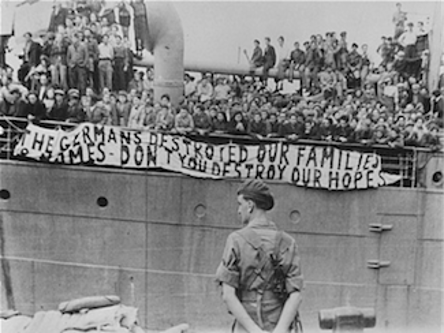
A refugee ship caught by the British. Their banner reads: The Germans destroyed our families – don’t destroy our hopes.” It is estimated that 70,000 Jews arrived in Palestine prior to 1948 under the Aliyah Bet (illegal immigration) program. Another 50,000 were rounded up by the British and placed in detention camps.
The claim it promotes – that Palestinians sheltered Jewish survivors of the Holocaust who later ‘betrayed’ them – has become common in activist discourse. A careful examination of the historical record shows why this narrative cannot be sustained.
A Continuous Jewish Presence – Not a Post-Holocaust Arrival
Any serious examination must begin with a basic historical fact: Jewish presence in the Land of Israel did not begin after the Holocaust, nor with modern Zionism. It has been continuous – though often under persecution – for over 3,000 years.1
Throughout Roman, Byzantine, Islamic, Crusader, Ottoman, and British rule, Jewish communities persisted in Jerusalem, Safed, Tiberias, Hebron, and elsewhere.2 By the late 19th century, long before the Holocaust, modern Zionist immigration joined this indigenous core under Ottoman rule.3
This continuous presence does not determine modern borders or negate Palestinian claims to national self-determination. But it does refute the premise that Jews were foreign guests dependent on Arab permission to exist in the land.
The Claim – and Why It Persists
The claim rests on a simple moral story: Palestinians were hosts; Jews were guests; the guests later betrayed their benefactors.
It persists because it offers clarity where history is complex, and moral certainty where reality is tragic.
But history does not cooperate.
Who Actually Controlled Entry? The British Mandate Reality
From 1917 to 1948, the land was governed by Britain, not by Arab or Jewish authorities.4 Immigration policy, border control, and entry permits were set exclusively by the British administration.5
Palestinian Arabs constituted a society – not a sovereign authority. The question is not whether a population existed, but what actually happened – did Arab leadership and institutions facilitate Jewish refuge during the Holocaust?
The evidence shows the opposite.
Blocked Refuge: The 1939 White Paper
In 1939, as Nazi persecution escalated toward genocide, Britain issued the White Paper, limiting Jewish immigration to 15,000 per year for five years, after which any further immigration would require Arab consent.6
This policy was adopted explicitly to placate Arab opposition.7 During the six years of World War II (1939–1945), Britain permitted roughly 90,000 Jews to enter Palestine – while six million were murdered in Europe.8
Between 1939 and 1948, more than 50,000 Holocaust survivors attempting to reach Palestine were intercepted and detained by British authorities.9
They were not sheltered. They were blocked.
In Their Own Words: Arab Opposition to Jewish Refuge
Arab opposition to Jewish immigration was not inferred after the fact: it was stated plainly at the time.
In 1939, the Arab Higher Committee demanded that Britain “prohibit all further Jewish immigration into Palestine”.10
Haj Amin al-Husseini, the Mufti of Jerusalem, consistently opposed Jewish refuge and later collaborated with Nazi Germany.11
British Colonial Secretary Malcolm MacDonald acknowledged that immigration restrictions were adopted to meet Arab concerns, even as European Jewry faced annihilation.12
This is not interpretation. It is documented record.
Population Reality: Jews Were Not Post-War Arrivals
Jewish presence grew over decades – not suddenly after 1945:
- 1880: ~25,000 Jews
- 1914: ~85,000
- 1931: ~175,000 (British census)13
- 1945: ~550,000 (Jewish Agency data)14
- 1948: ~650,000 (at Independence)
The idea that Jews arrived only after the Holocaust – as guests – collapses under these figures.
Ships Turned Away
Less remembered is that when Jewish refugees attempted to reach Palestine – the historic Jewish homeland – Britain blocked them with equal determination.15
The Exodus 1947, carrying over 4,500 Holocaust survivors, was forcibly boarded by British troops. Its passengers were returned – not to Palestine – but to detention camps in Germany, the very country they had fled.16
Earlier, in 1940, the refugee ship Patria sank in the Haifa harbor during a British deportation attempt, killing 267 Jews.17
These were not isolated incidents. They were policy.
Violence Preceded the Holocaust
Arab-Jewish violence did not begin in response to post-Holocaust immigration. It preceded it.
The 1929 Hebron massacre saw 67 Jews murdered, ending a centuries-old Jewish community that predated modern Zionist immigration by centuries.18
Riots in 1920, 1921, and the Arab Revolt of 1936–39 targeted Jewish civilians and institutions across the country.19
These events undermine the claim of a welcoming society later betrayed.
What This Article Is – and Is Not – Arguing
This article does not claim that:
- All Arabs were hostile to Jews
- Arab concerns about immigration were illegitimate
- Jewish actions in 1948 require no scrutiny
- Palestinian national identity is invalid
It does argue one specific point: the claim that Palestinians sheltered Holocaust survivors who later betrayed them is historically false.
Individual acts of kindness existed — as they do in all societies.20
But isolated goodwill cannot be conflated with systematic shelter, which the historical record does not support.
1948 and Palestinian Displacement
Approximately 700,000 Palestinians were displaced during the 1947–49 war – a humanitarian catastrophe that profoundly shaped Palestinian identity for generations.21 This suffering is real, well-documented, and deserving of acknowledgment.
But it occurred during a war initiated after Arab leadership rejected the UN partition plan and launched hostilities against the Jewish community and the newly declared State of Israel.22 It was not the result of Jews betraying hosts who had sheltered them during the Holocaust.
At the same time, approximately 850,000 Jews were displaced from their homes across the Middle East and North Africa in the years surrounding Israel’s establishment – expelled, stripped of citizenship, or forced to flee solely for being Jewish.23 Their properties were confiscated, their communities dismantled, and their centuries-old presence across the Arab world largely erased. Unlike Palestinian refugees, these Jewish refugees received no UN agency dedicated to their perpetual refugee status, no international advocacy apparatus, and no ‘right of return’ to the lands from which they were expelled.
These parallel refugee crises emerged from the same regional conflict and collapse of empire. One became the foundation of a Palestinian national narrative; the other was absorbed largely into Israel and the West, without an equivalent international refugee apparatus.
Understanding this history does not negate Palestinian suffering. But it decisively refutes the claim that Jews ‘betrayed’ a population that had sheltered them from genocide. These were two national movements colliding in a violent decolonizing landscape – not guests turning on benefactors.
Common Objections
“Some Arabs helped Jews.” Yes. Individual assistance existed. It does not equal collective or political shelter.20
“This ignores the Nakba.” No. It acknowledges it – while rejecting its misuse to justify a false historical claim.21
“Jews were European colonisers.” Nearly half of Israel’s early Jewish population came from the Middle East and North Africa – many as refugees from Arab lands.24 Combined with continuous Jewish presence, the colonial analogy collapses under inconvenient diversity.
“The Balfour Declaration proves colonialism.” The Balfour Declaration expressed British support but did not create Jewish ties to the land, which predate Britain by millennia.25 Moreover, Britain abandoned Jewish refuge precisely when Jews needed it most.
Conclusion
Two peoples with legitimate ties to the land entered conflict under imperial rule, amid genocide and decolonisation. History is neither simple nor comfortable.
But one claim does not survive scrutiny at all: that Palestinians sheltered Holocaust survivors who later betrayed them.
Why repeat a claim that collapses under evidence? History is not always convenient. Truth is not always comforting. But without historical honesty, there can be no path forward – only competing mythologies.
This one should be retired from serious discourse. Those who care about peace have a responsibility to insist on it.
References
- Walter Laqueur, A History of Zionism (Schocken, 2003).
- H.H. Ben-Sasson, A History of the Jewish People (Harvard, 1976).
- Michelle Campos, Ottoman Brothers (Stanford, 2011).
- British Mandate for Palestine, League of Nations (1922).
- Tom Segev, One Palestine, Complete (Henry Holt, 2000).
- UK Government, Palestine: Statement of Policy (White Paper), Cmd. 6019 (1939).
- Michael J. Cohen, Palestine and the Great Powers (Princeton, 1982).
- Bernard Wasserstein, Britain and the Jews of Europe (OUP, 1979).
- Dalia Ofer, Escaping the Holocaust (Oxford, 1990).
- Arab Higher Committee Memorandum, 1939, cited in Morris, Righteous Victims.
- Philip Mattar, The Mufti of Jerusalem (Columbia, 1988).
- UK Parliamentary Debates, House of Commons, 1939.
- British Census of Palestine, 1931.
- Jewish Agency Statistical Abstracts.
- USHMM, “Voyage of the St. Louis.”
- Benny Morris, 1948 (Yale, 2008).
- Yehuda Bauer, Flight and Rescue (Random House, 1970).
- Hillel Cohen, Year Zero of the Arab-Israeli Conflict (Brandeis, 2015).
- Yoav Gelber, Jewish–Palestinian Relations (Sussex, 1991).
- Bauer, Flight and Rescue.
- Benny Morris, The Birth of the Palestinian Refugee Problem Revisited (Cambridge, 2004).
- UN General Assembly Resolution 181 (1947).
- Edwin Black, The Farhud: Roots of the Arab-Nazi Alliance in the Holocaust (Washington, DC: Dialog Press, 2010); Martin Gilbert, In Ishmael’s House: A History of Jews in Muslim Lands (New Haven: Yale University Press, 2010); United Nations High Commissioner for Refugees (UNHCR), “Jews Displaced from Arab Countries,” historical overview.
- Georges Bensoussan, Jews of Arab Lands (Indiana, 2019).
- Jonathan Schneer, The Balfour Declaration (Random House, 2010).
This article was originally published by the Israel Institute of New Zealand.



![[The Good Oil] Stuff Up of the Day](/content/images/size/w1304/format/webp/2024/09/Stuff-up-image-1.webp)