John McLean
Citizen typist. Enthusiastic amateur.
The signed Free Trade Agreement between New Zealand and India will come into force in New Zealand when approved by New Zealand’s parliament. The National, Labour and ACT political parties have each committed themselves to voting in favour of legislation adopting the FTA. It’s therefore virtually certain that parliament will entrench the FTA in New Zealand’s indigenous law before the next general election scheduled for 7 November 2026.
And “indigenous” is apt, because the FTA contains the following express provision:
The Parties…affirm…the United Nations Declaration on the Rights of Indigenous Peoples, adopted in New York on 13 September 2007 and their respective positions made in that declaration.
Parliament has not to date incorporated the United Nations Declaration on the Rights of Indigenous Peoples (UNDRIP) into New Zealand law. And rightly so. UNDRIP is designed to protect such blasts from the past as lost tribes in the Amazon jungles. It was never intended or designed to confer special rights on such humans as societally integrated New Zealanders with Māori ancestry.
Despite that, UNDRIP is cited by New Zealand race activists – including in the Waitangi Tribunal – in support of a separate, self-determining Māori nation, in partnership with a non-Māori nation. This, from UNDRIP itself:
Considering also that treaties, agreements and other constructive arrangements, and the relationship they represent, are the basis for a strengthened partnership between indigenous peoples and states.
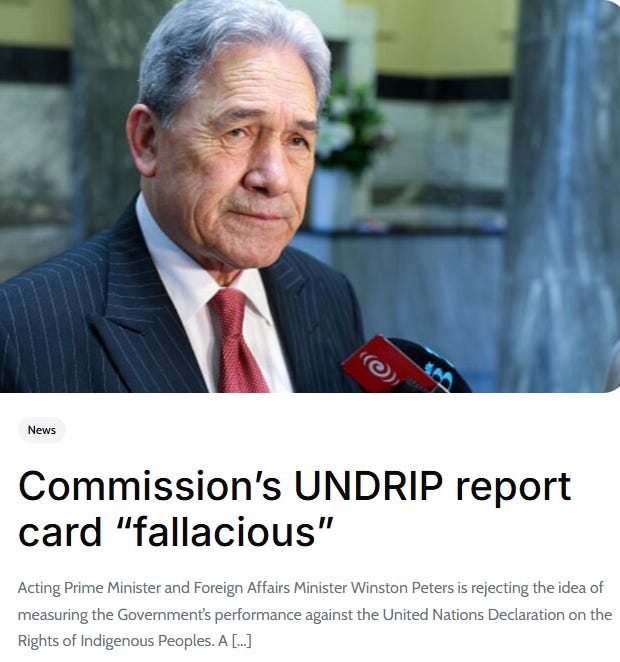
New Zealand’s Human Rights Commission monitors and reports on the New Zealand Government’s performance against UNDRIP.
More particularly, the 2021 Labour government’s ministerial He Puapua report advocated for full implementation of UNDRIP by 2040, the bicentenary of the Treaty of Waitangi, and the government secretly began work on a plan.
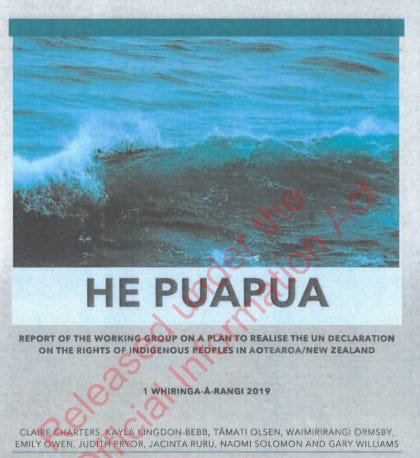
In July 2024, National MP Tama Potaka’s Ministry for Māori Development (Te Puni Kōkiri) appears to have announced that the government was no longer progressing a plan to embed UNDRIP in New Zealand law.
That ostensible announcement was consistent with the National/NZ First coalition agreement, which specifically provides:
The coalition government will reverse measures taken in recent years which have eroded the principle of equal citizenship, specifically we will…Stop all work on He Puapua [and] confirm that the coalition government does not recognise the United Nations Declaration on the Rights of Indigenous Peoples (UNDRIP) as having any binding legal effect on New Zealand.
The government minister behind the NZ/India FTA is The Honourable Todd McClay, as minister of trade and investment, and associate minister of foreign affairs. Hon Todd is therefore politically responsible for the inclusion in the FTA of the New Zealand Government’s express affirmation of UNDRIP, an affirmation that will have binding legal effect in New Zealand once parliament approves the FTA.

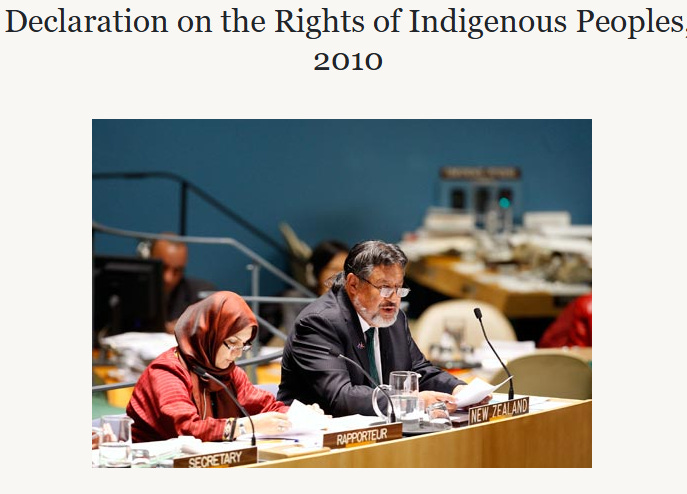
It’s logical that the National Party is now working towards embodying UNDRIP in New Zealand law. Because it was former Prime Minister John Key’s National government that decided in 2010 to support UNDRIP. Key arranged for Dr Pita Sharples, then minister of Māori affairs, to formally deliver New Zealand’s declaration of support for UNDRIP at the United Nations in New York.
But the awkward reality is that, by working to embed UNDRIP in New Zealand’s legal fabric, through the backdoor of the NZ/India FTA, the National Party is breaching its coalition agreement with NZ First.
To be clear, parliament has no option to exclude the FTA’s affirmation of UNDRIP, when it approves the FTA (parliament must either adopt the FTA in its signed form, or not. The choice is binary). On such approval, UNDRIP will be automatically supercharged and enshrined, becoming as much an integral part of New Zealand law as the FTA itself.
This is all profoundly undemocratic and sly. New Zealanders’ ouster of Labour at the last general election represented a profound rejection of the philosophies that underpin UNDRIP and which motivated such things as Labour’s “Three Waters” attempt at race-based governance of New Zealand’s fresh water.
The National/ACT coalition agreement contains no rejection of He Puapua and UNDRIP, which is perhaps why ACT feels free to vote in favour of making the FTA, including UNDRIP, legally binding on New Zealanders.
UNDRIP is much more than a drip in the bucket. Bringing UNDRIP into New Zealand law will have profound constitutional consequences. How can this have been allowed to happen? Who voted for this?

There’s a Hole in Our Bucket, Dear Reader, Dear Reader…a hole that may not be able to be fixed. UNDRIP by stealth significantly ups the risk of New Zealand going down the drain to race-based tribalism.
This article was originally published on the author’s Substack.