Much fantasy, even heroic fantasy, tends to depict pre-modern warfare as a somewhat bloodless affair. Swords are swung and foes felled, but there’s not much of the blood and guts brutal reality. Robert E Howard’s stories are a visceral exception: blood showers, brains spilling and men dying screaming. Some recent finds in archaeology amply illustrate why the Ancient Greeks made the sons of the god of war fear and terror. The knuckle-chewing fear of men seeing their enemies bearing down on them and the terror of combat.
The first is a Roman-era mass grave found beneath a soccer field in Vienna, in 2024. In it, archaeologists found at least 129 skeletons, all young men. At first it was thought to be a mediaeval ‘plague pit’ or perhaps from the Second Ottoman Siege of Vienna, in 1683. But, says Sheridan Strang, a bioarchaeologist at the archaeology firm Novetus, carbon dating placed the men’s deaths between 80 and 230 AD.
“For us Viennese archaeologists, this is a sensational Roman find, the most surprising in my career,” Kristina Adler-Wölfl, Head of City Archaeology (part of the Vienna Museum) told All That’s Interesting in an email in 2025.
It then seemed clear to the archaeologists that the men had died during a catastrophic military clash, but only now has the fresh analysis confirmed this theory.
It was indeed a catastrophic military clash – and it would have, for the victims, involved a lot of fear and terror. Not to mention a cacophony of “Heu! Testiculi mei!”
The dead were all men aged roughly 18 to 35, clustered near the old Roman camp of Vindobona on the Danube frontier. Most showed the unmistakable signatures of edged weapons: sword cuts and dagger thrusts scattered across the body, plus blunt trauma to the skulls. What stands out, though, is the concentration of projectile wounds in the groin.
Because the pelvic injuries were caused by projectiles, researchers believe that the most likely scenario was that attackers on the ground threw lances that pierced the enemies’ armor while they were on horseback.
“We have one individual where the lance head was still inside the pelvis when we excavated him,” Strang told Live Science. “The people who caused these injuries were aiming for these sensitive areas.”
Researchers suspect the victims were mounted when the lances came in. A man on horseback presents a high, relatively unprotected target between the legs once the shield is raised against higher threats. A well-thrown lance could punch through whatever light protection covered the area, drop the rider in agony, and leave him helpless on the ground for the follow-up. Soft-tissue anatomy was being exploited with cold precision. Whether these were Romans, Germanic tribesmen or a mixed pile from some unrecorded clash during or after the Marcomannic Wars remains unclear. What is clear is the method: incapacitate first, finish later. No clean Hollywood swordplay here: just Ow! My Balls! with extreme prejudice. Targeted mutilation designed to produce screaming, writhing men who would never fight again.
Seven centuries later and several hundred miles west, the same principle of overwhelming, impersonal violence appears in a different form.
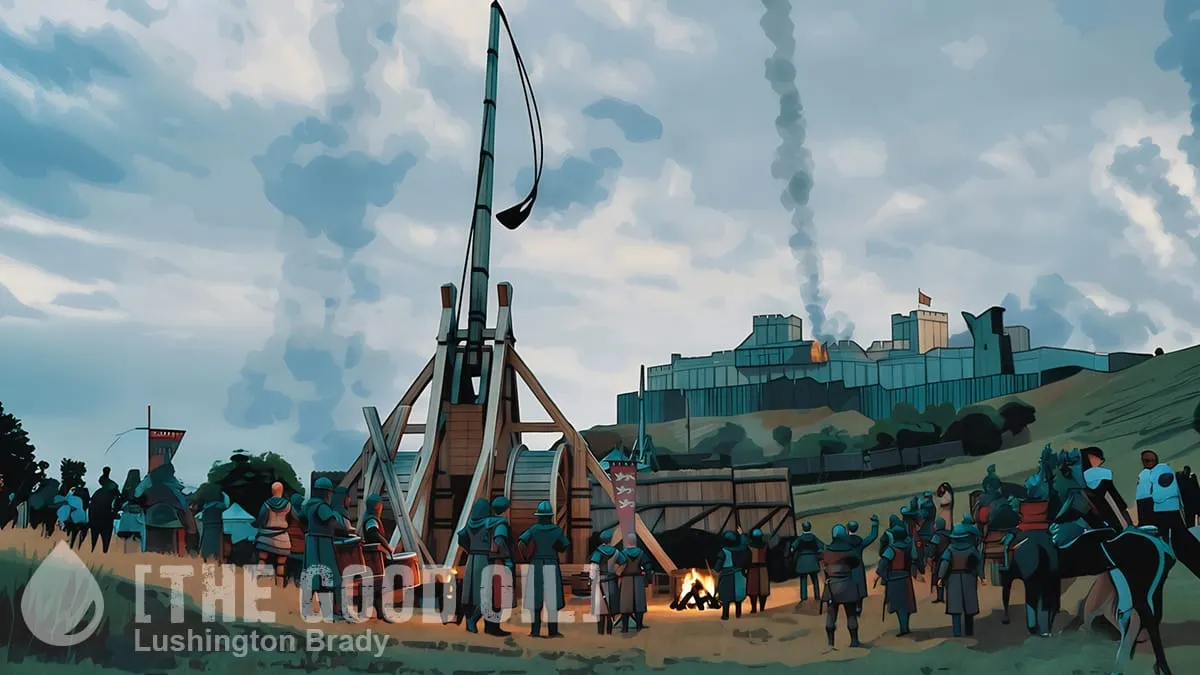
By 1304, as the Wars of Scottish Independence dragged on, just one Scottish castle still stood strong against the forces of England: Stirling Castle. Determined to bend the Scots to his will, King Edward I of England besieged the castle, and brought with him a powerful new weapon known as a trebuchet.
Edward called his trebuchet “Warwolf”. The defenders’ reactions are not recorded, but it was probably something like, ‘Och! Whit the fuck’s that massive yin for?’
What it was for, was smashing Scotsmen to a pulp.
Skeleton 150 […] coming from a man who was between the ages of 22 and 34 when he died, was “notable for having over 160 peri-mortem fractures across his skeleton,” [University of Bradford bioarchaeologist Jo Buckberry] explained, “from the top of his cranium to his knees.”
In other words, this man had not died from sharp force trauma, but blunt force trauma. Buckberry wrote that Skeleton 150’s death was seemingly caused by “a single, high-velocity impact,”
In other words, big rock go splat.
The death of Skeleton 150, Buckberry continued, was likely “the first evidence of trebuchet trauma in the archaeological record.”
When it came to making big rocks go splat, the Warwolf was certainly the goods.
Believed to be the largest trebuchet ever made, the Warwolf stood almost 300 feet tall and was capable of launching a 260-pound projectile more than 600 feet. According to some accounts, the Warwolf was so terrible to behold that the Scots surrendered immediately upon seeing it. However, King Edward still wanted to test out his new weapon, so he fired the trebuchet anyway, launching a stone that tore through the castle’s walls like “an arrow flying through cloth.”
And through some poor bastard who happened to be standing in the wrong spot on said walls.
So, no prolonged duel, no heroic last stand and no cries of FREEEEEDOM! Just a big ol’ crunch and ‘Gude nicht, Jimmy’.
Both finds strip away the romantic varnish. Whether by lance aimed deliberately at the groin or by a half-ton projectile flung by a timber giant, the reality of pre-modern battle was calculated terror. Fantasy may prefer elegant sword-strokes and noble last words, but the men in the Vienna pit and the shattered Scotsman at Stirling learned the hard way that it didn’t work like that.