Roger Crawford
FSB
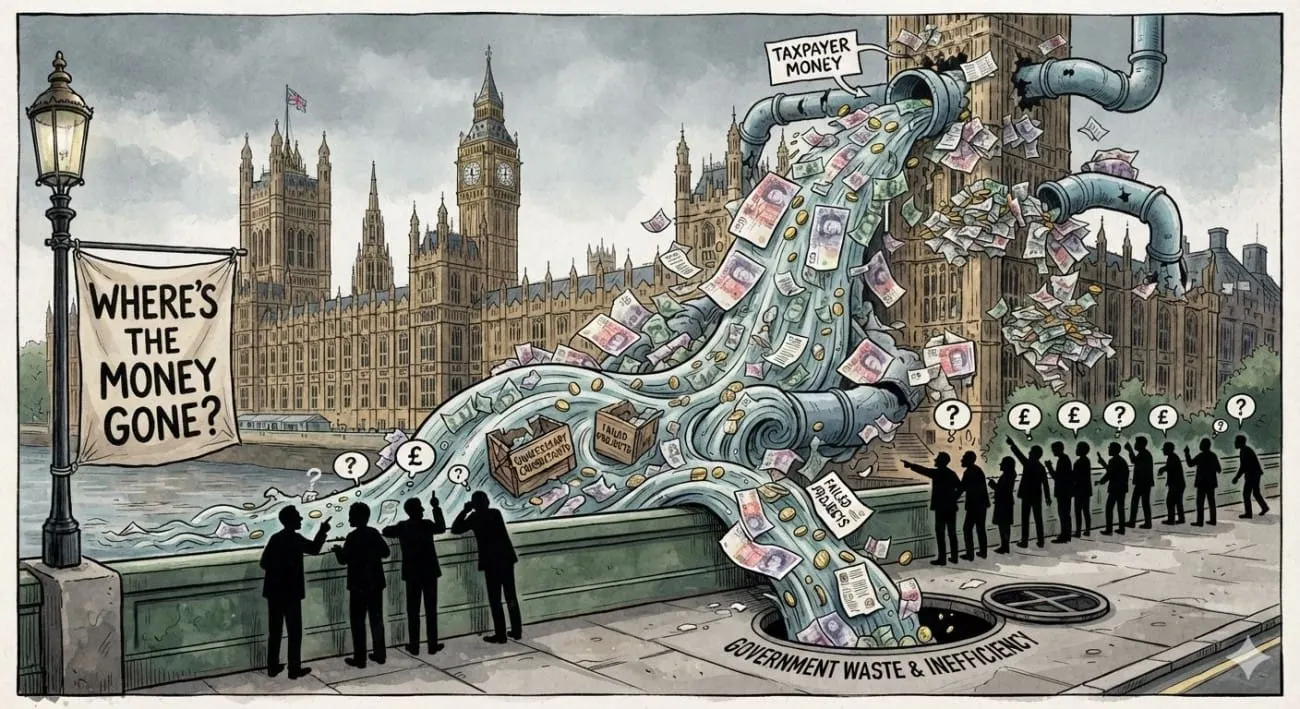
Every year, the British taxpayer is fleeced on a scale that would make a Nigerian online scamster blush. The huge sums are not abstract, but taken from the wages of nurses, lorry drivers, shop workers, small business owners and even pensioners, some of whom still believe that paying tax buys something resembling competent government. What they actually purchase is a vast machine of waste, virtue-signalling and institutional self-preservation.
Foreign aid, the open-ended costs of legal and illegal immigration, the funding of woke activist outfits that despise the very country that bankrolls them, a civil service swollen with gold-plated pensions, and the ruinously expensive Net Zero religion: these are not unfortunate side-effects of governing. They are the governing project.
Begin with foreign aid. Britain continues to ship billions overseas even as its own public services creak and its debt pile grows. The statutory target of 0.7 per cent of gross national income is treated as a moral absolute rather than a political choice. Money flows to governments that are corrupt, to projects that vanish into the sand, and to multilateral bodies whose accountability is microscopic. At best. While British hospitals struggle with waiting lists and British towns deal with the visible consequences of unmanaged migration, the aid budget is protected as if it were a sacred cow. Critics who point out that charity begins at home are dismissed as racists. The result is straightforward: British workers fund the development aspirations of other nations while their own infrastructure and security are ignored.
Then there is immigration. Legal and illegal inflows have been allowed to expand far beyond any serious attempt at integration or fiscal balance. The costs are not limited to the immediate hotel bills and asylum processing that make the headlines. They include the long-term pressure on housing, schools, the NHS and the welfare system. Illegal entrants who cross the Channel in small boats are housed, fed and processed at public expense, often for years, while the system for removing failed claimants remains glacial. Legal migration, particularly under successive expansions of work and study routes, has delivered large numbers of low-skilled workers whose net fiscal contribution is generally negative once education, healthcare and benefits for dependants are counted. The political class has fallaciously treated population growth through migration as an unalloyed economic good, ignoring the concentrated local costs that fall on the communities least able to absorb them. Taxpayers in coastal towns and northern cities pay the bill for decisions taken in Westminster that treat their neighbourhoods as dumping grounds.
The woke agenda has become a parallel spending stream. Public money is funnelled to charities and campaign groups whose explicit purpose is to reshape British society along ideological lines. Organisations that promote contested theories of gender, race and identity receive grants, contracts and privileged access. Some of the more extreme outfits, including those that traffic in the language of violence and street confrontation, have benefited from the broader climate of official indulgence toward radical activism. Antifa-style networks and their fellow travellers operate in a culture where the state is more interested in policing speech that questions the orthodoxy than in examining where public funds end up. The civil service and local authorities have internalised the language of diversity, equity and inclusion as a managerial religion. Training programmes, equality impact assessments and dedicated officers multiply. The practical effect is to divert resources from core services into the maintenance of an ideological apparatus that treats ordinary British culture as a problem to be managed rather than a inheritance to be preserved. They have, of course, not a shred of democratic mandate for any of this.
Nowhere is the contempt for the taxpayer more glaring than in the structure of the public sector itself. The civil service and the wider public workforce enjoy terms and conditions that the private sector abandoned decades ago. Final salary pensions, still common in the public realm, represent a transfer of wealth from current and future taxpayers to a protected class of employees. Private sector workers, many of whom have defined contribution pots that fluctuate with the market, fund these guarantees. The numbers are enormous. Unfunded public sector pension liabilities sit as a quiet mountain of future claims. Meanwhile, productivity in large parts of the public sector is appalling. Layers of management, endless consultation processes and a risk-averse culture produce delay and cost inflation. The same people who design the rules that bind private businesses operate under softer constraints themselves. Competence is rarely the measure – process and appearance are. When things go wrong, when procurement scandals occur, failed IT projects and chaotic policy roll-outs, etc, accountability is diffused until it disappears.
Net Zero is the purest expression of the pattern. An ambitious target has been elevated into a quasi-religious obligation, with costs imposed on households and industry while the global emissions arithmetic and most of the world remain indifferent to Britain’s futile gestures. Subsidies for intermittent renewables, the forced early retirement of reliable generation, the push toward heat pumps that many homes cannot afford or that the grid cannot support, and the regulatory pressure on agriculture and manufacturing all extract real money from real people. The benefits are asserted rather than demonstrated in proportion to the pain. Industrial jobs are put at risk. But the machinery of government continues to pour resources into the project because to question the pace or the method is treated as heresy. The same officials who lecture the public about personal carbon footprints, travel, heat and illuminate their own offices with little evident restraint. The asymmetry is the point. The costs are socialised onto the taxpaying public; the moral capital is claimed by the political class.
These are not isolated failures. They form a coherent picture. A governing elite has insulated itself from the consequences of its decisions. Foreign aid is protected because it signals virtue on the international stage. Immigration is managed as a labour market tool and a humanitarian performance, with the fiscal and social externalities dumped on the places least equipped to handle them. Activist causes are funded because they align with the cultural preferences of the administrative class. Public sector employment is expanded and rewarded with superior pensions because the public sector votes and lobbies for itself. Net Zero is pursued because it provides a grand narrative that elevates the importance of the people who administer it. In each case, the taxpayer is the residual claimant – the person who pays when the accounting is done.
The scale is not trivial. Billions that could have gone into repairing roads, expanding genuine energy capacity, training domestic workers or simply reducing the tax burden are instead absorbed by these priorities. The cumulative effect is a quiet redistribution: from productive private effort to unproductive public consumption, from the present generation of workers to the protected pensioners of the state, from the interests of the British people to the interests of those who arrive and those who advocate for ever more arrivals. The language used to defend the arrangement is always high-minded. The reality is, hover, base, even sinister. It is the systematic conversion of private earnings into public patronage.
Reform would require admitting that much of this spending is not investment but consumption dressed up as morality. It would require measuring immigration by net fiscal impact and social cohesion rather than by (often false) GDP headline figures. It would require ending the soft capture of public funds by activist networks. It would require bringing public sector pensions into line with the realities faced by the people who fund them. It would require treating Net Zero as a set of engineering and economic trade-offs rather than a test of ideological purity. Even better, scrap it altogether. None of that is likely while the incentives remain as they are. The people who design the system benefit from its continuation. The people who pay for it are told that questioning it is ungenerous, backward or extreme.
The British public is not ungenerous. It has tolerated high taxes and declining services with remarkable patience. That patience is not infinite. When ordinary people look at the hotels used for asylum accommodation, the grants to organisations that call their country racist, the pensions that their own employers could never afford, and the energy bills inflated by policy, they are entitled to conclude that the arrangement is a racket. The money is real. The waste is real. The contempt for the people who provide the money is real. Until the political class is forced to treat taxpayer funds as scarce rather than infinite, the scam continues.
This article was originally published by the Free Speech Backlash.