Steven Barnes
Steven is a retired doctor from North East England.
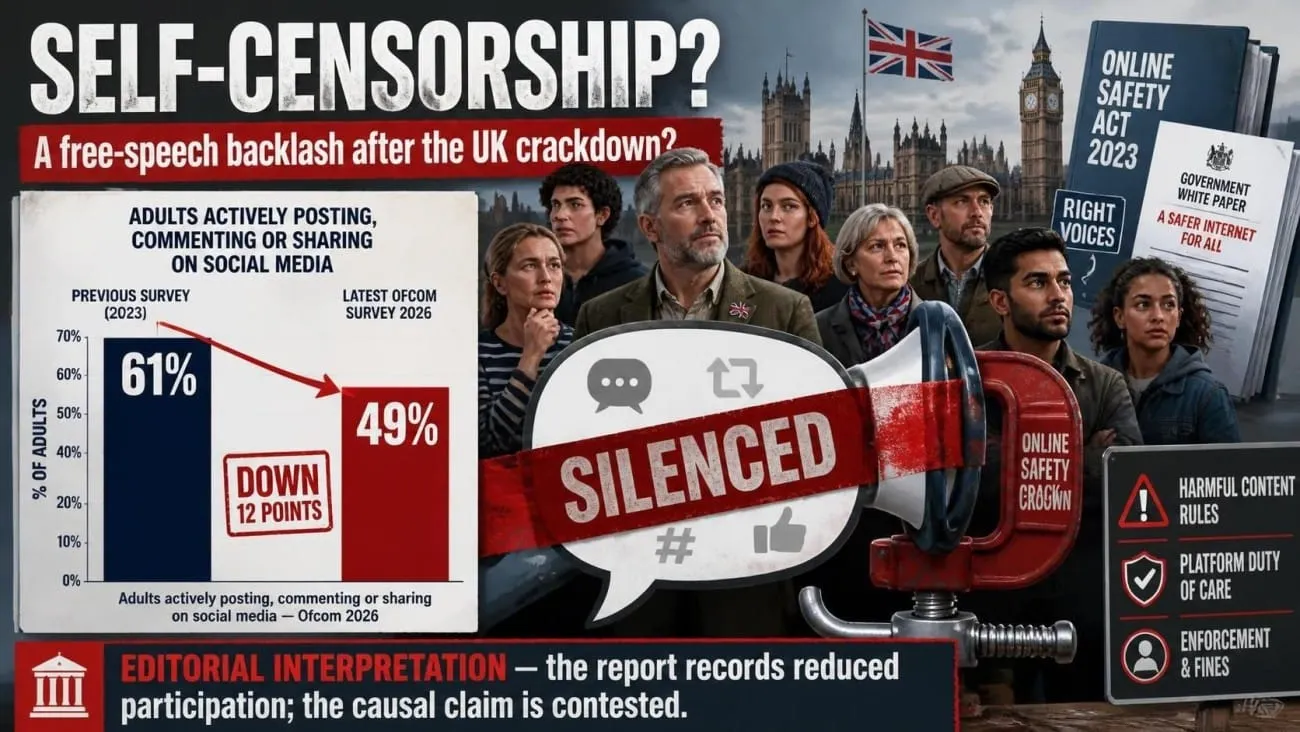
Public online commenting is in measurable decline across social media platforms and digital news websites. A 2026 Ofcom report found that only 49 per cent of UK adults actively posted, commented or shared material on platforms such as Instagram, Facebook and X, down sharply from 61 per cent the previous year. Analytics tracking mainstream news sites record reductions in comment volumes of between 30 and 60 per cent over the past decade, even while overall reader traffic has held steady or risen. These figures are not the product of boredom or technological fatigue alone. They reflect a deliberate shift in behaviour driven by an atmosphere of fear, one that successive UK governments have cultivated through policy, regulation and selective enforcement.
The assumption underpinning this essay is straightforward and, on the evidence of recent years, well founded: the suppression of free speech and the creation of a climate of caution is intentional government policy. This policy is aided and abetted by Ofcom, which has shown itself consistently harder on right-wing and conservative voices while remaining remarkably soft on equivalent or greater excesses from the left. The result is that ordinary citizens increasingly calculate that the risks of speaking openly online outweigh any benefit. Public discourse contracts, and the digital public square empties of the very contributions that once made it valuable.
Ofcom’s own data points to the mechanism. The regulator noted a rise in ‘passive’ social media use and an increase in the proportion of adults worried that online posts could cause them problems in the future – from 43 per cent to 49 per cent in a single year. Experts cited by Ofcom speak of “digital self-preservation.” Users migrate to private group chats and direct messages or simply stop contributing. The same pattern appears on news websites. Where once readers debated articles in comment threads that ran into the hundreds or thousands, many major titles have either closed sections, heavily moderated them into sterility, or watched volumes collapse. Traffic remains, but the conversational life of the page has withered.
This is not an accidental by-product of platform design or the rise of short-form video. It coincides with the progressive tightening of the legal and regulatory framework around online speech. The Online Safety Act 2023 handed Ofcom sweeping powers to impose duties on platforms regarding illegal content and, in practice, content that regulators or activist groups deem harmful. Platforms face the threat of fines reaching 10 per cent of global turnover. Faced with such penalties, the rational commercial response is over-removal. Content that is lawful but controversial – especially on immigration, gender, crime statistics, or cultural change – is more likely to be restricted, demoted or deleted than content that aligns with progressive orthodoxy. The chilling effect is predictable and intended.
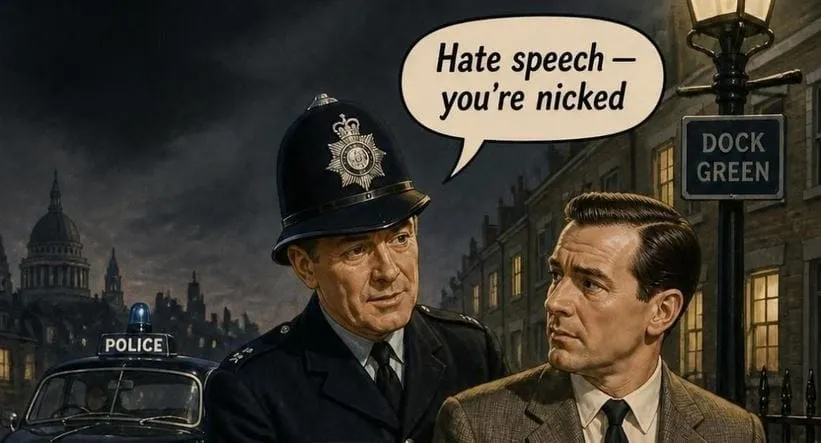
Arrest statistics reinforce the picture. Thousands of people have been arrested in recent years under communications offences for posts that would once have been treated as robust, if unpleasant, political argument. The threshold for investigation has lowered. Police forces devote resources to online speech that would previously have been ignored, while the same forces often appear slower to act against threats or incitement when the political abuse points the other way. High-profile cases involving right-leaning journalists, commentators and ordinary citizens who questioned official narratives on grooming gangs, two-tier policing or biological sex have demonstrated that the machinery of the state can be mobilised with remarkable speed against certain viewpoints. Equivalent mobilisation against left-wing excesses – calls for violence against political opponents, open celebration of terrorism, or sustained harassment of gender-critical women – is far rarer.
Ofcom’s role in this asymmetry is central. The regulator’s public guidance and enforcement priorities have consistently treated ‘hate’ and ‘harm’ through a lens that prioritises protected characteristics in a hierarchical fashion. Criticism of mass immigration, Islamic doctrine or transgender ideology is scrutinised intensely; criticism of Christianity, traditional family structures or national identity is routinely tolerated. Consultations and stakeholder engagement lean heavily towards organisations whose worldview is ‘progressive’ (aka as woke). The result is not neutral application of the law but the institutionalisation of a political preference. Platforms, knowing where the regulatory wind blows, adjust their moderation accordingly. Right-wing accounts face higher rates of shadow-banning, demonetisation and account restriction. Left-wing accounts enjoy greater latitude even when their rhetoric is inflammatory.
The policy succeeds precisely because it does not need to silence every dissenting voice. It only needs to make enough examples, and to create enough uncertainty, that the majority of people self-censor. The Ofcom figures capture that success. When nearly half of adults now fear that an old post may return to damage their employment, reputation or personal safety, participation collapses. Comment sections that once hosted genuine argument become ghost towns dominated by those who feel ideologically protected. News sites report stable traffic but hollowed-out engagement metrics. Social platforms report high usage numbers while the volume of original, argumentative content declines.
Critics of this analysis will object that the Online Safety Act contains formal duties to protect freedom of expression, that Ofcom insists it only targets illegal content, and that any chill is the unintended consequence of protecting children or preventing real-world harm. These formal assurances do not survive contact with the operational reality. When platforms are told to act on ‘potentially illegal’ material before full assessment, and when the definition of harm is elastic and politically loaded, lawful speech is collateral damage. When arrests for online posts run into the thousands while conviction rates remain low, the process itself becomes the punishment. When regulatory pressure is applied unevenly, the message to the public is unmistakable: some opinions are safer than others.
The decline in commenting is therefore not a neutral technological trend. It is evidence that the campaign is working. People are afraid. They have watched colleagues lose jobs, seen ordinary citizens interviewed under caution for social media posts, and observed the selective enforcement that treats right-wing dissent as a public order threat while treating left-wing radicalism as protected speech or necessary activism. In such an environment the rational response is silence or retreat into private channels. Public online discourse becomes thinner, more cautious and less representative of the actual range of opinion in the country.
A healthy democracy requires the opposite. It requires citizens willing to argue in public, to test ideas against opposition, and to risk being wrong without fear of state or corporate reprisal. The present trajectory moves Britain in the opposite direction. The statistics on declining participation are the measurable outcome of a policy that has prioritised control over openness. Until the legal framework is reformed, the regulatory bias corrected, and the culture of selective enforcement abandoned, the numbers will continue to fall. The digital public square will grow quieter, not because citizens have nothing to say, but because they have learned that saying it is no longer safe.
This article was originally published by the Free Speech Backlash.