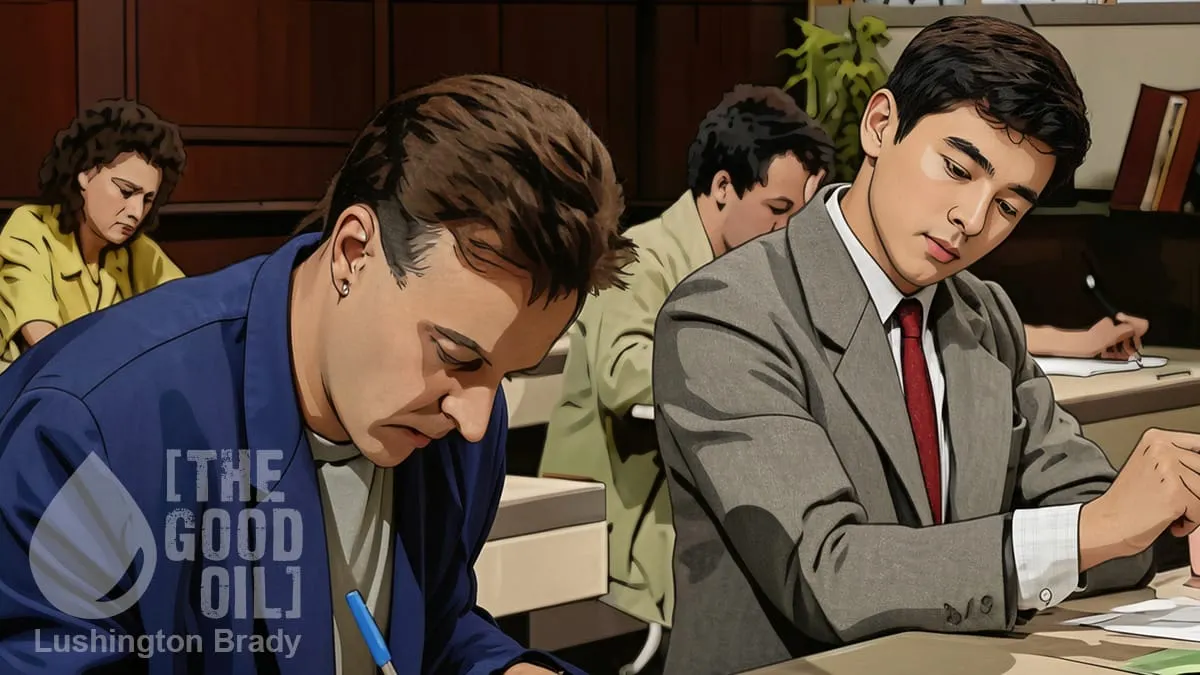
Well, I’m shocked. Shocked, I tell you. It turns out that the international students the Australian university sector has exploited as a cash-cow for decades are not just lowering teaching standards – they’re rampant cheats.
Whodathunkit!
International students were responsible for 91 per cent of serious academic misconduct and fraud cases at Australia’s oldest university last year, despite making up just over half the institution’s total student population.
And that’s just the ones they’ve actually bothered catching.
The University of Sydney’s own Student Affairs Unit, forced into the open by freedom of information, logged 330 serious misconduct and fraud cases in 2025. Fake medical certificates, forged documents and students simply paying someone else to do the work. Business and arts faculties led the charge. Two years earlier the foreign share was already 80 per cent. Now it’s 91. The university’s official line is that the over-representation “may reflect a range of possible risk factors, including limited support networks, financial pressures and family or cultural expectations”.
“Overrepresentation may reflect a range of possible risk factors, including limited support networks, financial pressures and family or cultural expectations,” the report said.
It also notes that organised agents and overseas cheating syndicates are happy to exploit those same ‘vulnerabilities’, complete with blackmail and extortion. The university has responded by inventing an Academic Integrity Taskforce. Pro-vice-chancellor Adam Bridgeman says it will “bring together cybersecurity, education and investigations”.
“We are concerned these providers are targeting students, exposing them to blackmail, financial loss, pressure to recruit other students, and serious academic misconduct consequences,” Professor Bridgeman said.
We could be forgiven for thinking they’re even more concerned about keeping the river of foreign gold flowing, no matter the cost to academic standards. In 2014 Fairfax exposed “functionally illiterate” Chinese students using ghostwriters. The following year Four Corners ran “Degrees of Deception”, detailing corrupt agents falsifying records, soft-marking, mass cheating and the bribery of academics. Scores of international students in New South Wales were caught in a cheating ring; the Independent Commission Against Corruption was unimpressed.
An ABC investigation in 2018 found universities deliberately lowering English standards to keep the fees flowing. By 2019 Four Corners was back with “Cash Cows”, local students at Murdoch were complaining about plagiarism and contract cheating, and the Australian Financial Review reported that cheating had “spread like wildfire”.
The pattern is consistent: lower the entry bar so anyone who can pay the fees can enrol, then watch the work get outsourced.
The consequences for actual teaching are no longer abstract. At the University of Melbourne, a first-year economics student found his mandatory tutorials conducted almost entirely in Mandarin. He “felt left out of the learning conversation”. The university declined to appear on radio but said it was looking into it. TEQSA reminded everyone that institutions are supposed to ensure students have the English to participate. Supposed to.
None of this is mysterious. Australia’s universities turned themselves into volume businesses barely distinguishable from the old magazine-ad diploma mills.
The core issue is that Australia’s higher education system has devolved into a commodity ‘volume-based’ business, with universities and private colleges lowering standards to sell as many places as possible to international students in order to maximise revenues.
Because of the lowered entry requirements, practically any overseas student can now study if they can afford the tuition.
Enrolment standards fell so that students from China, India and Nepal could be recruited in bulk. Many arrive unable to complete written work without assistance. Administrators have every financial incentive to look the other way – the international fee stream is the cash cow that keeps the lights on and the vice-chancellors well paid. The result is exactly what the numbers show: degrees whose value is eroding, domestic students sidelined in their own classroom and a parallel industry of agents and ghostwriters that has been allowed to flourish.