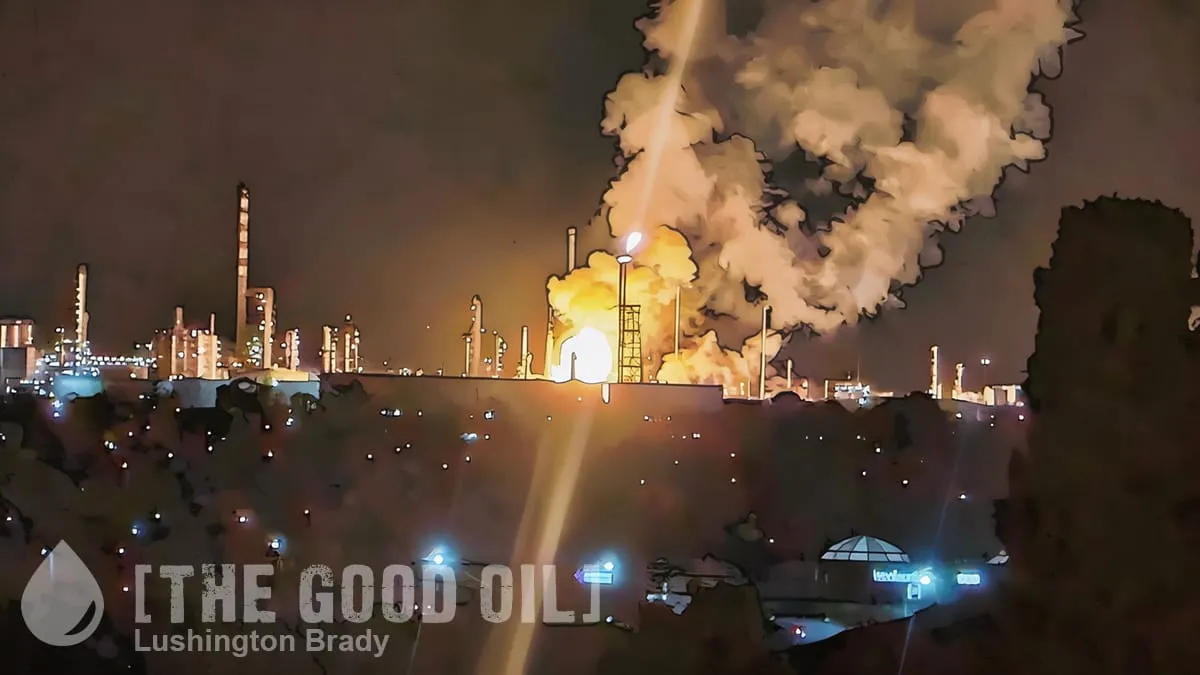
With the nation in the grip of a fuel crisis triggered by the Iranian regime’s blockade of the Strait of Hormuz, a massive fire at one of only two remaining oil refineries in Australia is naturally sparking a lot of questions.
Firstly, of course: how did we let ourselves get to this pass? Why does a nation of 27 million people have only two working oil refineries, when it once had seven, to service a population half that size? We know the answer to that one, unfortunately: Climate Cultism. If the Cult had had their way, we’d have no refineries. It was only swift action by the then-Morrison government that stopped our last refineries being sold off and shut down.
The other question that immediately sprang to mind was: was it sabotage?
This is not an unreasonable question. Sure, Australia may seem a long way away from and irrelevant to the war in Iran. But the same was true of ‘Palestine’ – which didn’t stop the Iranian regime sponsoring ‘pro-Palestinian’, anti-Semitic terror attacks in Australia. The regime has also, it has emerged, seeded sleeper agents in Western countries around the world.
So far, though, it looks like just one of them coincidences.
The exact cause of a major fire at one of Australia’s two main oil refineries is still under investigation, as questions persist as to how the blaze will impact the nation’s fuel supply […]
One analyst warned the fire “couldn’t come at a worse time”, though others have said it’s too early to predict the impact of the blaze on fuel prices.
The refinery can – when it’s not on fire – process up to 120,000 barrels of oil per day. It produces such critical materials as petrol, diesel, LPG, jet fuel and avgas, refining the products from crude oil. It also produces marine fuel oil, low aromatic fuel and plastic feedstock used to create food packaging, medical equipment and polymer banknotes.
Emergency Services were called following reports of explosions. They found flames burning approximately 30 metres high, with one witness reporting the fire sounded like an intense vacuum […]
Investigations will soon get underway to understand the cause, but authorities do not believe it was suspicious.
FRV has said an “equipment failure” was to blame, with the fire fuelled by a “significant leak of liquid hydrocarbons and gases”, which was detected by workers on site at the time of the fire.
This afternoon authorities said the leak was caused by the mechanical failure of a piece of equipment, but further details like how the fire was lit, was still under investigation.
As one expert pointed out – somewhat redundantly, perhaps – engineers “spend a lot of time and effort making sure that [fires] don’t occur” at fuel refineries. One would certainly hope so.
Ross Stidolph, the former engineering and maintenance manager at BP’s Kwinana refinery near Perth, said fires and explosions were the biggest risks managed by refiners.
As a result, Mr Stidolph said overwhelming efforts went into “identifying and mitigating” the possible ways in which fires might occur.
He said it was “very rare” for major fires to break out at refining facilities in Australia or other developed countries.
Refinery Manager Bill Patterson hosed down claims that a lack of maintenance was to blame.
“There was no delayed maintenance in relation to this specific unit,” he says.
“There wasn’t a link between any delays of maintenance and this event, that we know of.”
He also let slip that the explosion has damaged a part of the refinery that Australians really, really, didn’t want damaged, right now.
Mr Patterson says the units impacted last night relate to a part of the refinery that combines LPG to create “gasoline-type” molecules.
Mr Patterson said the specific area impacted by the fire is involved in LPG production and low aromatic gasoline (a product designed to reduce petrol sniffing) which is supplied to some remote parts of Australia.
(Stage whisper: they mean Aboriginal communities.)
While there is not clear information about the impact on national fuel supplies, one energy analyst noted the impact on specifically petrol could be significant.
Kevin Morrison from the Institute for Energy Economics and Financial Analysis (IEEFA) said Australia’s two local oil refineries (in Geelong and Brisbane) produce more petrol than diesel or jet fuel.
He said both refineries produce about 100,000 barrels of petrol each day or about a third of Australia’s petrol requirements, and any supply shortfall “couldn’t come at a worse time”.
He’s not just whistlin’ Dixie, there.