Table of Contents
Ani O’Brien
Like good faith disagreements and principled people. Dislike disingenuousness and Foucault. Care especially about women’s rights, justice, and democracy.
It’s election year so we are getting served up a whole load of political storytelling. The parties have their narratives, but our political leaders are also shaping the way they want to be seen by the New Zealand public. Chris Hipkins’ strategy hasn’t changed. He is still running as the “relatable leader”, the “practical dad”. He is also trying to balance his image as pro-environment, proactive on climate change, without being seen as a fruitloop. The hardcore environmentalists will vote Green, he just needs to demonstrate that he is on board with the kaupapa, so to speak.
Chris Hipkins’ recent interview with Rewiring Aotearoa paints the picture of a reluctant but pragmatic convert who ran the numbers, made the switch to electric, and discovered that doing the right thing for the planet also just happens to be great for the household budget.
He talks about installing 12kW of solar, switching from diesel to an electric car, induction cooking, and about running the calculations on a green loan. He describes electric vehicles as “guilt-free” and electrification as largely a “mental hurdle” people need to get over.

The guy interviewing him, from Rewiring Aotearoa, says:
If we electrify all the homes in New Zealand, which is obviously heating, water, cooking, cars, and we put solar panels on the roof and a battery in the garage, the homes of New Zealand will save $29 million a day.
It’s a seductive narrative, no doubt. The idea that the future is clean, financially savvy, and mostly just held back by sticks in the mud with a mental block is a nice story. The problem is that it isn’t true or fair. Because what Hipkins describes is not cost neutral. The cost of change is in fact the true barrier.
Around 44 per cent of New Zealanders could not cover a $5,000 emergency let alone be able to fund an electric makeover.1 And what Hipkins is describing is not a $1,000 a year tweak. It is, in 2026 New Zealand, a $95,000–$100,000 capital transformation. Additionally, not all of us can stick the cost on the taxpayers’ tab.
What does it actually cost to “live green” the way Hipkins describes?
He talks about electrifying “heating, water, cooking, cars”, adding solar panels to the roof, a battery in the garage, and charging electric vehicles from sunshine.
Taking the electric vehicle first, a mid-range family EV in New Zealand today sits somewhere between $50,000 and $75,000. Even if you shop carefully and avoid the top trim, you’re realistically in for about $60,000 for something that works for a six person household, as Hipkins’ claims his is. Then you need a home charger, which has installation costs, switchboard compatibility adjustments, and wiring. We can estimate that would be another $2,000 to $3,500.
Now let’s look at the induction conversion. Hipkins says he “loved cooking with gas” but now he has induction he wouldn’t go back. Induction cooktops retail for between $1,500 to $4,000, but many homes require electrical upgrades of an additional $1,000 to $3,000 to accommodate the change. To cover off disconnecting gas lines and plumbing changes let’s add another $500 to $1,500. So for induction mid-range you’re at about $5,000. *[Update in footnote]
Solar. Hipkins says he installed a 12kW solar and battery system, which is at the high end for residential. A set up of that size would usually require 30-35 solar panels and is not a modest starter kit. That kind of system is designed for large households, EV charging, battery integration, and high annual consumption. A 12kW system in New Zealand typically costs $18,000–$25,000 installed. If paired with a battery, total system cost can easily exceed $35,000–$40,000.
To avoid inflating our cost estimation for ordinary New Zealanders, I’m going to go with a more typical system: 5–8kW residential solar installations cost in the area of $12,000 to $18,000. Add a battery, and we will because Hipkins talks enthusiastically about batteries removing pressure from the grid, and you’re looking at another $14,000 to $20,000. So let’s put solar plus battery at roughly $30,000.
All put together, to “go green” like Chris Hipkins New Zealanders would have to pay approximately:
EV and charger: $60,000–$65,000.
Induction conversion: $5,000.
Solar and battery: $30,000.
Total: $95,000–$100,000.
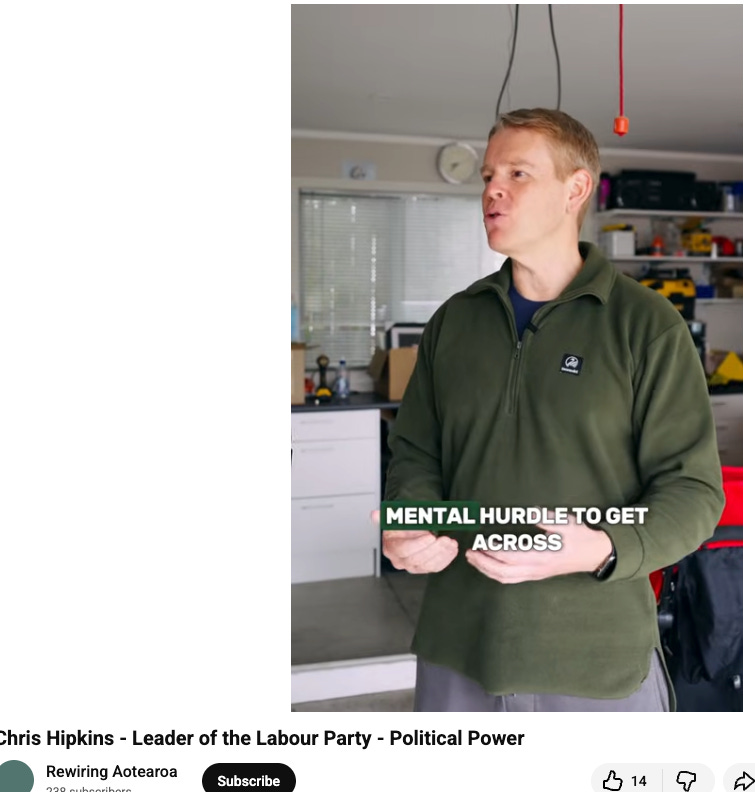
Even if you trim it back with no battery, a used EV, and minimal upgrades, you are still staring down $35,000 to $45,000 upfront. Chippy, that is not a “mental hurdle”.
Power bills are high? Go green! Go electric! Get solar! It feels terribly like “let them eat cake”.
This so-called solution is being presented during a time of ongoing cost of living pressures. Although inflation has come down from the heights of 7.3 per cent when Hipkins was last prime minister, we are still at 3.1 per cent and hoping that no new international shocks interrupt our recovery. The legacy of Hipkins’ government’s massive spending, immense waste, and Covid-19 pressures, means food prices remain elevated, insurance premiums are climbing, and power bills continue to rise. At least rents have stopped skyrocketing.
In this context, the idea that households are hesitating to transition to electric because they’re psychologically resistant to induction stovetops or emotionally attached to their 12-year-old Toyota is, frankly, insulting.
Now, to be fair to the guy from Rewiring Aotearoa, he does briefly acknowledge privilege:
For guys like me, guys like you, we have space on our mortgages.
“Space on our mortgages” means equity. It means access to lending and that the bank is willing to extend credit. Hipkins says he secured a zero per cent interest loan for his solar system, to be repaid over five years via a green loan:
The bank gave me one of those interest free loans that sits alongside my mortgage, which means that I’ll pay it back in five years. So after five years, it’s all 100 per cent money that’s just coming back to offset my power bill.
It is worth noting that Chris Hipkins’ current salary, as paid for by you and I, is NZ$305,900 per year (before tax) rising to NZ$309,000 from 1st July. When he was prime minister his salary was NZ$471,000 annually (before tax). And of course, neither of these figures includes the many perks of being a senior MP.
But not everyone makes triple six figures and has access to zero per cent lending nor does everyone have equity. And while Hipkins suggests suspended loans secured against a house, repayable upon sale, as a way to help pensioners, that solution again assumes home ownership. There are only 1.2 million owner-occupier dwellings in New Zealand (2023 Census) and among those, many are heavily mortgaged and refixing at rates that have already shredded discretionary spending.
At the moment, the green transition in New Zealand is not a mass movement, it is an elite one. The upfront capital required for EVs, solar, batteries, electrical upgrades and ongoing maintenance places full electrification firmly in the realm of asset-rich homeowners with disposable income and mortgage flexibility. Home ownership itself is a prerequisite for most of it as renters cannot install panels or induction tops.
In practice, “going electric” has become a lifestyle marker of the professional class: a visible signal that you have the roof space, the capital, and the bank’s confidence to participate. And that reality grates on ordinary New Zealanders who are told this is a simple moral choice, when in fact it is a financial one they may never be in a position to make.
There is one other matter that should be acknowledged in all of this. Most New Zealanders do not get to offload the cost of electrification onto taxpayers. Hipkins describes himself as a “reluctant convert” who switched from a diesel to a Hyundai Kona EV and “would not go back”. It sounds like a recent consumer choice, right?
But his Hyundai Kona EV is part of the Ministerial Services self-drive catalogue available to ministers and the leader of the opposition.2 This was not a $60,000 purchase from his after-tax personal income. It is a taxpayer-funded vehicle entitlement and one that he has utilised for several years since he was a minister.
Parliament also installs approved home-charging infrastructure for these electric vehicles. That means the EV charger at his house was also not an out-of-pocket expense. What’s more, he has access to charging facilities at parliament, meaning even the electricity cost is not borne personally if one chooses to charge it while at work.
Hipkins’ calls driving an electric vehicle “guilt free”, but perhaps what he really means is “totally free” because our taxes pay for it. Ordinary New Zealanders receive none of that support. They pay the sticker price and for the charger and for the electricity.
Oh, and one more thing! A little technicality… Hipkins still has his diesel car! He has not in fact swapped to an electric. He uses a taxpayer self-drive Hyundai Kona EV and his 2018 Hyundai Santa Fe 2.2L Diesel 4WD.
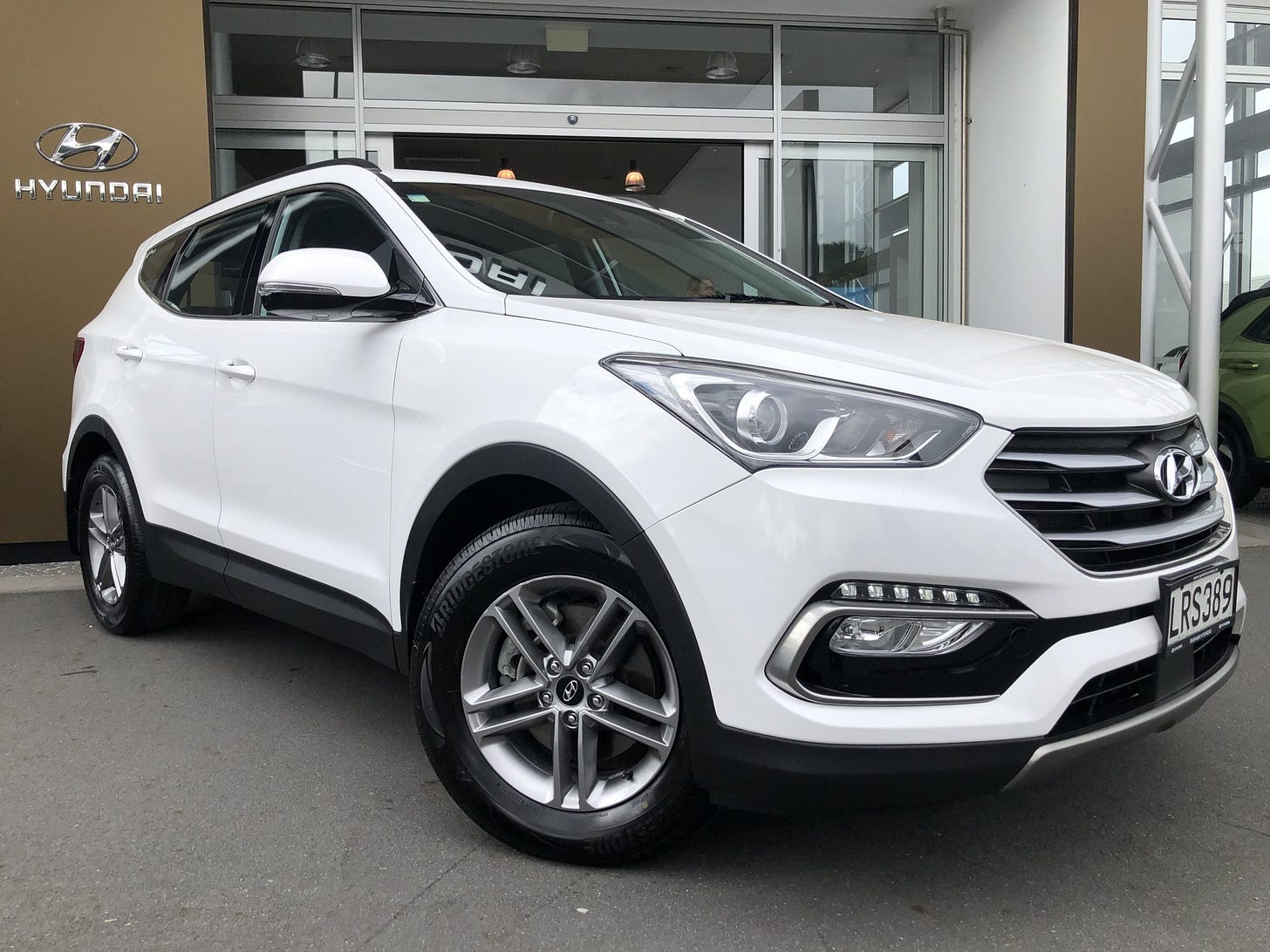
Chris Hipkins is correct that solar and electrification can deliver long-term savings under the right conditions. But the right conditions in this case include being paid more than $300,000 per year, owning his own home (and beach house), and having the taxpayers pay for a good chunk of his transition.
Considering this, it is unbelievably rich of him to put resistance to transitioning to electric down to some kind of psychological clinging to the past. If Hipkins and Labour are serious about running with electrification as an election policy, they need to acknowledge reality and grapple seriously with the upfront cost divide. Because this version of climate leadership is not actually inspiring. And it’s not a mental hurdle, Chippy. It’s a six-figure one.
1 https://sorted.org.nz/guides/saving-and-investing/how-to-build-up-your-emergency-savings
2 https://fyi.org.nz/request/29681/response/117905/attach/6/Appendix%20A%20Self%20drive%20catalogues%202.pdf
UPDATE: Since publishing I have learned that the house Chris Hipkins has lived in since 2018 has always had induction cooktops and the house before that did not have gas either.
This article was originally published by Thought Crimes.