Table of Contents
If you were to believe the legacy media, you’d believe that conservatism is dead, and buried or cremated in Australia. But if you were to believe the legacy media about anything, I’ve got a bridge on the Moon to sell you.
What’s really happened is that the conservative vote in Australia has been fractured and leaderless, as the mainstream centre-right conservative party, the Liberals, progressively (in every sense of the word) succumbed to wishy-washy, lettuce leaf ‘moderates’. These spineless jellyfish are conservatives in name only, slavishly aping every idiotic nostrum peddled by the left – and then wondering why their base has deserted them.
The left have only looked ascendant by virtue of having the parliamentary battleground to themselves. In fact, just one-third of Australians voted for the Anthony Albanese Labor government. So, why are Labor dominating the parliament?
Because, up till now, centre-right voters have been politically homeless. As happened in Britain and the US, the mainstream conservative parties betrayed and alienated their base. But, in Britain, Reform have roared up the polls to become the de facto opposition party. In the US, Donald Trump revitalised the Republican base, even as the party establishment fought him tooth and nail.
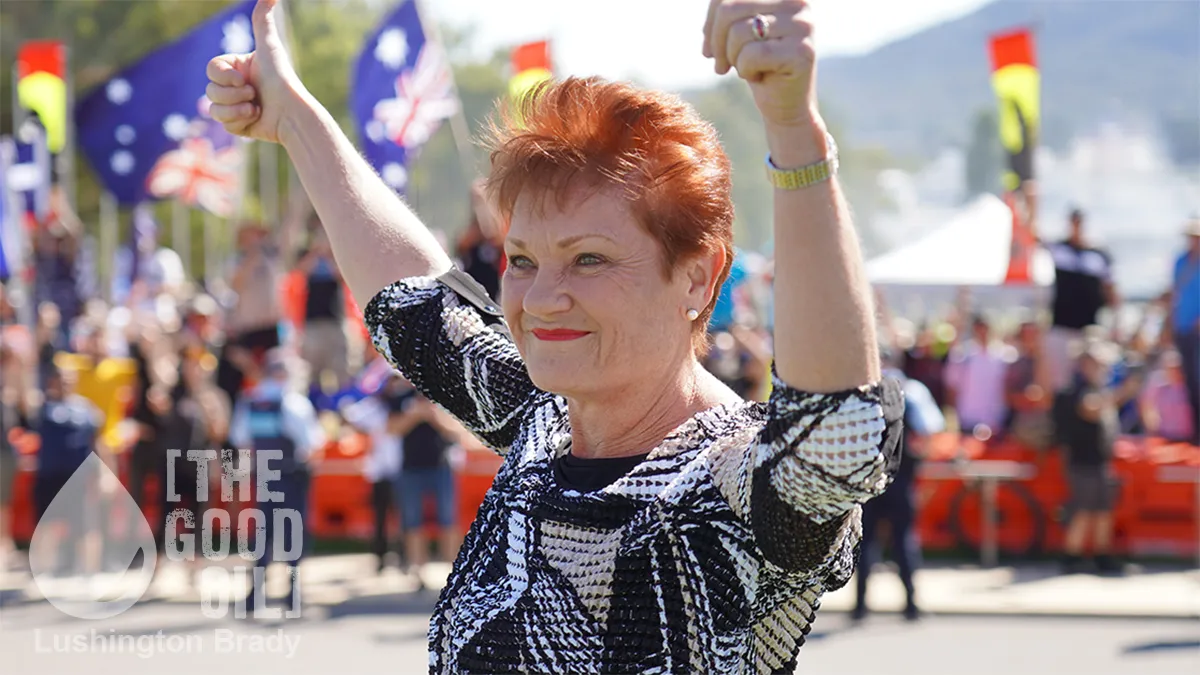
It’s taken years and a couple of election cycles, but a new mainstream centre-right opposition has suddenly surged to the forefront of the polls. Even more than Reform in the UK, One Nation’s success has been like Campbell’s descent into poverty in The Sun Also Rises: “Gradually, then suddenly”. Leader Pauline Hanson, even more than Nigel Farage, has tenaciously lurked at the fringe of mainstream politics, reviled and dismissed by the Establishment and its legacy media bootlickers.
Until, suddenly, she is bang at the forefront and enjoying enormous popularity. One Nation’s A Super Progressive Movie, and its theme song, are respectively selling out their limited screenings and zooming up the pop charts. In three successive polls, One Nation have surged ahead of the established opposition.
At the same time, the polls show both Labor and the Greens slipping from their positions at the last election. In total, Labor and the Greens – the left vote, in other words – hold just 43 per cent of primary votes. Their combined vote has dropped nearly four per cent since the election.
One Nation and the coalition’s combined vote is also 45 per cent. While the coalition’s vote has nearly 11.6 per cent, One Nation’s has skyrocketed by just shy of 19 per cent.
The remaining 10 per cent are split between independents and ‘other’. The percentage of independents is falling, suggesting that the dissipation of the vote is falling.
Outside of the inner cities, something even more telling is happening.
One Nation have traditionally been regarded as a rural protest vote. Unsurprisingly, then, their polling in rural areas is a staggering 35 per cent, ahead of Labor by nearly a third. But in outer metropolitan seats, once Labor heartlands, One Nation is nipping at Labor’s heels. Currently, they sit at 27 per cent to Labor’s 30.
Of course, it’s the two-party-preferred vote that ultimately matters, in Australia’s preferential system. This is looking worrying for Labor, too.
On a traditional split of Labor-coalition, Labor are well ahead, on 55 per cent to the coalition’s 45. Splitting it between Labor and One Nation delivers an almost equal result.
But what if One Nation enters into a power-sharing agreement with the coalition, as Labor did with the Greens in 2010? Such a prospect must have Labor strategists terrified. So we can expect an intense campaign to pressure the coalition to ‘put One Nation last’. But while such a pressure tactic has worked while One Nation were the untouchables, its impact will be blunted by the party’s soaring popularity.
In fact, given the poor public standing of both, the more the media and the left try to demonise One Nation, the more likely voters will give them the finger and shout, ‘Onya, Pauline!’
Compounding Labor’s reasons to worry is the PM’s plummeting personal popularity. As we saw during the Voice campaign in Labor’s first term, Albanese is the ultimate hollow man. Confronted with a determined opposition instead of a disunited rabble, he fumbles the ball like an imam playing rugby with a bacon-greased pigskin. Albanese’s pathetic response to the Bondi massacre has damaged him even more, with his approval ratings slipping further into the negative.
Meanwhile, on the hot-button issue of immigration, One Nation is the only major party whose policies reflect public sentiment. And they’re not afraid to say so. Voters overwhelmingly want reduced immigration, as poll after poll shows. Nearly half want immigration slashed. One Nation is the only party to have such a policy.
There are dangers ahead, of course. Two years is a long time till the next election. But that’s also a plus for One Nation. To even come close to realising its ambitions, the party has to recruit a slew of new candidates to stand in the lower house, which amplifies the possibility of a gronk or two slipping through the pre-poll vetting.
This is a problem for all parties, of course, but the legacy media will go absolutely berserk with glee should even a single One Nation candidate have even so much as a single ‘problematic’ social media post in their past.
But, shoals and pitfalls notwithstanding, One Nation has got to have strategists for both major parties facing many sleepless nights ahead.