
Emzari Gelashvili is a former member of parliament of Georgia (7th Convocation) and former senior official in Georgia’s Ministry of State Security, Ministry of Defense, and Ministry of Internal Affairs.
A recent Gallup poll, conducted in August 2025, found that 66 per cent of Democrats view socialism favorably – while only 42 per cent of those same Democrats viewed capitalism favorably. At protests across American cities, demonstrators have carried Soviet flags, the hammer and sickle on red cloth, as symbols of resistance. Senator Bernie Sanders, Representative Alexandria Ocasio-Cortez, and Zohran Mamdani – the new mayor of New York City – have built careers on the promise of democratic socialism, drawing crowds of young Americans who see that word not as a warning but as a hope.
I am not going to answer them with statistics or economic theory. I am going to tell them about my grandfather, my father, and myself. Three generations. One system. One verdict.
Part One: The Night of February 25, 1951
In the village of Bebnisi, in the Georgian Soviet Socialist Republic, 14-year-old Shota Gelashvili had fallen asleep over his German language textbook. He had a test the next morning at Bebnisi Secondary School. The book lay open beside him in his bed.
His parents, Vakhtang and Ekaterine, had gone to sleep. Ekaterine was visibly pregnant. Shota’s sisters – Izolda, born 1939, and Meri, born 1941 – were asleep. Their grandmother, nearly 100 years old, had also retired for the night.
At two in the morning, soldiers of the NKVD – the Soviet secret police – stood over them in the darkness. The order was simple: dress quickly, make no sound, come with us. There was no time to gather belongings. As the soldiers searched the room, one of them pulled Shota’s German textbook from his bed. They passed it from hand to hand, then gave it to the commanding officer – as if a schoolboy’s grammar book confirmed what they already believed.
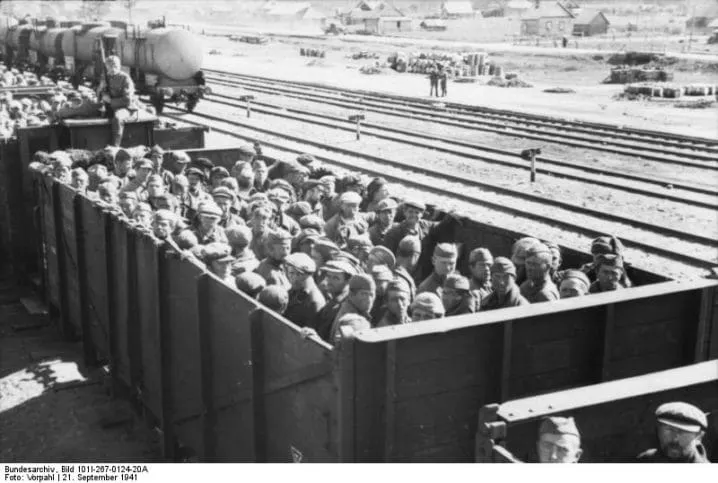
The family was loaded onto a truck and taken to the railway station in Khashuri. There, a train of 14 freight cars was waiting – cattle wagons, the kind used to transport livestock. Soldiers beat people as they forced them inside: children, women, elderly men, the pregnant Ekaterine. They used rifle butts. They screamed “faster.” There was no toilet, no water, no food.
For three days the train did not move while more families arrived from villages across Georgia. Inside the sealed wagons, people hung clothing across one corner to create a makeshift toilet. Imagine dozens of human beings locked in a freight car in the winter dark – that curtain of clothing the only barrier between dignity and its complete erasure.
A young man, maddened by thirst, jumped from his wagon to reach water from a stream. The soldiers shot him on the spot.
Through a relative with connections, a freshly slaughtered pig was quietly passed into Vakhtang’s wagon. Dozens of people ate it raw. They had nothing else. For the entire four-week journey to Kazakhstan, the train stopped only twice to allow prisoners near water – and even then, only two people per family were permitted to leave the car. One man had already been shot for trying.
At the end of it, the wagons were stopped on an open steppe and the people were told: this is your new home. A flat, empty field. No shelter. No explanation.
Part Two: The Man Who Was Called “The Forest Man”
Vakhtang Gelashvili was the chief engineer-mechanic of the local tractor station – the most technically skilled man in his region. He was also physically extraordinary: enormous in frame, covered from head to toe in thick body hair, with a strength that became local legend. The school principal of Bebnisi would tell students for decades that Vakhtang could pull a DT crawler tractor forward with his bare hands and lift a grown man by the shoulders like a sheet of paper.
In 1941, Vakhtang was drafted and sent to the front. The soldiers were loaded into trains without weapons. Before they could be armed, the train was bombed and captured by German forces. Vakhtang became a prisoner of war.
He passed through the Dulag camps and was transferred to Stalag 352 at Masjukowshchyna, near Minsk – a place prisoners called “pure hell,” where historians estimate more than 100,000 people died.
When the Germans saw Vakhtang – his enormous frame covered in hair – they called him “the forest man.” Officers came from other camps just to look at him. A German general had him wrestle prisoners, then brought in a decorated German champion. Vakhtang defeated him so decisively that the guards prepared to shoot him. The general intervened and saved his life.
The general’s intervention was meant as mercy. Vakhtang understood it as opportunity. On February 17, 1942, he organized 15 prisoners and they walked out through the gap the guards had stopped watching. They fled into the forests of Belarus. After two weeks on the run, he reached a village, joined the partisans, and eventually fought with the Soviet forces until 1945.
He came home alive to a house he had built himself from basalt stone — large, well-furnished, with its own natural spring. The house stood. The family was whole.
The local Communist Party officials could not forgive it. A man they could not surpass in skill or intellect, whom workers respected and whose presence commanded a room – he was, to them, a permanent reproach. They put his name on a deportation list with two accusations: former prisoner of war, and kulak.
Not a trial. Not evidence. Not a hearing. Two words written beside a man’s name, and the machinery moved.
Part Three: The Steppe
On the open steppe of Kazakhstan, with no shelter, Vakhtang and the heavily pregnant Ekaterine dug a pit in the earth and lived in it. Guards on horseback drove the ‘special settlers’ to work with whips. Children labored alongside adults.
Vakhtang fixed two broken tractors that no one else could repair and was transferred to the tractor station. One afternoon, Shota and two other boys picked a watermelon from the fields. A Kazakh guard opened fire. One child was killed. Shota ran.
Boys kept disappearing from the camp – taken to labor on the Amu Darya-Syr Darya canal. Shota was among them. After three months of brutal work, he organized the surviving boys and they escaped under fire.
Shota’s younger brother Mikheil was born in the camp in 1952. To keep him quiet while she worked, Ekaterine was told to give him a brew of poppy seeds. He drank it throughout his infancy. In adulthood, he would struggle with alcohol.
There was a man in the camp the guards feared – a Georgian-born ethnic Greek known only as “Greki.” He lived alone, spoke little, and seemed indifferent to authority in a way that unnerved even armed men. When Kazakh guards tied Shota’s hands and feet to two horses, intending to pull him apart for defending his mother against a guard who had cheated her at the weighing station, it was Greki who appeared. The guards dropped the reins and fled without a word. Greki kept Shota for two months and told Vakhtang plainly: a father who leaves his child unprotected in this place is failing him. In a camp designed to break people, Greki remained unbroken – and that, it turned out, was the only protection that worked.
In 1953, after Stalin’s death, two young Georgian colonels arrived in the camp. Of the 14 wagons that had left Georgia in 1951, only two wagons’ worth of families were told: your deportation was an error. You are free. The Gelashvilis were among them. Both colonels wept as they embraced the freed families.
Years later, when I was vetted for the Ministry of State Security, the document from Moscow on Vakhtang Gelashvili read: fully exonerated. All charges groundless. I read it myself.
Of fourteen wagons that left Georgia in the winter of 1951, only two wagons’ worth of people were told: your deportation was an error. You are free.
Part Four: What the System Leaves Behind
The family returned to Bebnisi. Shota and his sisters were two years behind in school. The label “enemy” did not disappear with a piece of paper. Neighbors had taken their furniture, dishes, and carpets.
Vakhtang rebuilt what he could through hard labor on the ancestral land, but at 46 his heart gave out. The system had kept the account.
Shota rose through skill and intelligence alone, refusing to join the Communist Party. He became director of a wine factory and then a juice factory, all while secretly listening to Radio Free Europe. After his father-in-law’s protection ended, the party came for him. They tried to destroy him with a fabricated case. He was acquitted but then made unemployable. He survived, as his father had, by farming the land.
In 1989 he proposed Georgia’s first private family lease – five hectares of orchard with a high quota. It worked. It was shut down after Shevardnadze returned to power. The same motion, different name.
Part Five: The Son
I was born in 1972. I am Shota Gelashvili’s son.
I grew up knowing exactly what socialism was, because my father made sure of it – not through lectures, but through the specific weight of the stories he told. The German textbook. The cattle wagon. The children who disappeared from the camp. The two colonels who wept.
In 1990, I passed the entrance examination for the Georgian Technical University on merit. In 1991, Georgia declared independence. The people breathed. It did not last.
Russia – the Soviet Union’s direct institutional heir – moved to recover what it considered its sphere. Civil war followed. The war in Abkhazia followed. The economy collapsed into hunger, corruption, and criminality. Everything my father had described about the Soviet system appeared again, under different names.
In my final semester at university, the dean called me in. Two officers of the Georgian Ministry of State Security were waiting. They had identified me as a candidate for recruitment. I asked for time to speak with my family.
My father and I spoke privately. I told him: if Georgia had ever had a chance at genuine independence, and if that chance was to come again, then someone had to be inside building institutions rather than only criticizing them from outside. My father – who had spent his entire life in quiet, unbroken resistance to the system – listened. Then he agreed.
I rose through the ranks. In 2003, the Rose Revolution removed Shevardnadze. Mikheil Saakashvili became president. Georgia turned toward the United States and Europe. For the first time in my life, the direction of my country matched what my family had always known was right.
In 2008, Russia invaded Georgia with military force. I was there. I survived.
In 2010, Georgian intelligence obtained a GRU document – Russian military intelligence – listing 20 Georgian officials marked for physical elimination. I was third on that list. For six months, the Georgian security services protected me without my full knowledge, because the plan was to detonate an explosive device in my vehicle.
I served as a member of parliament – Seventh Convocation, majoritarian deputy for Kareli. In 2012, Bidzina Ivanishvili – a Georgian-born oligarch whose fortune was built in Russia – won the parliamentary elections. We transferred power democratically. Then the persecution began. Colleagues warned me: they did not want only to arrest me. I fled Georgia.
I am writing this from San Francisco.
My father had spent his entire life in quiet resistance to this system. He listened to what I was asking. Then he said yes.
Part Six: Even in Exile
I left Georgia in 2012. I was 41 years old. I had built a career, served in parliament, worked in intelligence, survived an assassination list. In the first months in the United States, I ate twice a week. Not twice a day. Twice a week. I had no income, no savings, no safety net. I sat in San Francisco and counted the days between meals. This is what the system leaves you with when it is done with you.
My father watched it all from Bebnisi. He watched me be smuggled out of the country. He watched me begin again with nothing. And then the system reached across the ocean for him too.
Ivanishvili’s government sent activists to the village with blank sheets of paper. They told residents they were signing something routine. Those sheets became petitions demanding Shota Gelashvili’s land and property be confiscated. Complaints were filed at every level of government. Women activists confronted him on the street. The village refused to turn against a man they had known all their lives.
There is video. Leri Khabelovi, a Georgian Dream member of parliament, sits furious at a municipal meeting because the campaign is not working. He instructs officials to escort villagers to file complaints and calls on people to physically enter my father’s home. “The village,” he says, “is being too passive.”
Before the 2012 elections, Ivanishvili himself stood at a public rally in Kareli and named me by name. When his party won, he said, they would take my property. My family’s property. He did not say this in a closed meeting. He said it at a rally. Into a microphone. As a promise to his supporters.
My father had watched socialism destroy his own father at 46. He had watched it strip him of his livelihood twice. He had survived deportation, Soviet courts, and decades of persecution. And now, in his 70s, he watched the same system cross an ocean to come for his son’s family in the village where he had lived his entire life.
He had suffered a stroke in the 1990s – the weight of decades finally breaking through. In 2016, his heart gave out. My mother, broken by the same years of fear and persecution, suffered a stroke and died in 2018. I could not be there for either of them. I mourned them both from San Francisco, alone, across an ocean the system had put between us.
He did not live to see his son build something in America. But he knew what I was trying to do. We had agreed on it, years before, in a quiet conversation. He had said yes. He said yes until the end.
What Is Behind the Flag
The Gallup poll does not ask respondents to define socialism. It asks only whether their impression is positive or negative. Most Americans associate the word with equality and government services – not with deportation lists, not with sealed cattle wagons, not with children hauling earth until they die of heat, not with a bullet that ends a young man’s life because he was thirsty.
They are voting on a word. They have not been asked what the word contains. I have been asked. My family paid for the answer.
When I see protesters carrying the Soviet flag through American cities, I see the flag of the system that pulled a 14-year-old boy from his bed at two in the morning because he had a German grammar book on his pillow. I see the flag of the system that shot a young man for drinking from a stream. The flag of the system that tied a child’s hands and feet to two horses for defending his mother.
My grandfather survived a Nazi prisoner-of-war camp and Belarusian forests, then came home and built something beautiful – only to be destroyed for it at 46. My father survived Kazakhstan, rebuilt himself twice, and was stripped of his livelihood because he would not pay a bribe. I ended up on a Russian military intelligence elimination list and fled my country. Three generations. The same system. The same motion: flatten what is strong, punish what refuses to bend, exile what cannot be broken any other way.
Socialism – in practice, not in theory; lived, not lectured – is not a policy. It is not Scandinavia. It is a machine with one consistent function: it destroys the people who are capable enough, principled enough, or stubborn enough to threaten those who operate it. It does this legally, bureaucratically, and when necessary, with a rifle.
Dressed in the language of democracy and fairness, it is a malignant tumor: it adapts, changes its vocabulary, finds new hosts. But it does not change what it does.
In 1988 – the same year my father was secretly listening to Radio Free Europe, a broadcast Soviet law classified as a crime – Bernie Sanders sat bare-chested in a banya, wrapped only in a towel, singing “This Land Is Your Land” with his Soviet hosts over vodka toasts. He later called it “a very strange honeymoon.” His hosts knew exactly what to show him, and what to hide. My father knew what was being hidden. He had lived inside it.
Before you carry that flag – before you cast that vote, before you cheer that candidate – I ask one thing: know what is behind it. My family paid for that knowledge with their bodies, their decades, their country, and their lives. The least you can do is learn it before you celebrate it.
My grandfather did not get that choice. Neither did my father. I nearly did not get it either.
This article was originally published by RealClearDefense and made available via RealClearWire.



![[The Good Oil] Stuff Up of the Day](https://storage.ghost.io/c/31/f4/31f4e20a-0315-499e-83ff-139e8eab53bf/content/images/size/w1304/format/webp/2024/09/Stuff-up-image-1.webp)


