
This is edition 2026/092 of the Ten@10 newsletter.
Hi all,
This is the Ten@10, where I collate and summarise ten news items you generally won't see in the mainstream media.
Enjoy!
1. Democracy Briefing: The Landlord Parliament
Bryce Edwards
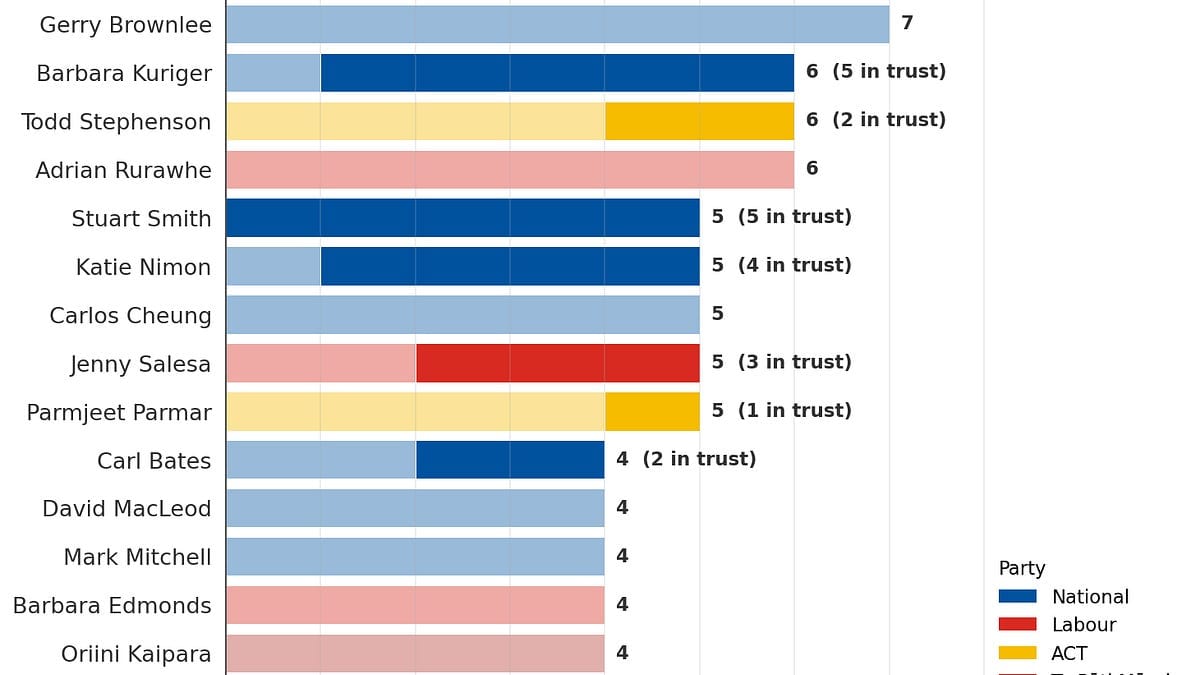
- 🏛️ New Zealand's annual Register of Pecuniary and Other Specified Interests was tabled in Parliament, revealing 271 declared properties across 121 MPs — roughly 2.24 properties per MP.
- 🔵 National MPs are the most property-heavy caucus, averaging 2.82 properties each, with more than half owning three or more properties.
- 🟡 ACT and NZ First MPs also sit well above the one-home norm, while Labour MPs average lower than the governing parties.
- 🌿 The Greens are the outlier caucus, with less than one property per MP on average and several MPs declaring none at all.
- 🏢 The largest individual declarations include National's Andrew Bayly and Gerry Brownlee, each with seven properties, and Barbara Kuriger with six.
- 🟡 ACT Parliamentary Under-Secretary Todd Stephenson declares six properties across Queenstown, Wellington, Sydney, Geelong, and Te Ānau.
- ⚠️ The register was published the same day the Government announced social housing tenants will be required to pay more of their income in rent and face tighter eligibility criteria.
- ⚖️ Social Development Minister Louise Upston claimed $52,000 in parliamentary accommodation allowance last year while jointly owning a Wellington apartment with no declared mortgage debt.
- 🔥 Upston is simultaneously tightening the Accommodation Supplement threshold for ordinary New Zealanders, requiring households to contribute more before receiving support.
- 📰 When Stuff asked whether Upston would herself meet the 40% income-contribution threshold she is imposing on others, she declined to answer.
- 💰 MPs receiving parliamentary accommodation support face no equivalent means test, despite ministerial salaries reaching $320,600 per year.
- 📊 The register reveals Parliament is overwhelmingly asset-rich and insulated from housing insecurity experienced by hundreds of thousands of New Zealanders.
- 🏛️ The article argues the housing policy debate focuses on unfairness between low-income groups while largely ignoring the system's tilt toward landlords and property investors.