The war in Ukraine might be a bloody squabble between two corrupt former Soviet provinces, but you have to give the Ukrainians some credit. While the grifters running the Most Corrupt Country in Europe might be finagling billions from gullible Western governments, they’ve also set about writing the book on 21st century warfare. While Russia launched what they thought would be a blitzkrieg of conventional 20th century armour, drones and missiles have rewritten the script.
Similarly, while the legacy media love to smirk at a supposed lack of results in the US’s war with Iran, the American military is similarly rewriting the rulebook in ways that the brow-furrowers of the legacy media either aren’t noticing, or don’t want to talk about. Iran, like Russia, banked on what it thought was its Ol’ Reliable strategies, in the Strait of Hormuz. But nearly two decades after Obama smirked that navies were as obsolete as horses, the US is writing the book on 21st century naval warfare.
Here is something the Iranians called their greatest strategic advantage in the Persian Gulf: three small rocky islands sitting directly at the mouth of the Strait of Hormuz, the most important 33 km of ocean on Earth.
Iran had spent 50 years turning them into layered fortresses – cruise missile storage bunkers, coastal defense radar systems, fast attack boat launch points, air defense batteries covering the entire strait. Iranian officials themselves called these islands, and I’m quoting them directly, their “stationary and unsinkable aircraft carriers.”
The islands were turned into an interlocking defensive network, crammed with cruise-missile bunkers, radar nets, fast-boat launch pads and air-defence batteries: the whole kit. These islands were the backbone of everything the IRGC Navy has done in this conflict. Every tanker swarmed, every container ship crew forced to abandon ship, every cruise missile launched at a vessel transiting the strait: all of it was planned, staged and supported from these islands. All designed to make the Strait of Hormuz impossible for any adversary to control without Iran’s permission.
On 15 July 2026, the Americans turned up at dawn and spent 90 minutes proving the “unsinkable” bit was as genuine as the Titanic’s. Greater Tunb copped a dedicated precision package that erased its coastal defences, missile storage and launch sites in one go. Two more waves that same day hammered command nodes, surveillance radars and the rest of the island network. Daylight strikes, no less. A deliberate two-fingered salute: we’re not sneaking around after dark any more.
But here is the part most people are not telling you. The island strikes were not even the most significant thing the US did that week. Not even close. I am going to give you the full picture today: the islands, the mosquito fleet, the robot boats, the Warthogs hunting speedboats at wavetop altitude, and the one moment that most defense analysts are calling a genuine turning point in how naval warfare works.
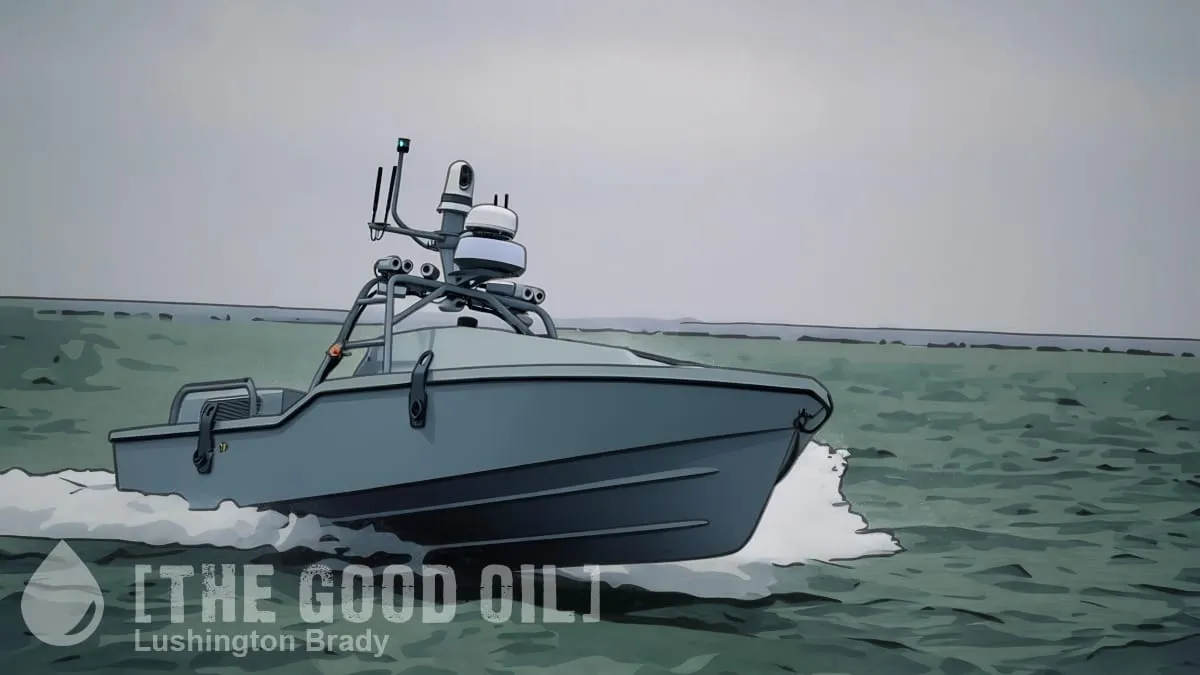
Over the past week, the US wrote a new chapter in naval history. Three Seronic Corsair autonomous sea drones – robot boats with 1,000-nautical-mile range and a 1,000-pound warhead – slipped into Bandar Abbas naval base, Iran’s main Gulf hub, and blew a Ghadir-class submarine clean out of its maintenance gantry. No crew, no risk: first combat use of American autonomous surface vessels. Footage from the drone’s own camera shows the yellow gantry, the sub hanging helpless, then black. China, Russia and every harbour-bound navy on the planet just took notes.
Meanwhile the infamous mosquito fleet, thousands of high-speed swarm boats that were supposed to make the strait a no-go zone by sheer numbers and chaos – is being hunted at wavetop level by the unlikeliest predators: A-10 Warthogs and Apache gunships. In a game-changer to rival Catalinas equipped with radar in the WWII Atlantic, the Cold-War tank-buster – that flying GAU-8 cannon with wings – is now chewing through speedboats that hide in sea caves and coral. Low, slow, brutally effective, and able to tell a fishing dhow from an IRGC suicide skiff by eyeball. The Apaches add Hellfire precision. Suddenly the swarm doctrine that worked against 1980s tankers looks a lot less clever.
To round it off, the Americans reimposed a naval blockade and enforced it the old-fashioned way: Hellfire missiles into the smokestack of a tanker that ignored warnings. Ship disabled, crew unharmed and message received. Transit numbers have collapsed from 110 ships a day to a fraction. Insurance rates are doing the rest of the work.
The legacy media will still sniff that ‘nothing is happening’, because they are looking for big, telegenic carrier battles, while the real war is being fought by robot boats, low-flying flying guns and precision packages that systematically blind, disarm and starve Iran’s asymmetric playbook. The islands that were the eyes and launch pads of the entire strategy are being dismantled. The maintenance yards that kept the submarines and boats running are burning. The mosquito fleet is being swatted one swarm at a time.
Of course, the biggest problem facing the US is not strategic: it’s political. Sooner or later, there are going to have to be American boots on the ground, not least to capture critical assets like Kharg island, Iran’s major oil terminal. But, having campaigned on ending the Forever Wars, that will be a hard political sell. Unless the US can repeat its lightning raid in Venezuela.
In the meantime, the naval rulebook is being re-written. Iran spent 50 years building a doctrine designed to close the world’s oil artery without ever winning a fleet action. In one week the Americans showed that doctrine can be unpicked, piece by piece, with tools the mullahs never saw coming.