Table of Contents
Call them ‘zombie facts’: the firmly held popular beliefs about history that just won’t go away, no matter how many times they’re debunked.
‘The pyramids were built by slaves’: while some slaves were probably used, the bulk of the labourers were freemen, such as farmers working on the building projects in lieu of paying taxes. ‘Napoleon was short’: in fact, he was slightly above average height. The ‘short’ myth comes from propaganda caricatures by James Gillray. ‘Mediaeval people thought the world was flat’: from at least 300BC, most even reasonably educated people knew the world was a globe.
I hate to break it to you, too, but Vikings didn’t wear horned helmets. Einstein didn’t fail school maths. Scientists didn’t prove that bumblebees shouldn’t fly. And van Gogh didn’t cut off his own ear.
Oh, and the Inquisition wasn’t a free-for-all of hideous torture, mutilation and murder.
Oh, hang, on, you say: everyone knows that the Inquisition was the pinnacle of mediaeval Christian barbarity. Fevered, religious, fanatical men hunting down and torturing innocent village ‘wise women’ in droves. Once again, what ‘everyone knows’ is utterly false.
The most infamous, the Spanish Inquisition, is estimated to have executed 3,000–5,000 people. But this took place over 350 years, meaning that, at the highest estimate, around a dozen people a year were put to death. If that sounds a lot to you, bear in mind that that’s maybe 5,000 people out of around 150,000 prosecutions. Meaning that the average person tried by the Spanish Inquisition had a better than 97 per cent chance of staying alive. Inquisitions in other states had a similar survival rate.
It must also be remembered that mediaeval justice was exceptionally brutal. In the reign of Henry VIII alone, around 1,600 people were executed every year for crimes from treason, to murder, rape, arson, counterfeiting and theft.
The Inquisition begins to look positively benign by comparison.
There was certainly less torture and less arbitrariness in a medieval inquisition than has often been portrayed, and more bureaucratic record-keeping. There were fewer confessions of Satanic conspiracies and sabbaths and more down-to-earth reports of non-conformist meetings and beliefs.
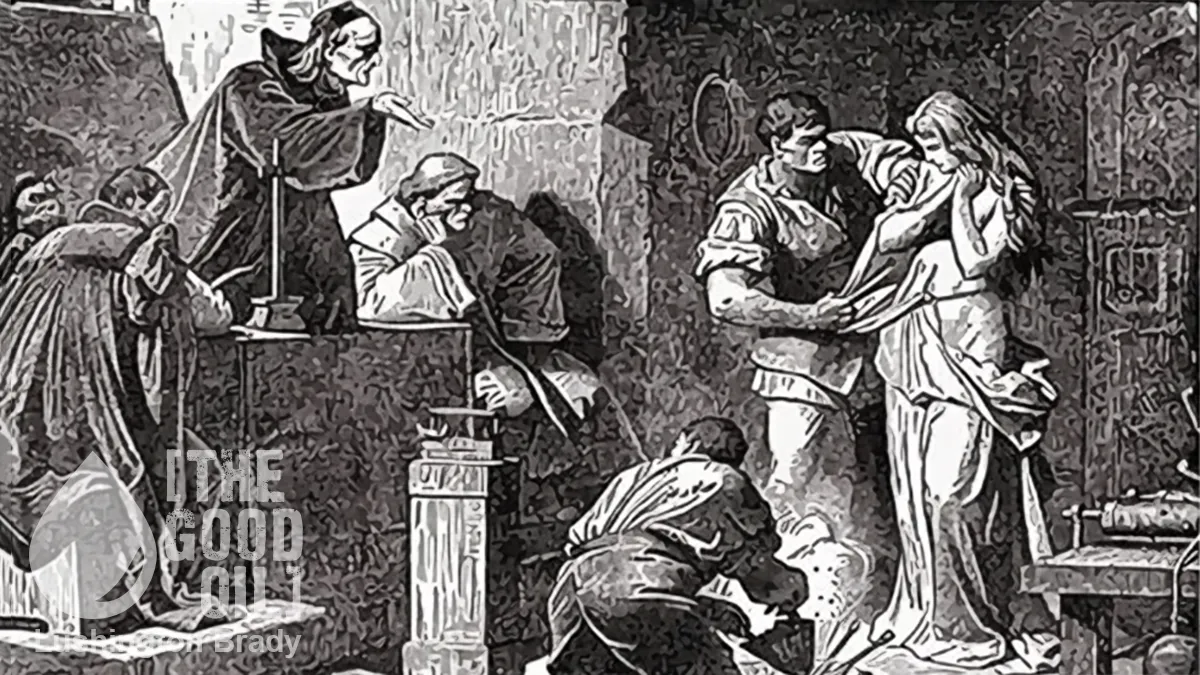
But what about the dimly lit inquisitorial chambers? To what extent were such spaces actually used for questioning subjects? And were women really subjected to the pressure of private interrogation by male inquisitors?
In fact, “images of distressed, partially stripped women being examined in private by unscrupulous inquisitors are products of later Protestant and Enlightenment imaginations”.
Rather than executing people willy-nilly, the most common punishments meted by the Inquisition were penances, confiscation of property or, in the worst cases, imprisonment.
Also contrary to popular belief, “Inquisitors only had authority over baptized Christians and did not investigate Jews, Muslims or pagans”.
Indeed, the Inquisition was founded in the first place to stop arbitrary torture and execution of innocents. Prior to the Inquisition, accusations of heresy (which, to the mediaeval mind, was an existential threat to the entire community: heretics risked bringing down God’s wrath on everyone) were heard by local magistrates, usually the local squire or some other petty official.
The church was concerned that such people, with no religious education, were in no place to judge the truth or otherwise of heresy. So, the Inquisition was, however we might regard its practices, set up to protect the innocent.
But what about all the torture?
Most often, an inquisitorial investigation was pretty much bureaucratic.
A mid-13th century Inquisitor manual declares, “To no one do we deny a legitimate defence,” and the same manual stated, “We do not proceed to the condemnation of anyone without clear and evident proof or without his confession, nor God permitting, will we do so.” The statement emphasizes the importance of fair and just trials […]
The use of torture during the Inquisitions has been greatly exaggerated, and many other related misunderstandings have endured. For example, torture was not used by the church until it was reintroduced through Roman law, and secular courts used torture before the church first approved it in 1252. Inquisitors then began using it, but only when there was substantial evidence of heresy and no confession was given. Most inquisitors chose not to utilize torture, and many questioned its usefulness […]
Torture could only be used once during the interrogation process, and a local priest, inquisitor, doctor, and, at times, local bishop must be present for it.
Torture was used only when the preponderance of evidence pointed to guilt but a confession wasn’t forthcoming. Even then, confessions made under torture had to be repeated later without the use of torture. According to French historian Régine Pernoud, in the Languedoc region of France, there are only three certain cases of torture being used in the history of its Inquisition.
So, how did a typical Inquisition case proceed?
Inquisitors came to an area, announced they were there, and gave a grace period (where heretics could confess and repent and be forgiven) of 30–40 days – they would also teach and preach the faith. The most well-known inquisitor of the medieval period, Bernard Gui, stated in his inquisitors’ manual that heretics should receive a written warning and one year to repent. After the grace period was over, the people would bring one accused of heresy (inquisitors did not hunt them down, and those who accused others would face a penalty if the accused were not guilty), and the evidence was gathered to bring a heretic to court where they would be tried. The defendant could gather evidence (and witnesses), and everything said was recorded and written down. If they were found guilty, the inquisitors would try to show the heretics why they were wrong and why their souls were in danger and try to bring them back.
The heretics received a written notice containing accusations before being charged. Heretics were protected from personal enemies, who couldn’t testify due to bias. False witnesses who accused others faced a lifetime in prison on bread and water as a form of penance.
Even if condemned to death, heretics were turned over to local authorities instead of being executed by the Inquisition.
Over-zealous inquisitors were also punished. When Robert the Dominican sent 180 heretics to the stake along with a local bishop who’d already freed them, he was suspended by the Pope and imprisoned for life.
In many instances, the inquisitors were able to save lives; overall, it is hard not to see them as doing so. For example, in 1256, the inquisitors were able to save Jews who had been falsely accused of ritual murder […]
The church prioritized letting the guilty go free over falsely condemning the innocent. This meant that there must be substantial evidence or a genuine confession that proves the accused’s guilt beyond doubt. Historian Will Durant wrote, “In general the inquisitors were instructed that it was better to let the guilty escape than to condemn the innocent, and that they must have either clear proof or a confession.”
This doesn’t mean that the mediaeval church was all sweetness and light. But the next time someone springs the ‘But whatabout the Inquistion’ gambit on you, you can be certain they don’t know what the hell they’re on about.