Table of Contents
Peter MacDonald
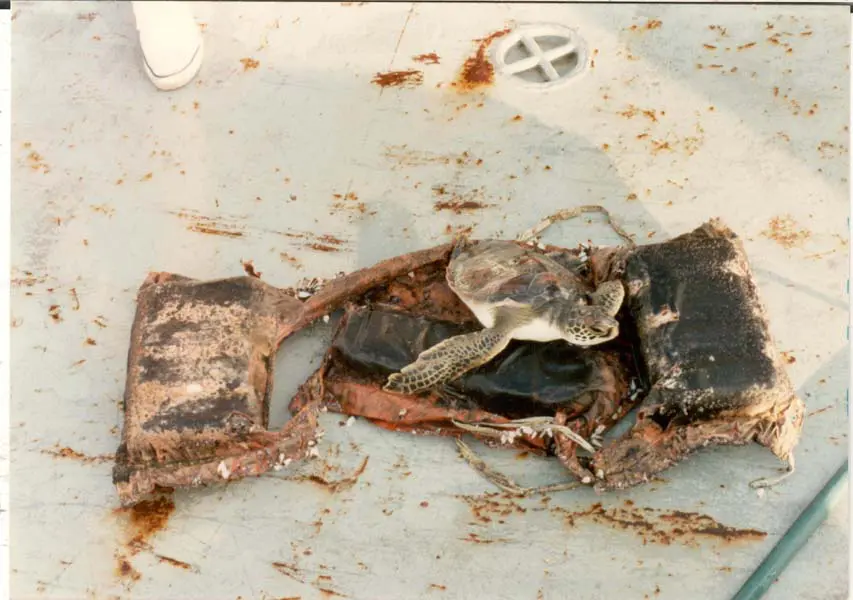
HAMILTON, Bermuda (AP) The US Coast Guard spent hours searching for a boat in distress off Bermuda’s coast even scrambling a rescue plane from the US mainland only to find a turtle behind it all.
The incident began when Coast Guard monitors picked up an emergency beacon signaling that a vessel was in trouble about 470 miles (756 km) northwest of Bermuda, Petty Officer Tim Pike of the US Coast Guard in Miami said.
The Coast Guard dispatched a C-130 Hercules aircraft from Elizabeth City, North Carolina, diverted the Norwegian tug Skandi Moegsger, and alerted nearby ships to assist in the search.
After hours of searching, the plane located the source of the signal and directed the tug to investigate.
“They pulled a turtle out of the water, and found it was somehow caught up in a rope with the beacon,” Pike said. “I don’t know what state the turtle was in.”
Beacons can be triggered by a jolt, movement, or sudden exposure to water. This one was encrusted with barnacles and debris and when traced to its registered owner, he confirmed by phone that he had lost it some time ago.
The rescue occurred in April 2003 and was quietly distributed worldwide as a one-column Associated Press brief: a charming oddity in the style of traditional newswire reports.
A Rescue and a Reflection
The sea turtle was rescued and no doubt taken to a sanctuary as the US Coast Guard has a consistent record of saving turtles and other marine wildlife caught in man-made debris. Many sea turtles today suffer from entanglements that restrict their movement, often caused by discarded fishing gear, plastic, or rope, like in this case.
What makes this case especially compelling is the idea that intelligent, sentient, beings have been observed seeking human help. There are accounts of sea turtles swimming toward boats, surfacing near people or behaving in ways that suggest an understanding that help might come from above.
One can’t help but wonder if this particular turtle, in its struggle, sensed that the emergency beacon trailing beside it could offer rescue and somehow activated it. Whether coincidence or something more remarkable, the outcome was real: a full-scale US Coast Guard response that ended with the turtle being freed.
The News We Need, But No Longer Get
This little story made its way into newspapers around the world: the kind of gem editors once prized. Small in scale, but unforgettable. These were the stories that made readers smile, pause and reflect on the wonder of the natural world and the quiet power of compassion.
They didn’t dominate headlines, but they shaped cultural memory. They were often clipped out, pinned to the fridge or passed across breakfast tables.
But such stories are rarely seen anymore. In today’s newsrooms, built around digital metrics, algorithmic popularity and screen-optimised narratives, they don’t fit. The editorial space once reserved for quirky and humanising news has been crowded out by outrage, spectacle and repetition.
A Small Miracle to Remember
These age-old snippets – once staples of news wires and print editions – added humanity to the reader’s mind. They were small miracles of perspective: a struggling creature of the sea, lifted from peril by human hands and made large and noble in print.
Such stories nudged secular readers into moments of quiet awe. A creature of God, lost, entangled and helpless, is saved. There is no sermon. Just a story. But in that story is the commandment reawakened: love thy neighbour, even when your neighbour happens to be a sea turtle adrift in the Atlantic.
These kinds of stories were legion in the pre-digital press: not because they were sensational, but because they were true, beautiful and soulful. They broke through the numbness of everyday life. They reminded us that the world is still strange, still tender and still worth rescuing.
Perhaps they jolted public perception a bit too much. Perhaps they softened readers in ways the ‘newsbenders’ of today no longer prefer. And so, they’ve been quietly removed replaced by scrollable noise.
But they mattered.