Table of Contents
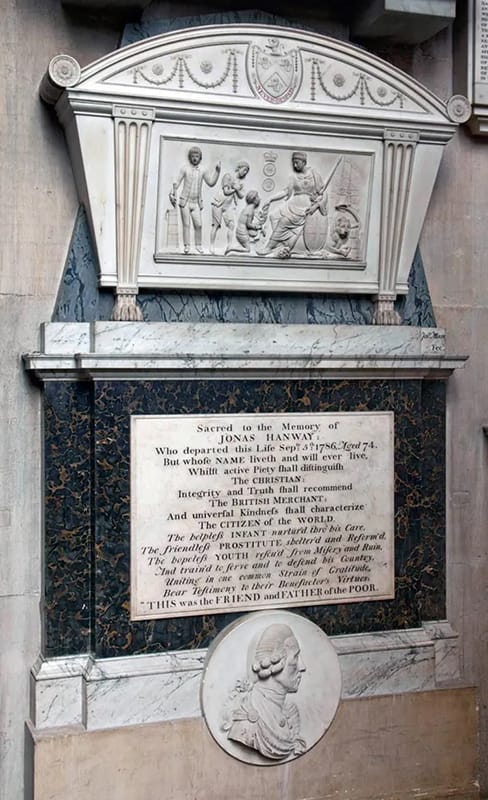
This month marked the 313th anniversary of the birth of Jonas Hanway. While not exactly a household name, Hanway made an indelible contribution to British culture – somewhat ironically, given that he vigorously opposed perhaps the most British thing of all: tea drinking.
Hanway’s opposition to tea drinking put him at odds with the vastly more famous Samuel Johnson. By contrast, his own lasting contribution to British culture earned him much ridicule and vilification in his turn.
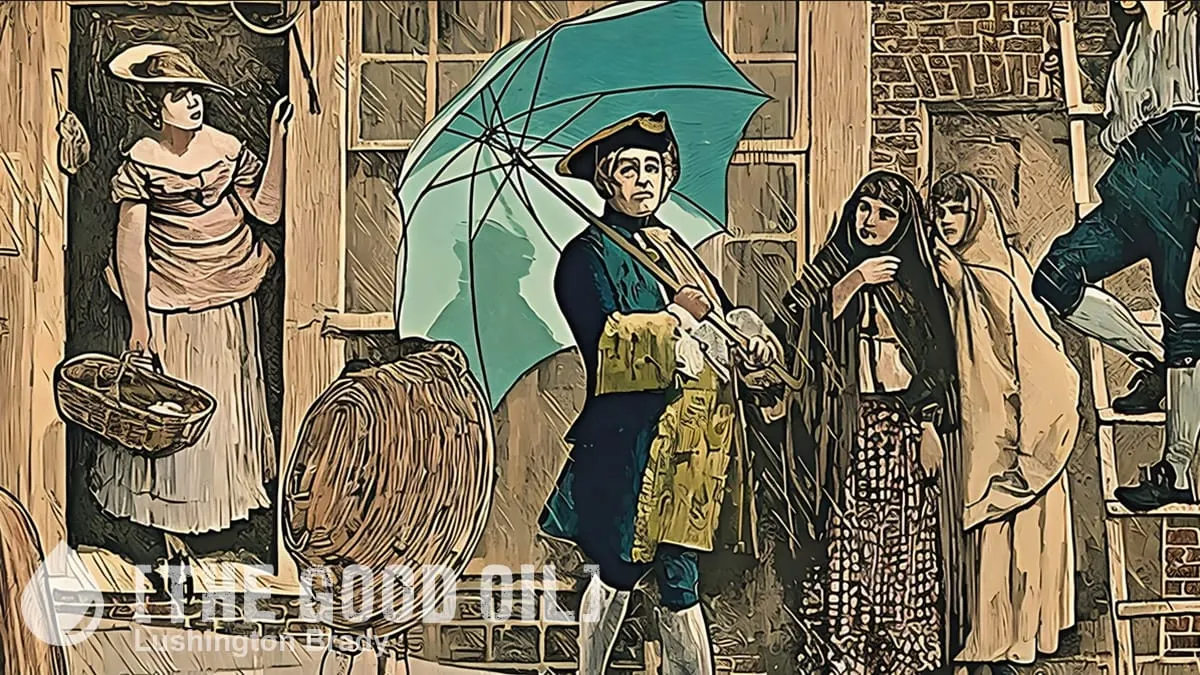
What was this lasting contribution to British culture? Hanway was the first Londoner to carry a brolly.
Today, we associate the umbrella with the quintessential Englishman every bit as much as tea and bowler hats. Three centuries ago, though, it very much wasn’t the case. Back then, umbrellas were for girly types or Frenchmen – who were even less popular in England in the 18th century than today. Consequently, Hanway’s appearing in public with an umbrella incited mocking chants of “Frenchman, Frenchman! Why don’t you call a coach?” (You had to be there, I guess.) Children jeered, too, while passing cab drivers pelted him with rubbish.
Why did something as simple – necessary, even, given Britain’s infamous weather – as an umbrella provoke such ridicule? And who was Jonas Hanway, anyway?
Hanway was a widely travelled merchant. His commercial travels led him to Russia, Persia, Germany, the Netherlands and France. His published accounts of his travels made him a man of some note. Hanway used his wealth to fund much philanthropy: he founded the Marine Society, helped establish the Magdalen Hospital and was a governor of the Foundling Hospital.
It was during his travels that Hanway encountered umbrellas in wide usage. It had been a long time coming: the umbrella was first attested in China in 500 BC, when the wife of inventor Lu Ban came up with a means of sheltering her husband from sun and rain while he worked. They were in widespread use in Persia when Hanway travelled through the region and were becoming fashionable in France as well.
But in the mid-18th century, only English women carried them. Compounding the ridicule this attracted for Hanway, umbrellas were seen as a business threat by cab drivers. Cab business always picked up when it rained, so a means of remaining pedestrian in the rain was seen as taking away valuable business. On at least one occasion, after a coach driver tried to run him over, Hanway used his umbrella to give the man a good beating.
Hanway might have been stubborn and eccentric, but he was clearly no shrinking violet. He also enjoyed the last laugh: by 1801, umbrellas were not only a common accessory for men and women, they had become known as ‘Hanways’.
By 1830, the world’s oldest continuing umbrella business was founded by James Smith, just off Regent Street (now relocated to New Oxford Street). Appropriately, the James Smith and Sons Umbrella Shop has a portrait of Jonas Hanway hanging on its wall.
It’s a long way from being pelted with rubbish for being a poncey Frog.