Ani O’Brien
Like good faith disagreements and principled people. Dislike disingenuousness and Foucault. Care especially about women’s rights, justice, and democracy.
Before “I don’t think you have, mate” there was ‘I don’t think you have, girls.’
The most shocking and damning thing about Britain’s rape gangs scandal is not that it happened. Don’t get me wrong, the fact that it happened is truly horrific, but human societies have always produced monsters. The truly unforgivable fact is that so many people knew what was happening and chose not to stop it. That is ultimately an indictment on the British establishment.
For decades, vulnerable girls in towns and cities across England were groomed, trafficked, raped, beaten, terrorised, and discarded. They were abused in Rotherham, Rochdale, Oxford, Telford and numerous other communities that would eventually become synonymous with one of the greatest child protection failures in British history. Many of them were children already failed by the adults around them. They were girls in care, girls from unstable homes, girls carrying other trauma long before their abusers arrived.
It is unforgivable that when these girls reported what was happening to them, they were frequently ignored. Or worse, when police encountered them, they were too often treated as troublesome adolescents rather than victims of organised sexual violence. Social workers and schools missed warning signs or deliberately looked the other way. Prosecutors declined cases and local politicians were worried only about protecting the Muslim vote and avoiding tensions. Institutions that existed to protect vulnerable children repeatedly protected themselves, or even the rapists, instead.
While for a long time saying even this much was unthinkable, the general facts of the rape gangs are no longer controversial. It is established by multiple inquiries, report after report, court case after court case that overwhelmingly Pakistani Muslim men raped and trafficked British girls. What now needs to be grappled with is how it happened and how every single part of the establishment failed these girls. It is also really important that the public understands just how depraved and widespread the horrors were. We cannot let anyone look away. This is the scandal of our time and while large sections of the media and the political establishment will continue to bury it, I will not. I will write in plain English what happened.
This is your trigger warning.
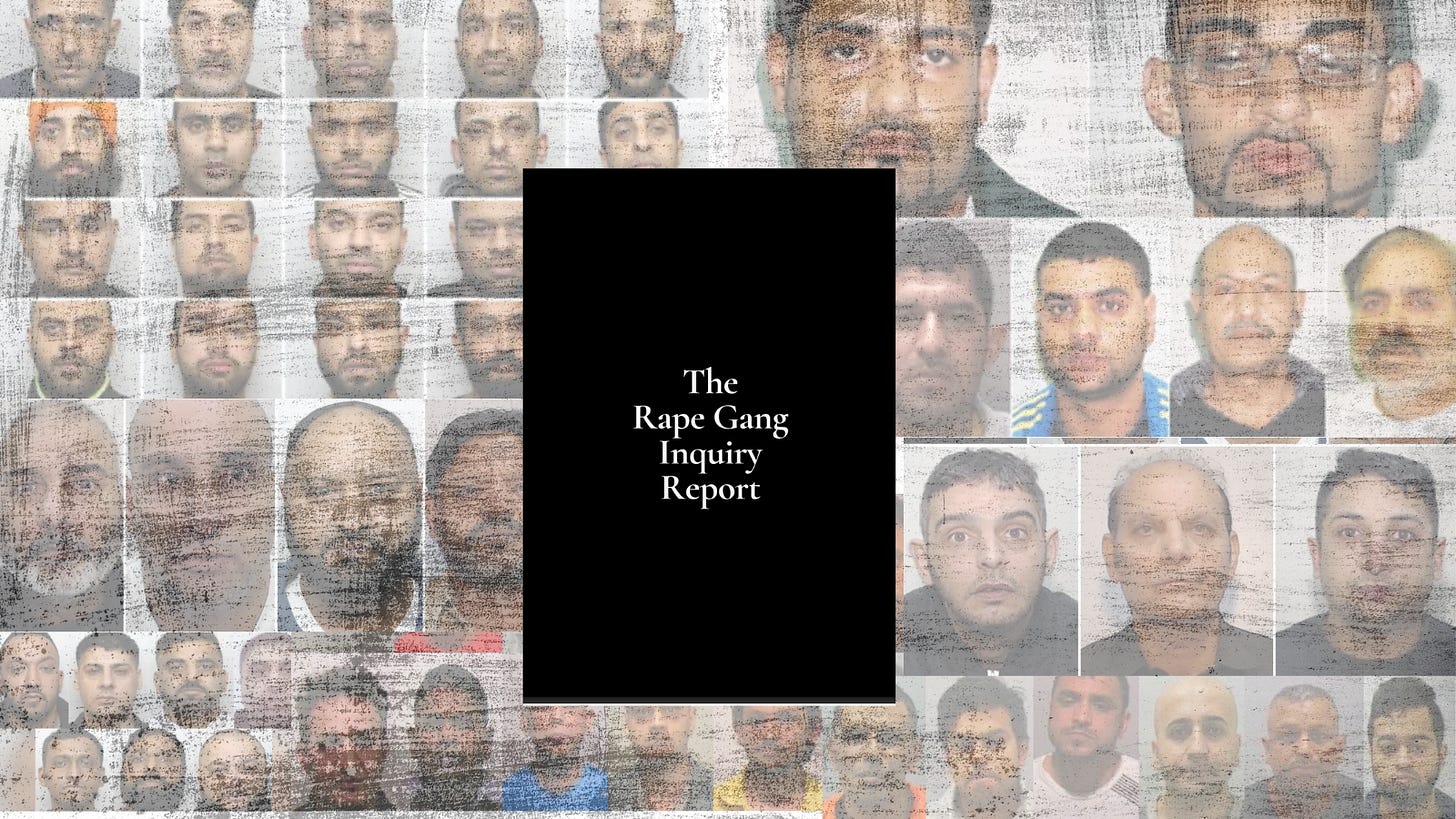
The publication of Rupert Lowe’s Rape Gang Inquiry Report has thrown open wide the door that previous inquiries left ajar. It is not a statutory inquiry and does not possess the powers of a public commission. And yet it is profoundly more honest than the euphemistic, politically correct bureaucratic analysis we have been served up previously.
It is far more substantial than many of its critics appear to realise. More than 200 pages long, the report is not simply a collection of anecdotes or political commentary. Rather, it is an attempt to create a comprehensive public record of Britain’s rape gang scandal through survivor testimony, whistleblower evidence, expert submissions, analysis of offender demographics, examination of institutional failures, and a detailed set of recommendations for reform.
The inquiry heard evidence from survivors, family members, frontline professionals, campaigners, academics, and politicians. It examines not only the crimes themselves, but also the role played by police, social services, schools, health authorities, local government, licensing bodies, and successive governments in allowing the abuse to continue for decades.
The report concludes with recommendations covering child protection, policing, safeguarding, data collection, therapeutic support, and legislative reform. Whatever view one takes of its conclusions, it is difficult to honestly characterise the document as anything other than a serious attempt to investigate one of the gravest public scandals in modern British history.
She was subjected to repeated sexual violence, severe physical assaults, and sustained torture – including being raped by a dog as the men placed bets on whether it would penetrate her vagina or her anus, filmed, and forced to rewatch the footage.
Excerpt from The Rape Gang Inquiry Report
Among the questions that have haunted this scandal from the beginning this one rises to the top: why did so many officials appear terrified of discussing the ethnic, cultural and religious background of many of the perpetrators?
Not every offender was Pakistani, nor were they all Muslim. But it is impossible to honestly examine the historical record without acknowledging that a significant number, an overwhelming majority, of the rape gang cases involved offenders of Pakistani Muslim background. Official reports have acknowledged this pattern, survivors have described it, and some journalists (the ones with integrity) have reported it. It is also worth noting that some brave police officers, social workers and whistleblowers raised concerns about it years before many authorities were prepared to publicly discuss it. And yet, the spineless and craven still cry “racist” or “Islamophobe”.
The “poisoned M&Ms” analogy is often used by progressive feminists (the kind that seem to not do a lot of good for women) to explain why many women are cautious around men they do not know. The argument is that even if only a small minority of men are dangerous, women cannot reliably identify who those men are in advance. Just as most people would avoid eating from a bowl of M&Ms if a few were poisoned but indistinguishable from the rest, women may adopt a baseline level of caution around all men because the consequences of misjudging a genuinely dangerous individual can be severe. The analogy is commonly used as a response to the phrase “not all men”.
And yet. And yet! These same women would scream bloody murder if the analogy were applied to rape gangs and the prevalence of the predators responsible in Pakistani Muslim communities in Britain. Perhaps next we should ask whether women would rather encounter an unknown Pakistani Muslim man or a bear while alone in the woods – another often-used analogy.
Are you uncomfortable yet? Are you tempted to tell me “not all Muslims”? Or “not all Pakistani men”? We know it is “not all”, but it was an awful lot. This is uncomfortable. It is not pleasant to realise that one group of people has treated another so horrifically, but the discomfort should not be for the sensibilities of the group who did the offending.
The girls were not saved because saving them required saying things the respectable class did not want said. It required admitting that many of the worst organised rape gang cases were not random clusters of generic male violence, but involved recurring patterns of ethnicity, religion, community pressure, clan loyalty, misogyny, contempt for non-Muslim girls, and institutional fear. It required admitting that some perpetrators were not merely taking advantage of individual children but operating within networks sustained by family, business, community, and criminal ties. It required admitting that the phrase “Asian grooming gangs” was both evasive and cowardly, because “Asian” blurred the issue and implicated other communities who did not deserve to be tarnished with the association.
Britain’s Sikhs, Hindus, Chinese, Japanese, Filipino Christians, and countless others were not the recurring demographics in the major cases that scarred towns like Rotherham and Rochdale. The recurring profile that officials were afraid to name was overwhelmingly Pakistani Muslim men abusing largely white working class girls.
It is beyond belief that so many people were convinced that confronting this demographic reality was more dangerous, or perhaps more offensive, than allowing the abuse to continue. That decision had consequences that can now be measured in newspaper headlines and terrible statistics, but most of all the consequences can be measured in broken children, many of whom have become broken adults. Some did not become adults at all.
What the pearl-clutchers need to understand is that the survivors who appear throughout Lowe’s report are not engaging in abstract theories about multiculturalism. They are describing what happened to their bodies and minds. They are not racists, they are bravely recounting the utterly depraved acts that were committed against them. Rapes, gang rapes, bestiality, humiliation, degradation, torture, psychological abuse... The destruction of their sense of self.
Survivors describe being groomed as a children before being repeatedly raped by groups of men over periods of years. Others describe being trafficked around the country and treated as property. Others describe violence, intimidation, forced pregnancies, forced abortions, threats, and psychological destruction.
They were taken to houses, flats, restaurants, and hotels where they were raped repeatedly by groups of men, tortured, filmed for blackmail, and told they were “white trash” or “kuffar” who merited punishment. Many became pregnant while still children. Some miscarried under trauma, others endured coerced abortions, and some gave birth to children who were later removed by the state. We found that the same unspeakable crimes occurred in at least 149 local authority districts – close to 40 per cent of all such districts across the United Kingdom.
Excerpt from The Rape Gang Inquiry Report
If we are to have a discussion about racism there is actually plenty to say about the hatred the perpetrators expressed for white British people, in particular white girls. One survivor described:
“a closed and intimidating social world governed by fear, loyalty, and silence,” in which racially supremacist attitudes were openly and regularly expressed. White British people were described as “white trash,” and white girls as “English pig‑dogs.”
In fact in some of the trials of the rapists described their victims as:
“white slags,” “white trash,” “kuffar bitches,” or told they were “only good for men like me to fuck and use like trash.” Perpetrators shouted “Allahu Akbar” and boasted of racial supremacy.
Victim/survivors describe how they treated Muslim women differently in front of them. Some were promised better treatment if they would convert to Islam and marry their rapists. These men also boasted of how they were gaming the British system by living for free off the state. They laughed as if the men of Britain were cuckolds paying for these men who were raping their daughters and sisters. They could hardly believe they could get away with all they were doing. But they did get away with it for a long, long time.
It is impossible to understand how these crimes continued for so long without examining the culture of fear that surrounded them. Official investigations have repeatedly documented that authorities were terrified about accusations of racism. Baroness Casey’s review highlighted serious failures in data collection and ethnicity recording because there was an awareness of what data would show were it recorded. Local officials feared community tensions, police feared reputational consequences, and politicians feared political fallout.
The result was a grotesque inversion of priorities. Institutions that should have been obsessively focused on the safety of vulnerable girls became preoccupied with managing narratives, protecting relationships, and avoiding controversy.
The victims paid the price for this cowardice and ethical failure.
But, politically, that failure belongs to no single party – there is plenty of blame to go around. Labour councils were implicated and Conservative governments failed to confront the issue. Police forces, prosecutors, social services, and journalists failed. The failure was so broad, so persistent, and so bipartisan that it can only be concluded that these white working-class girls were betrayed by every single level of government and bureaucracy in the United Kingdom.
For years, institutions have found reasons not to look directly at this scandal. They have objected to the tone of campaigners, the politics of the whistleblowers, the roughness of survivor testimony, the “danger” of “far-right” exploitation, the complexity of the data, the difficulty of prosecuting historic offences, the risk of damaging community relations, and the ever-present spectre of racism. At every stage, there has been some procedural, ideological, or reputational reason to avert their eyes. Everything, it seems, came before safeguarding girls. It was more important to avoid someone saying “you can’t say that”.
Meanwhile, children were raped. Mostly girls. Some 250,000 of them, it is estimated.
One of the most sickening features of these cases is the bureaucratic reclassification of rape into various accusations of bad behaviour. Girls were not treated as children being raped by adults: they were treated as troubled teenagers, sexually precocious girls, runaways, liars, nuisances, prostitutes, addicts, and difficult brats to be managed.
We now know that an underage girl could be found in a car with adult men and the men would be waved on. Or a child could disclose sex with adults and be asked whether she had consented. A girl could even have injuries and trauma unmistakably made by sexual violence and be processed as a problem rather than a victim to protect.
When Fiona’s mother called the police to report her daughter missing and mentioned a history of abuse by Asian men, the call handler told her: “You can’t describe them as Asian men because that’s racist. You should just be glad your child is being taught a different culture.” On one occasion, a police officer returned Fiona to the house where the abuse was occurring and told the men to “have fun with her.” On another occasion, police instructed the abusers that if they could persuade Fiona to sign herself out of care, the police would stop bothering them.
Excerpt from The Rape Gang Inquiry Report
The testimony in Lowe’s report is almost unbearable to read. One feels sick one moment and is brought to tears the next. It is devastating and enraging in equal measure.
It is plain to see that some of the very people who have traded off condemning “male violence against women and girls” in the abstract were willing to sacrifice white working-class girls for Muslim votes. Labour MP Jess Phillips stands up each year to read the names of women murdered by men. If she has the gall to repeat the performance this year she should be handed the names of rape gang victims to read. Phillips is, of course, not the only politician to speak in hashtags and put on a performance: they are all as phoney as the institutions which issued strategy documents to manage the situation. The state and its mechanisms instinctively acted to suppress and control the narrative rather than rescue the girls.
Even now as we are confronted by the sobering reality of facts and data, people are quick to point out that not every perpetrator was a devout Muslim committing crimes from a mosque-approved manual. Many of these men drank, took drugs, broke Islamic rules, and lived lives of obvious hypocrisy, they say as if that absolves the faith of responsibility. But religion is not only doctrine recited by perfect saintly adherents. It is also about identity, hierarchy, shame, honour, sex roles, family structure, in groups and out groups, and the moral vocabulary through which contempt can be expressed. In survivor testimony, Islamic language and anti-kuffar contempt appear often enough that serious people should not be equivocating.
The following week, her daughter attempted suicide by overdose. She went missing one final time and was found in a field with injuries to her head and ear, a severed finger, and numerous cuts and bruises. Following this, she wrote a post on Facebook alleging that she had been a victim of grooming gangs. The post went viral. Within half an hour, the police arrested her and she was sent to prison.
Excerpt from The Rape Gang Inquiry Report
Sex, race, and religion are central to this story, but so too is class. That is another of the ugliest truths in all of this. Many of the victims were simply the wrong kind of victim for the British political class. They were often white, poor, unstable, angry, traumatised, difficult, from care homes or broken families, from estates, from rough backgrounds. They did not speak the language of human rights NGOs. They were the daughters of “gammon” and the sisters of hooligans. They were girls who swore, ran away, drank, fought, self-harmed, took drugs, lied sometimes, went back to abusers, and behaved exactly like traumatised children behave. All of this was weaponised against them. Every vulnerability they had was used as evidence that they were either lying or asked for it.
The scandal sits at the intersection of sex, race, religion, and class. This kind of analysis would usually excite the well-to-do academic progressives who quote Kimberlé Williams Crenshaw. But the intersections met at an inconvenient place. They were not the fashionable victims universities had decided we were to talk about. These little girls living their lives of trauma and torture were meant to “check their privilege”.
And so, vulnerable white working class girls were targeted by men who regarded them as sexually available and socially disposable. The rapists knew no one cared about what happened to them. They knew they could treat them as dirty, used, slags, sluts, whores, and worthless. The girls were then failed by a professional class that also regarded them as disposable, albeit in more polished language accompanied with disapproving head shakes and condescending tones.
So, you see, what the perpetrators did was show the girls with crude brutality that they despised them. What the institutions did showed them more politely that society despised them too.
An associate of the gang from a neighbouring town arrived at the house. A notorious sex trafficker, he soon began taking Chloe to bars and nightclubs in the surrounding area. There, he would spike her with heroin before handing her over to men who sexually assaulted and raped her. Chloe became addicted to opiates and her health deteriorated rapidly. She became anorexic, weighing just five stone at the age of 18. The use of heroin was a method of control by the gang, as it left her with no ability to defend herself physically. Her daily existence became a relentless cycle of rape, exploitation, and violence.
Excerpt from The Rape Gang Inquiry Report
Rotherham should have ended the national denial. The town’s name became synonymous with “grooming gangs”. The Jay Report found that at least 1,400 children had been sexually exploited there between 1997 and 2013. That number alone should have shattered the country. Wherever you are reading this from, imagine for a moment that your area has around 250,000 people living in it and over just 16 years at least 1,400 children were found to have been raped by multiple perpetrators, trafficked to other towns, threatened with violence, doused in petrol, intimidated with guns, and dismissed by agencies that should have intervened. How many victims would you know? Would you stay and raise your own children there?
If the British establishment was capable of shame, Rotherham would have produced a permanent revolution in child protection procedures and services. Instead, Rotherham documented failure after failure by police and council officials, including anxieties about ethnicity and community tensions. Then nothing happened.
After Rotherham the genie was out of the bottle somewhat. More towns uncovered their own rape networks and the country moved through the now-familiar ritual of expressed horror, official statements, apologies (on rare occasions), reviews, recommendations, training, acronyms, maybe a few prosecutions and resignations, and of course promises that lessons would be learned. Then there would be another town. Another inquiry. Another set of broken abused girls.
Rochdale. Oxford. Telford. Oldham. The pattern of groups of Pakistani Muslim men abusing girls repeated and so did the pattern of institutions failing to act on repeated opportunities to intervene.
I’ve used the word failure a lot, but failure is actually too gentle a word. It suggests an attempt that did not succeed. “We tried,” it suggests. What happened is worse than that. It looks more like refusal. They did not try.
Refusal to see. Refusal to record. Refusal to escalate. Refusal to offend. Refusal to name. Refusal to believe girls whose lives did not fit the safeguarding PowerPoint version of victimhood. Refusal to confront the fact that some of these rape gangs and their rapist members had developed enough local political, social and economic power to make officials cautious, evasive and afraid.
Police forces ignored repeated reports, criminalised victims instead of perpetrators, destroyed evidence, and allowed known rapists to walk free on bail. Social care services undermined protective parents, placed children in trafficking hubs inside children’s homes, closed cases despite clear indicators of exploitation, and retaliated against whistleblowers. The NHS recorded genital injuries, multiple sexually transmitted infections in children as young as 13, pregnancies caused by rape, and suicide attempts, yet discharged victims back to their abusers without safeguarding referrals or trauma care. Schools observed older men collecting girls at the gates, heard disclosures of rape on school premises, and responded by excluding victims rather than protecting them.
Excerpt from The Rape Gang Inquiry Report
The police refusal is particularly infuriating because they are paid to take the kind of action these girls needed. They have powers ordinary citizens do not. They could have arrested, searched, seized, charged, and protected. But again and again survivors describe police officers who treated them as criminals, nuisances, or liars. They were told nothing could be done or asked whether they had consented to sex with adult men, gangs of them, despite being children. The girls learnt that reporting usually only brought more danger. In fact, there are several recorded incidences of police officers themselves being part of the rape gangs.
Between leaving school and joining college, at seventeen, she was groomed by a 55-year-old police sergeant. He knew her background and claimed that he would catch her attacker and get justice for her. Instead, one evening he offered to take her out of the house and raped her. He went on to rape her on another occasion.
Excerpt from The Rape Gang Inquiry Report
Social services occupy a different but equally damning place in this story. They were the people supposedly trained to understand vulnerability and to recognise grooming, coercion, trauma, behavioural changes, and red flags. Instead, too often, they converted those warning signs into sanitised case notes and lacklustre risk assessments while the abuse continued. In some accounts, they treated protective and worried parents as the problem. In others, they placed children in environments where exploitation and abuse continued.
Health services also failed. Or refused to act. An underage girl presenting with genital injuries, sexually transmitted infections, pregnancy, overdose, or self-harm should trigger alarms so loud that every state lever is pulled. But survivor testimonies repeatedly describe being patched up and returned to their abusers. Medical professionals in hospitals are often overworked and I do not suggest they should have taken down whole criminal networks. But surely, in these dire circumstances they might have asked: How has this child sustained these injuries? Why is a young girl presenting with sexual trauma and no one is joining the dots?
Schools refused to save these girls too. Schools see children almost daily. They see changes in behaviour, sudden exhaustion, changes in appearance, who has older “boyfriends” collecting them from school. They know what frightened children look like and the signs of dysfunction. But these schools would routinely respond to a raped and abused child acting like a raped and abused child by disciplining them. The girls faced exclusion, isolation, and bureaucratic “concern”. She was a disruption. Difficult. She was passed on to become someone else’s problem.
Taxi licensing authorities failed by refusing to act. Many don’t realise how integral taxis have been to rape gangs. They are critical infrastructure in the network. The report tells of taxis moving girls from schools, care homes, streets, takeaways, restaurants, flats, hotels, and abuse houses. These taxis drivers were rapists and traffickers. And even when this fact was whispered about, the companies that managed taxi drivers failed to implement basic safety measures or take any action.
The role of taxi drivers in the gangs is one reason the phrase “grooming gangs” is misleadingly soft. These were not just loose groups of creepy men hanging around teenagers. They were organised local networks with logistics, premises, transport, intimidation, supply chains, and the ability to move victims around like goods.
The political refusal to act is the deepest failing of all because politics sets the permission structure. Local politicians and national ministers did not need to know every individual case to understand the pattern. By the time Rotherham was public, nobody could plausibly claim ignorance. Yet the response remained slow, defensive, fragmented and ostrich-like.
The Labour Party does have to bear a heavy burden because most of the local authorities involved were Labour-run, and because parts of the party had deep electoral relationships with Pakistani Muslim communities, and because too many on the left treated discussion of grooming gang demographics as inherently racist. In saying that, the Conservatives do not get a free pass. They held national power for years after the worst scandals had been exposed and refused to deliver the level of inquiry, enforcement, and accountability required. As I said, this was not a left-wing failure or a right-wing failure. It was an establishment failure. An establishment refusal to care enough about white working class girls to do something. Anything.
The phrase “community relations” is triggering to some survivors. It is a phrase that speaks to them of what the system prioritised over their safety. In principle, good community relations are important. But, in this scandal, the term too often functioned as a moral neutraliser. It turned the protection of abused girls into just one stakeholder among many. On one side, sure they had vulnerable girls being raped. But on the other was the possibility that naming perpetrator demographics might inflame tensions or stigmatise a minority community. Now, a functioning society with a decent moral compass does not struggle to figure out the correct order of things. It protects the children first and manages the politics afterwards. The rape gangs have evidenced that Britain is not a functioning society with a decent moral compass.
The media self-censored the ethnic and religious pattern for fear of being labelled racist. Social media platforms became the primary tools for initial grooming, distribution of rape videos, and coordination between perpetrators.
Excerpt from The Rape Gang Inquiry Report
The media’s role is not simple either, because some journalists did do brave and important work exposing these scandals. There were reporters who pursued stories that institutions wanted buried. Local journalists, campaigners, and survivors who forced the issue into public view. But much of the mainstream media approached the subject with visible discomfort. The BBC, the Guardian, Sky, and others only reported on the matter when absolutely forced to and even then they were determined to cover the scandal as a story of institutional failure in the abstract rather than as a story about specific patterns that respectable liberal Britain did not want to confront. The editorial reflex of the mainstream media has been to police the discussion around the scandal rather than relentlessly pursue the scandal itself.
The British people are now far beyond being fooled by the trickery of the likes of Keir Starmer and the BBC. They can see the hierarchy of concern in what gets urgency and what gets caveats. They are sick to death of seeing two-tier policing and reporting.
If a figure associated with the right says something inflammatory, the media machine knows exactly what to do. It produces explicit outrage, push alerts, condemnations, reaction pieces, and context within hours. The perpetrator is named, as are his demographics and his motivations are laid out for all to see. On the other hand, a Muslim or non-white figure can commit a literal act of terror and the tone becomes slower, cooler, more cautious. Suddenly everyone discovers complexity and language must be careful. Everyone is terribly concerned about the prospect of backlash. The real worry for the political and media class is not the bodies of murdered or raped British people, but the possibility that the “wrong” people might draw the “wrong” conclusions from it.
The international mainstream media silence is instructive, too, because these scandals test whether liberal democracies can tell the truth when the truth is socially dangerous. It is easy to condemn abuse when the perpetrator fits the preferred villain template. Catholic priests are fair game, but Muslim gangs are not. White men can be blamed for violence against women and historical colonialism, but caveats are layered when the man is brown or black. The measure of a society’s commitment to women and children is whether it can confront abuse when the perpetrators belong to protected or politically sensitive groups. Please hear me loud and clear when I say that if your “feminism” becomes shy and shrinks when it has to address particular races or religions, it is not feminism. It is bullshit.
The New Zealand media has determinedly ignored the news of the Rape Gang Inquiry Report. Apparently we need to know every possible embarrassment to befall Donald Trump, but not that 250,000 girls were raped and abused by rape gangs in Britain. They too are refusing to see, record, acknowledge, confront.
Spreading this news is left to X, the platform of hate and bigotry according to the same people who “believe all women,” but not when it is inconvenient. The women who are still talking about Trump talking about grabbing pussies, but who won’t hear a bad word about a religion that explicitly categorises women as less than men and endorses violence and sexual violence against them. Spare us your moralising, you Vichy feminists.
Survivors such as Sammy Woodhouse, whistleblowers like Maggie Oliver, and the women who continue to speak publicly have forced Britain to confront what it would rather euphemise. Their testimony is not necessarily tidy or expressed in ways that the well-to-do might prefer. It is full of rage, despair, trauma, and disgust. And that is what makes it powerful. These women are the true feminists and they are not asking for another awareness campaign. They want to know why the state let men rape them when it had the power to intervene.
Operation Beaconport, which emerged from a recommendation in Baroness Casey’s National Audit report, is the National Crime Agency’s nationwide review of group-based child sexual abuse investigations. It is both a long-overdue attempt at justice and an extraordinary indictment of the system that preceded it. Every police force in England and Wales has been ordered to examine fifteen years of closed cases involving multiple suspects and allegations of child sexual exploitation. The purpose is not simply to revisit history, but to determine whether investigations were closed prematurely, whether evidence was missed, and whether viable opportunities for prosecution were abandoned.
The operation is a tacit acknowledgement that there are undoubtedly many many more victims who came forward and were failed not only by their abusers, but a second time by the criminal justice system itself. Every neglected lead, every suspect who was never properly pursued, every victim whose testimony was discounted, and every investigation that drifted into a dead end represents the possibility that offenders remained free while girls were denied justice.
Justice now must mean more than prosecutions, though prosecutions matter a great deal. It must mean naming institutional failures clearly and name and shaming those in power who knew and were complicit. It must mean standardised practice of recording ethnicity, nationality, religion, and relevant cultural factors. It has to include significant consequences for officials who ignored, minimised, or concealed abuse. Proper support for survivors must be provided without forcing them to become lifelong campaigners simply to be heard. And it must mean serious examination of care homes, taxi companies, hotels, police practice, CPS thresholds, missing children protocols, and the role of local political networks. It must mean the end of treating “community cohesion” as a reason to suppress facts.
And crucially, it must mean confronting Islam and deciding how to make it absolutely crystal clear that no matter your culture, religion, or race, if you are in the United Kingdom you abide by the laws and values of the land. The values of a tolerant and liberal society can only survive in a high trust environment. The ideas, practices, and beliefs of a religion that has not evolved to respect women, accept difference, and abhor political violence are not compatible with a liberal democracy. Britain needs to decide whether it is going continue to allow its values to be desecrated or whether it is going to set some expectations for those who have chosen to make the lands their home.
If Christian theology had been invoked by gangs of men raping Muslim girls, every journalist in Britain would be eviscerating the religion across every inch of the news. The same standard must apply here. The phrase “Islamophobia” cannot be allowed to function as a rape shield. A country serious about child protection must be capable of holding that innocent Muslims must not be blamed for crimes they did not commit, and the role of Pakistani Muslim offender networks in these scandals must be investigated without cowardice.
Rupert Lowe’s report is already being attacked. Politics is being used as a shield against the testimonies it contains and the raw data it lays out. Those who continue to politicise the suffering of white working class girls because their “side” doesn’t benefit from supporting them are the lowest of the low. The report exists because establishment Britain forfeited trust. When victims believe the establishment will not tell the truth, they will turn to anyone who will. In this case it is Rupert Lowe. That is not the fault of the victims nor of Lowe. It is the fault of the establishment and they should be nothing but ashamed.
Participating in our hearings, listening to the survivors, was the most harrowing experience of my life. It is impossible to understand how such evil has been allowed to flourish on such a horrifying scale.
Rupert Lowe MP
If mainstream institutions wanted to own this issue, they should have owned it when the girls were still children. They should have believed them and investigated properly. They should have chosen truth over comfort and children over “community management”. They did not. Now they do not get to complain that the reckoning is politically inconvenient.
So now the least the rest of us can do is tell the truth plainly. Britain’s rape gang scandal was not merely a story of predators. It was a story of permission. The perpetrators committed the crimes, but institutions allowed those crimes to continue. They did so through cowardice, ideology, incompetence, class contempt, bureaucratic inertia, fear of racism accusations, and a grotesque willingness to treat vulnerable girls as expendable.
The abuse against the girls was not hidden. It was in plain sight. The girls were there battered, bruised, raped, and traumatised showing up in police stations, hospitals, schools, care homes, taxis, takeaways, hotels, flats, and courts. They told adults. Their bodies were crime scenes with pregnancies, infections, injuries, overdoses, and mental illness.
The survivors of the rape gangs have every right to want to tear the institutions of Britain down. The establishment should be glad all they want is justice, and not revenge.
The evidence heard by this Inquiry is unequivocal, overwhelming, and devastating in its clarity. Organised networks of Muslim men systematically raped, trafficked, drugged, impregnated, and destroyed the lives of thousands upon thousands of British children across every region of the United Kingdom for decades.
Excerpt from The Rape Gang Inquiry Report
This article was originally published by Thought Crimes.