Table of Contents
It seems like forever ago that the late Christopher Hitchens warned Tucker Carlson to stay away from television. Hitchens praised Carlson as a writer, but warned, in a nutshell, that TV was rotting his brain. God knows what Hitch would have thought of podcast-era Carlson.
If, as Ricardo Huerta writes, TV Carlson “was and is the conservative hope that never was”, podcast Carlson is even worse.
On television, Carlson turned out to be less William F Buckley and more Jerry Springer channeling Nick Fuentes. His TV shows were too often one-sided yelling matches with guests apparently handpicked simply for being stupidly extreme, Carlson’s voice squeaking higher and higher, until he sounded like an outraged penguin skating barefoot on wet glass.
On his podcasts, the shtick is slightly different and even worse. Carlson’s podcasts invariably consist of him dredging up some fringe loon of the right, lobbing them loaded questions, then pretending, with wide-eyed and squeaky-voiced astonishment, as said loon spouts exactly the bullshit Carlson clearly wanted to hear. Like Joe Rogan, Carlson pretends to be ‘just sounding out ideas’, when in fact he’s giving uncritical airtime to idiots, or worse.
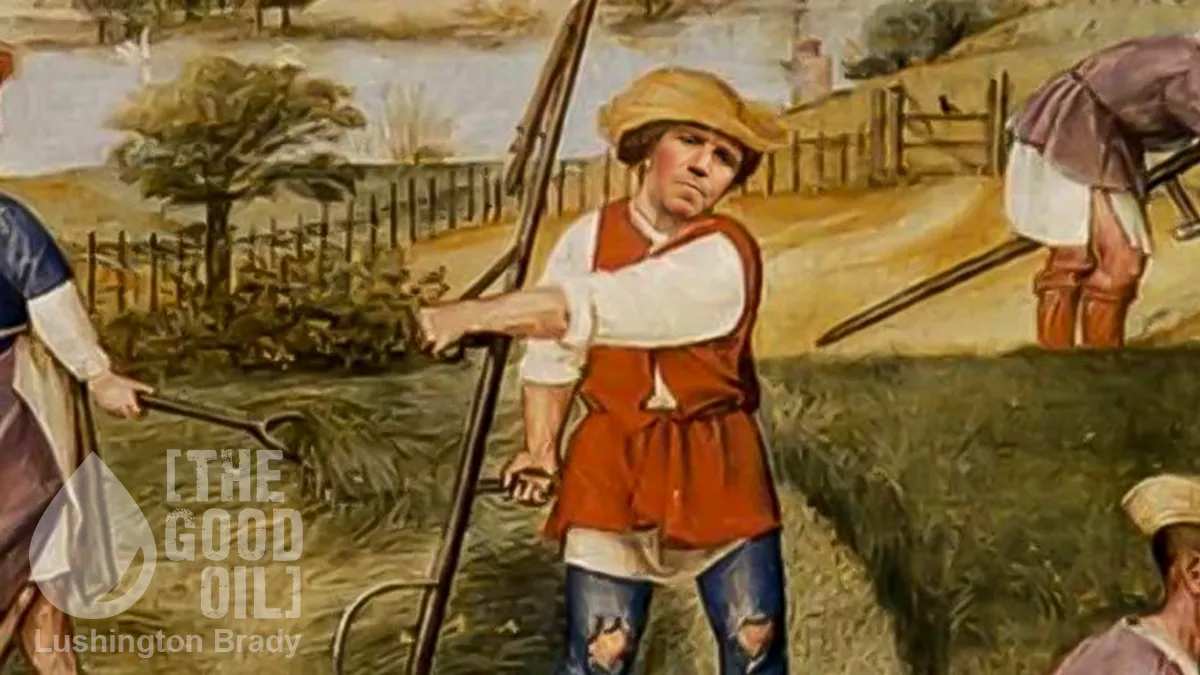
As a textbook case of the sort of stupidity Carlson willfully indulges, consider his recent circle-jerk with Auron MacIntyre, in which both enthusiastically agreed with each other that feudalism ‘is so much better’ than modern capitalist democracy. Their reasoning? “Because, at least in feudalism, the leader is vested in the prosperity of the people he rules.”
Clearly, neither of these two over-represented idiots has ever read a history book. Feudalism was a system of unalloyed misery for the 75 to 85 per cent of people who were serfs. At least most of them could look forward to escaping the system by dying well before their teens. Child mortality was so staggering that fully one-quarter of children died by age seven. Only between 40 and 70 per cent ever reached adolescence.
For those who survived the perils of feudal childhood, even the elite lived shockingly short lives. Even monarchs died young: only a handful between the 11th and 15th centuries lived even into their 60s. Alfonso VI of Castile and León, who reached 79, was an outlier. Today, even a poor Westerner can confidently expect to live into their 80s.
If the pinnacle of the elite lived far shorter lives than the poorest commoner today, feudal peasants were lucky to live to what today would be considered middle aged.
And what a miserable life it was. It’s a common internet myth that mediaeval peasants worked less than moderns. This myth stems from an early estimate by historian Gregory Clark, who claimed peasants worked only 150 days annually. Not only did Clark later revise that to 300 days – which is much higher than today’s 260 working days, even before accounting for paid holidays and vacation. And that only accounts for the ‘official’ labour they performed for their feudal masters.
As for Carlson’s claim that feudal lords ‘cared for’ their serfs, again, read a history book.
In reality, medieval Europe was marked by frequent famine, war, and violence. Crop failures were devastating, and local lords often demanded their share of harvests regardless of whether peasants had enough left to survive. Raids and small-scale wars were constant features of life, and the people at the bottom had little protection when armies swept through their fields.
A regular feature of the Holy Roman Empire, the loose conglomerate of petty kingdoms, duchies and city-states that ‘ruled’ Central Europe for a millennium after the Fall of Rome, was that each new emperor had to more-or-less reconquer Italy, which meant that marauding armies swept across central and southern Europe for centuries. ‘Supply lines’ for feudal armies consisted of little more than outright banditry: peasants who couldn’t hide what little they possessed had it stolen by hungry soldiers, while cities and towns were repeatedly sacked and burned.
Unlike citizens in modern states who benefit from the rule of law and relatively impartial modern justice system, peasants depended on their lords for protection but had no meaningful recourse when those same lords were the source of oppression. For most peasants, daily life combined backbreaking labor with exposure to hunger, violence, and disease, far from the idyllic stability sometimes imagined today […]
In Russia, where serfdom endured until 1861, abuse could be extreme. Serfs were frequently beaten or killed without legal consequence. The notorious case of Darya Saltykova, who tortured more than 100 of her serfs to death, was unusual only in that she faced punishment.
Material conditions were equally bleak. In 1300, the United Kingdom’s average income was about $1,657 in today’s dollars. That represented one of the wealthiest regions in Europe at the time. Even kings lived in poverty by modern standards, while ordinary peasants experienced deprivation that is difficult to imagine today.
The only way you could tell they were kings was because they didn’t have shit all over them.


![[The Good Oil] Stuff Up of the Day](/content/images/size/w1304/format/webp/2024/09/Stuff-up-image-1.webp)