Table of Contents
There are many things I despise, but rank hypocrisy is right up there. So, spare me the weeping and wailing from the growing number of left-wingers who are finding their arses out the door over their gloating online responses to Charlie Kirk’s murder.
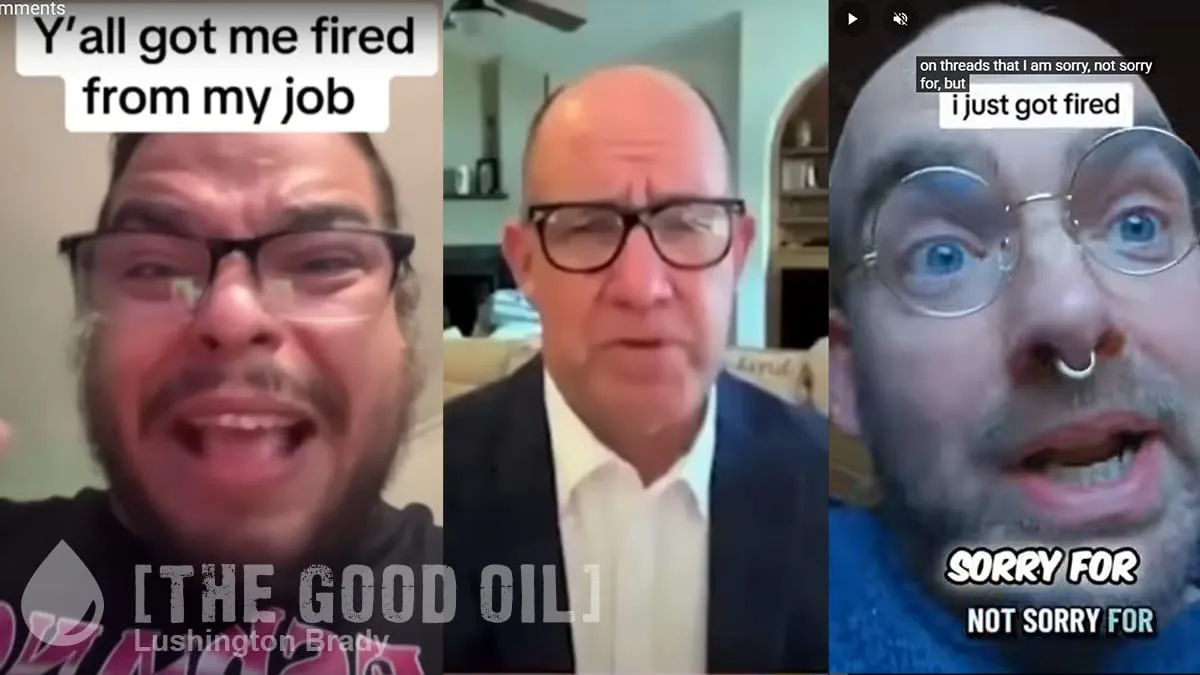
Within 24 hours of Charlie Kirk’s killing, an assistant dean at a Tennessee college, a communications staffer for an NFL team, a Next Door employee in Milwaukee and the co-owner of a Cincinnati barbecue restaurant were fired after posting about it.
They had all used language or memes their employers deemed offensive or insensitive about the 31-year-old conservative firebrand, who was killed in a shooting on Wednesday, local time.
Well, cry me a river.
But, wait, Lushy, you say. Isn’t this cancel culture? I thought you hated cancel culture! You’re right: cancel culture is wrong. I don’t want to see anyone lose their job because they said something dumb on social media.
But there’s a number of reasons why I’m not shedding tears over any of this.
At least a dozen employers, including the Carolina Panthers, the University of Mississippi and the Federal Emergency Management Agency (Fema) have put staff members on leave or dismissed them for their online activity, as well as apologised for and publicly disavowed their remarks. The rash of disciplinary actions over workers’ responses to Kirk’s killing, online and in real life, highlight the tension between employees’ right to free speech and employers’ need to protect their reputations and maintain civility in their ranks.
Firstly, as I’ve previously written, You Leave Your Free Speech at the Boss’s Door. Free speech is a matter for the public sphere: the workplace belongs to the private sphere. The norms of free speech do not apply once you clock on. The rise of social media has blurred that line, but almost all workplaces now have a suite of policies that governs employees making social media commentary when they are easily identifiable as employees.
Karen North, a professor of digital social media at the University of Southern California Annenberg School for Communication and Journalism, said […] “People’s comments are perceived as representing the company that they work for,” North said. “You have the right to free speech in the town square, not in a private business.”
In the case of a famous recent incident in New Zealand, the employers in question had a very clear code of conduct. That code reminded employees to bear two things in mind: How would you feel if you were treated in this way? How would your actions be reported by the media?
The latter is the most pertinent. Employers are justifiably wary of blowback from employees’ social media commentary affecting their business.
Dawn Solowey, a labour lawyer with Seyfarth Shaw in Boston, said the Kirk killing “goes right to the core of some of the deepest divisions in American society”, including tensions around “race, gender, sex and sexual orientation”.
In the past 48 hours, she has heard from several clients looking for guidance on handling social media postings from employees who seemed to be endorsing violence. As a member of her firm’s “cultural flashpoints team” – which was created in 2023 to address what the firm sees as polarisation in society increasingly spilling into the workplace – Solowey encourages employers to keep their social media policies up-to-date because it’s better to be “proactive than reactive”.
Ironically, it’s here we see the clear disconnect between social media policies and one of the most ridiculous modern HR nostrums: ‘bringing your whole self to work’.
“When employees are asked to bring their whole self to work, they bring their whole self to work, including their strong opinions,” she said.
Make up their minds: do they want employees to abide by social media policies, or bring their ‘whole self’, which too often seems to include being a gigantic douche, to work?
For employers, their workers’ social media posts have been increasingly problematic, because “companies realise the ramifications of an unpopular or offensive view from an employee can have a devastating impact on the company’s reputation, stock or sales”.
It also “almost guarantees some level of hostility in the workplace the next day”, [North] added.
The second reason I’m not much fussed over any of this is, frankly, that they just had it coming. If the left are suddenly discovering that cancel culture is a bad idea, well… good. The centre and the right have been fighting an asymmetrical war for over a decade, and, as any military commander knows, when you try and fight an asymmetrical war by sticking to the high ground… you lose.
Remember Saul Alinsky’s fourth ‘rule for radicals’:
Make the enemy live up to its own book of rules.
Others of Alinsky’s rules for radicals apply: “Keep the pressure on. Never let up.” “A good tactic is one your people enjoy.” “The threat is usually more terrifying than the thing itself.”
But, there is one last rule that the centre-right needs to keep in mind, even while it’s mightily enjoying seeing these creeps get their well-deserved comeuppance:
A tactic that drags on too long becomes a drag.
Let the lesson sink in and, if it does (always a stretch), move on. Go back to normalcy.
If we can.