Table of Contents
Extinction is the lot of nearly every species which has ever lived, which puts the hysterics of the green-left over the lesser yellow-bellied slug or the blue-headed tit (who sound rather like green activists than animals, but I digress) into some perspective. It seems most likely, then, that such will be the inevitable fate of humanity. Or at least, Homo sapiens: some evolved variant of the human species may well continue the line on. The ‘Homo superior’ both Nietzsche and Bowie dreamed of, perhaps.
Assuming, though, that one day our species will be something for future, non-human, archaeologists to dig up, what will those future archaeologists look like? Some scientists believe they may well be digging with tools held in their tentacles.
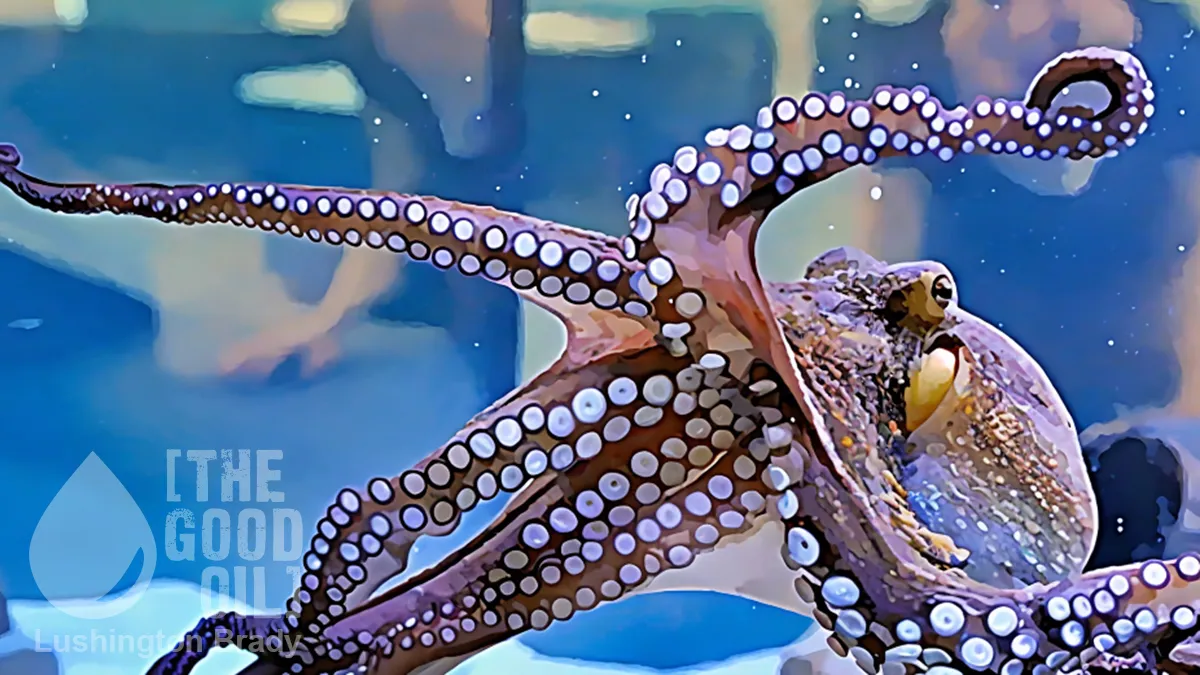
The octopus, often overlooked in discussions of animal intelligence, could prove to be the most formidable survivor in a post-human Earth. With advanced cognitive abilities that rival some of the most intelligent mammals, octopuses possess remarkable problem-solving skills. They have been observed opening jars, using tools, and escaping enclosures – tasks that require complex thinking. According to Professor Tim Coulson from the University of Oxford, “Their intelligence is one of the most advanced in the animal kingdom.”
These cephalopods possess an extraordinary neural system, with about 500 million neurons – many of which are located in their arms, allowing each one to operate semi-independently. This decentralized brain structure is key to their adaptability, as it enables the octopus to handle multiple tasks at once, a trait that would prove useful in a world without humans.
Here we run up against the first problem with the argument: it keeps being made in reference to ‘a world without humans’. Why should this matter? If octopodes (yes, I’m getting all nitpicky and technical with that plural form: indulge me) have the wherewithal to evolve human-like intelligence, the presence or absence of humans is irrelevant. What, after all, are humans doing to hinder or help the evolution of octopuses? Some might object that human predation is a limiting factor; yet, the threat of predation is likely partly what drove the evolution of human intelligence.
Then there is the other biggie that would likely hinder octopus from evolving to human-like intelligence: fire. Taming fire was a pivotal moment in human evolution, affecting not just diet and behaviour but even physiology (it’s believed the chemical changes in cooked meat spurred human brain development). Fire was also crucial to developing machinery.
In Larry Niven and Edward Lerner’s Fleet of Worlds SF series, the G’woth are a race of extremely intelligent starfish-like creatures inhabiting an ice-encrusted water planet very like Europa. Living underwater means that, despite their intelligence, they are locked in the most primitive of states, for the simple reason that they have never had fire.
The other odd assumption of the pro-octopus crowd is that social creatures are at an evolutionary disadvantage.
Unlike most mammals, which rely on complex social structures, octopuses are solitary by nature. This independence may serve them well in a world where human influence is absent. Their ability to thrive without cooperation from others is a stark contrast to species like dolphins and crows, which are highly social and could struggle to adapt to a post-human world. The absence of social constraints would give octopuses a significant advantage, allowing them to fill ecological niches that others might not be able to.
On the contrary, it would likely limit their abilities due to not being able to adopt new cultural innovations. If humans were not intensively social creatures, it’s highly unlikely that we’d have ever left the trees, let alone started banging rocks together.
Then there’s the fact that octopuses are forever limited by their biology to one environment: the sea.
Sure, humans were for a very long time barred from all but the shortest excursions underwater. Some octopus species can survive outside water for a short time, probably longer than a human diver underwater. But even enthusiasts for oceanic intelligence admit that the marine environment is a huge hindrance to developing the sort of technology that really catapulted human evolution.
The idea that octopuses could one day fill the ecological role left vacant by humans might seem far-fetched.
Put it this way: the major modern groups of octopodes evolved some millions of years before the dinosaurs vanished. The earliest hominids appeared just one-tenth of that time ago, yet we’ve rapidly evolved intelligence beyond anything octopuses possess.
If octopodes are going to rule the planet, they might want to pull their tentacles out.