Here’s a little hat-tip, if any of Xi Jinping’s Ten Cent Army are monitoring my posts (nǐ hǎo, guys!): if you’re going to go around threatening to decapitate foreign heads of state, nobody’s going to take it seriously when you accuse them of ‘militarism’. Nobody, except of course the domestic audience for whom such hysterical announcement are really intended.
The rest of us can see you, China.
So, when China’s Ministry of Foreign Affairs recently declared that “Japan’s new militarism has become a menace, threatening regional peace,” you could hear the derisive guffaws clear across the Taiwan Strait.
Japan rejected China’s accusation that it is pursuing “new militarism,” a sharp rebuke against Beijing as tensions between the two countries continue to simmer.
After all, as Japanese Defence Minister Shinjirō Koizumi dryly points out, Japan is being finger-wagged by “a country that has a huge arsenal of nuclear weapons and strategic bombers”.
Japan has neither of such weapons, and yet Japan is labeled new militarism. Isn’t it strange?
It’s even more strange, not to say blatantly hypocritical, when you look at the numbers. China is now the world’s second-largest military spender, comfortably ahead of Russia: a country that is actually fighting a major war. Beijing’s defence budget is roughly five times that of Japan, according to SIPRI data cited in the Japanese response. While Tokyo has lifted some restrictions on weapons exports and is acquiring longer-range missiles for deterrence, it remains a non-nuclear power with no strategic bombers and a transparent, publicly debated, defence build-up. China, by contrast, is racing ahead across every domain with minimal transparency.
The same regime that poses as the guardian of regional peace has spent the last decade turning the South China Sea into a militarised fortress through its illegal island-building program. Artificial reefs have been turned into airbases, radar stations and missile platforms. That campaign of expansion has now been extended to near-daily pressure on Taiwan and increasingly provocative operations around Japan’s southern islands.
Beijing has sought to rally other countries around the idea that there are parallels to the fight against Imperial Japan during World War II.
Two can play at that game: Japan merely needs to remind China of how many times it tried to invade Japan – and just how it worked out for them.
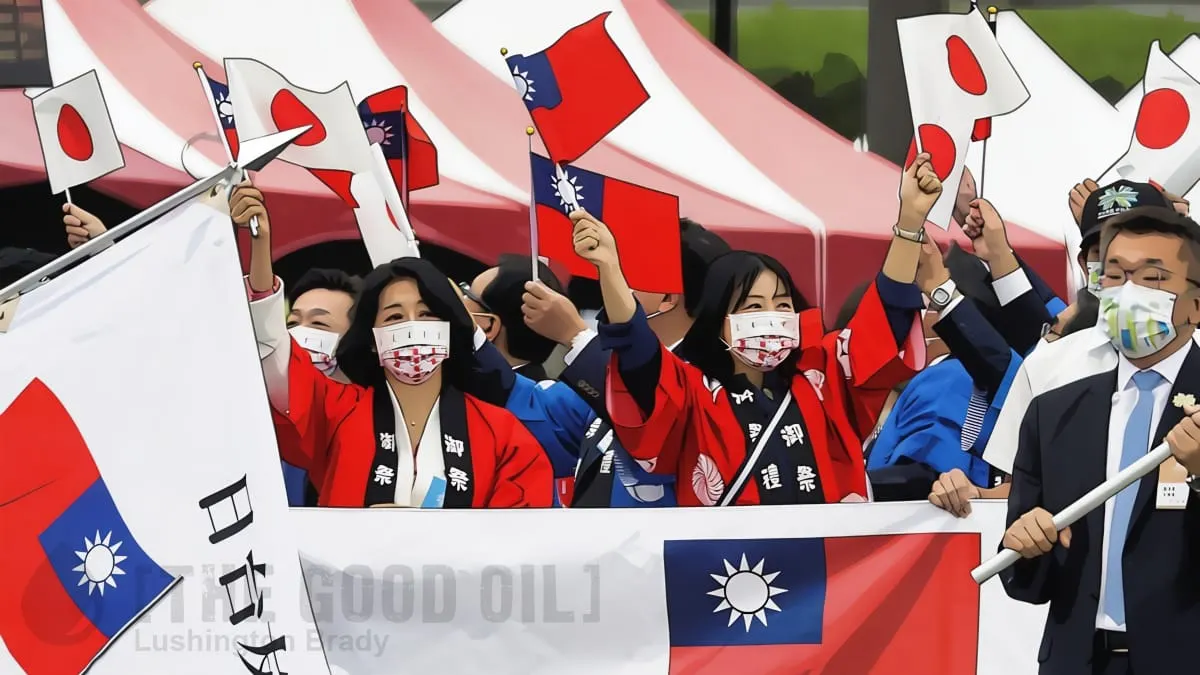
Japan’s near-neighbour, Taiwan, meanwhile is already living on the coal face of Chinese militarism.
Taiwan sent ships and fighter jets to monitor the second Chinese “joint combat readiness patrol” in a week near the island, in what a senior Taiwanese security official said showed China was the sole source of instability in the region.
China has pressured Taiwan by increasing its military presence around the island, and Taipei is on high alert for further actions by Beijing after Chinese President Xi Jinping discussed Taiwan with US President Donald Trump in Beijing this month.
Chinese warships armed with cruise missiles have been operating as close as 24 nautical miles from Taiwan’s shores, cutting response times for any surprise attack to as little as three minutes. Taiwan’s coast guard has also been forced into direct confrontations with Chinese coast guard vessels near the Pratas Islands. These are not routine exercises. They are rehearsals and probes designed to wear down Taiwan’s defences and test allied resolve.
An invasion of Taiwan, Beijing’s openly stated goal, would not be a distant regional squabble. It would immediately threaten Japan. The island sits at the southern end of the first island chain. Any successful Chinese operation would place hostile forces within easy striking distance of Japanese territory, sever critical sea lanes, and put the US-Japan alliance under direct pressure. Tokyo knows this. That is why Japanese troops recently joined US-led exercises in the Philippines for the first time and why Prime Minister Takaichi has spoken openly about the possibility of conflict over Taiwan.
China’s strategy is at least consistent in its blatant hypocrisy: accuse others of the aggression it is itself committing, while steadily expanding its military reach and testing every red line. The “new militarism” label is simply the latest attempt to invert reality and paint a defensive Japan as the threat. The numbers, the island-building, the daily incursions around Taiwan, the carrier deployments and the crude threats against a Japanese prime minister all tell the real story.
The Indo-Pacific is not drifting toward conflict because Japan decided to spend more on its own defence. It is being pushed there by a revisionist power that has decided military intimidation is the quickest route to regional dominance. Japan’s response, measured, transparent and long overdue, is not the problem. It is the minimum required to deter the much larger problem Beijing has created.