This is edition 2026/056 of the Ten@10 newsletter.
Hi all,
This is the Ten@10, where I collate and summarise ten news items you generally won't see in the mainstream media.
Enjoy!
1. The Establishment joins the electricity insurgency
Bryce Edwards
- ⚡ A year ago, breaking up electricity gentailers was dismissed as “radical,” but it has rapidly become a mainstream national debate
- 🧠 Support is now coming from prominent establishment figures (business leaders, former politicians, executives), not fringe activists
- 📉 The shift highlights a widening gap between political elites and public/business sentiment on energy reform
- 📞 The proposal draws comparisons to the Telecom breakup, which faced similar criticism but ultimately improved outcomes
- 💰 Data shows gentailers paid $10.7B in dividends vs $4.5B invested—suggesting a system prioritising shareholders over infrastructure
- 🧩 The sector is accused of using “weaponised complexity” to stall reform and avoid scrutiny
- ☀️ Low solar buyback rates are criticised, with proposals for net metering to incentivise household energy generation
- 📄 NZ First has produced a detailed policy paper, attempting to move beyond rhetoric into implementation
- 📉 Broader economic context: declining GDP per capita, rising debt, and fiscal pressure heighten urgency for reform
- 👑 The idea is framed as politically “obvious,” yet ignored by major parties—raising questions about political inertia
- 🏛️ The “Stakeholder State” theory suggests power has shifted from voters to entrenched institutional interests and lobby groups
- 🔌 دونوں major parties (Labour and National) are accused of protecting the electricity cartel through weak or ineffective policies
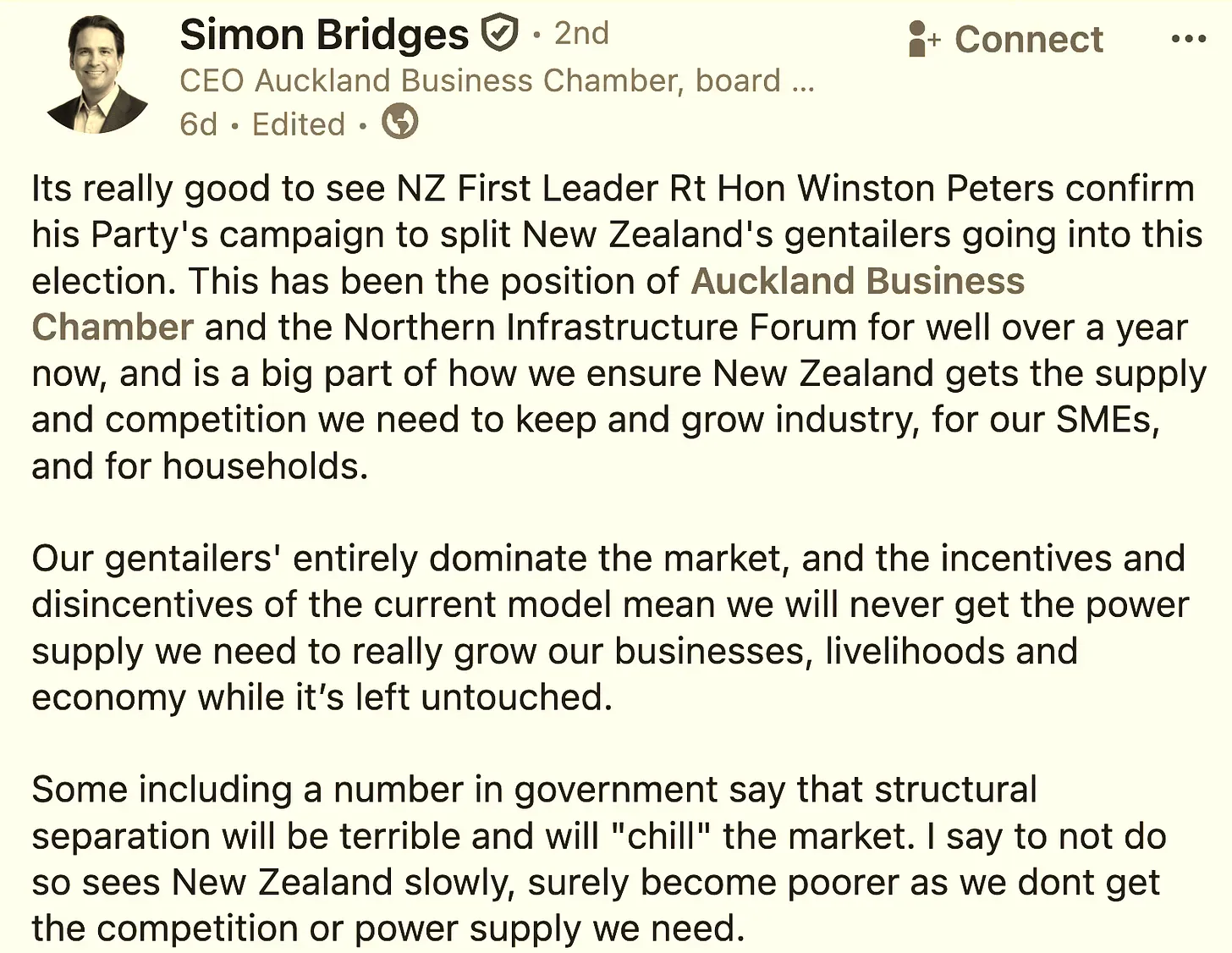
- 💼 Business leaders like Rod Drury and Simon Bridges publicly support structural separation, signalling a major shift in elite opinion
- 🌍 Reform is framed not just as cost-cutting, but as a strategic opportunity for innovation, renewables, and global competitiveness
- 🏦 Critics argue governments enabled the problem by extracting dividends while underinvesting in generation capacity
- 🏢 Incumbent gentailers are seen as unlikely to disrupt themselves due to profit incentives and risk aversion
- 🚫 Market competition is questioned, with smaller retailers being absorbed or squeezed out by dominant players
- 🗳️ Multiple parties (NZ First, Greens, Labour) are now considering reforms, though political positioning and ownership of policy remain contentious
- 📊 Polling shows strong public and business support for breaking up gentailers, outpacing political action
- ⚖️ The core issue is whether politicians are willing to confront powerful corporate interests in the public interest
- 🔥 The debate has accelerated দ্রুত, signalling a potential turning point in New Zealand’s energy policy conversation