
This is edition 2026/118 of the Ten@10 newsletter.
Hi all,
This is the Ten@10, where I collate and summarise ten news items you generally won't see in the mainstream media.
Enjoy!

1. Entitled to the Entitlements
Bryce Edwards — The Democracy Project
- 🍁 Shane Jones’ March 2025 trip to a Toronto mining conference cost about **$63,000** — roughly double the $33,068 Cabinet had approved.
- 🚗 The bill included a chauffeured limousine on standby for 24 hours across three days, costing just under C$4,000, even though Jones appears to have stayed in a hotel connected by an indoor passage to the conference venue.
- 🏨 The hotel cost was **$1,674.69 per night**.
- 📝 Ministerial Services began chasing an explanation in May 2025; Jones only sought retrospective approval from the PM’s chief of staff after repeated prods.
- 🗣️ Jones called the coverage a media beat-up and told interviewer Ryan Bridge: “Stop laundering these lies, you breathless hobbits.”
- 🎙️ Winston Peters, when pressed by Stuff’s Jenna Lynch, said: “Yours is a crap story, you know that” and “I’m not putting up with your professional crap any longer, next question.”
- 💰 Nicola Willis condemned the overspend as an integrity issue: “You should never exceed what Cabinet grants you in terms of your travel budget.”
- 🚕 David Seymour noted Brooke van Velden had been in Singapore “and didn’t have her own limo, by the way,” and said he would probably repay the limo cost out of embarrassment.
- 📊 Edwards’ core point: the sums are small in the Budget, but the public is judging whether a political class that preaches restraint will accept the same discipline.
- 🎯 Takeaway: the scandal is less about money and more about reciprocity — and the coalition’s contempt for scrutiny may be the real damage.

2. Should We Be Forced to Invest in SpaceX?
Richard Prebble — Brash & Mitchell
- 🚀 Richard Prebble argues National’s compulsory KiwiSaver policy would force New Zealanders to invest roughly **$12 billion a year overseas**, about **$8 billion of it in the United States, much of it in big tech and AI.
- 📈 Luxon’s plan: employee contribution rises to 4%, employer contribution rises to 4%, and KiwiSaver becomes compulsory — a combined 8%.
- 🇺🇸 With around 60% of KiwiSaver funds already invested overseas, Prebble says we are effectively financing America’s AI revolution, including tonight’s SpaceX share-price rollercoaster.
- 🏗️ Meanwhile New Zealand has an infrastructure deficit of more than $100 billion in roads, hospitals, electricity, water, and housing.
- 📉 Prebble questions whether compulsion actually increases total national savings, or just redirects money from mortgages, rentals, businesses, and direct investment into managed funds.
- 🧑🔧 He also argues compulsion ignores individual circumstances: some people need to buy tools, start businesses, or pay off debt rather than save for a distant retirement.
- 👨👩👧 Prebble’s alternative: lift contributions to 4% each but allow opt-out, and give every newborn both a bank account and a KiwiSaver account so families can build savings gradually without compulsion.
- 💼 He notes 120,000 young people are NEETs and says “employment is the best retirement policy ever devised.”
- ⚠️ Prebble supports higher retirement savings and diversified investment, but opposes forcing savers to export capital when domestic infrastructure is starved.
- 🎯 Takeaway: the KiwiSaver debate is really about whether national savings should rebuild New Zealand or chase Wall Street returns.

3. Skynet on the Brain
A Halfling’s View
- 🤖 Much of the panic over “unregulated AI” is, the author argues, less a response to the technology than the latest flare-up of Isaac Asimov’s “Frankenstein complex,” supercharged by James Cameron’s *Terminator* films.
- 📜 Asimov traced the fear back through Mary Shelley’s 1818 novel, the Golem legend, Prometheus, and Karel Čapek’s *R.U.R.* — the conviction that any creation resembling or exceeding its maker will inevitably rise up and destroy him.
- 🔧 Asimov’s response: treat robots as manufactured products with safety interlocks, like elevators or power saws; his Three Laws of Robotics were a literary argument for sane engineering.
- 🎬 Cameron supplied Skynet, Judgment Day, and the glowing-red-eyed endoskeleton — imagery now used unironically in policy commentary.
- 🧠 The author says the *shape* of today’s alarm is inherited from fiction: a single threshold event, an adversary with unlimited capability, and a closing window for human action — the plot of *Judgment Day*, not a description of a large language model predicting the next token.
- ⚠️ This framing misdirects regulation toward speculative “rogue AGI” containment and away from real, present harms: discriminatory hiring/lending outputs, bias laundering, labour displacement, synthetic media, surveillance, and concentration of power in a handful of firms.
- 🎯 The corrective: stop asking whether we are building a monster and start asking, product by product, what these machines do, how they fail, who is liable, and what interlocks a sane society would require.
- 📉 The author concedes serious technical AI-risk arguments exist, and warns against using the cultural-neurosis argument as a tool to dismiss all regulation.
- 🗣️ Myths can encode compressed wisdom; the danger is letting cinematic vocabulary set policy priorities.
- 🎯 Takeaway: the AI debate is being conducted in a borrowed emotional vocabulary that may crowd out the regulation actually needed.
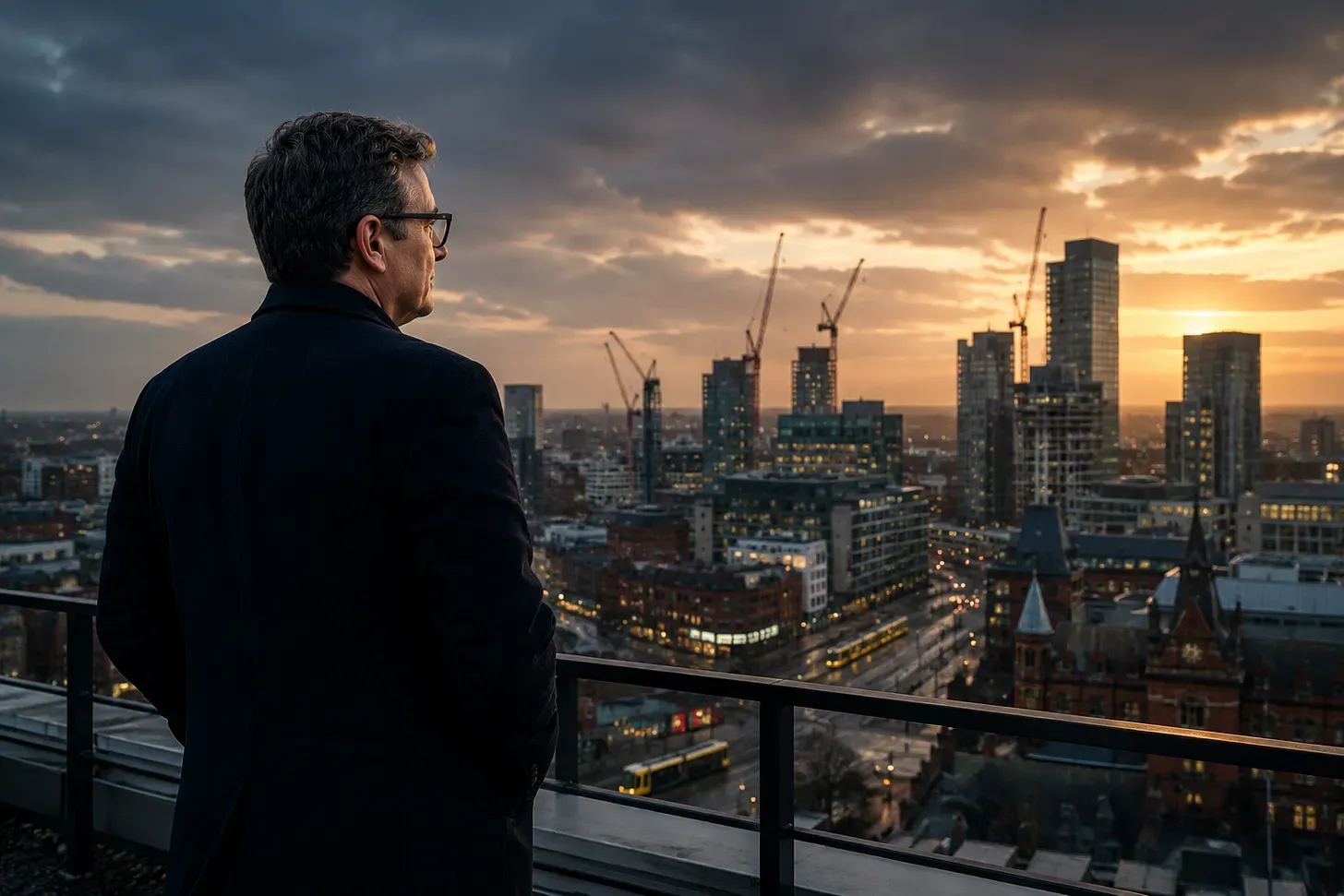
4. Britain’s Labour Government Can Be a Party of Growth — But Not Like This
Roger Partridge — CapX / Plain Thinking
- 🇬🇧 Partridge argues centre-left parties can use market reform to achieve progressive ends, and Britain’s Labour should learn from New Zealand’s Fourth Labour Government (Roger Douglas) and Australia’s Hawke-Keating Labor Government.
- 📉 Andy Burnham says growth cannot be ordered top-down and must be nurtured bottom-up; Partridge agrees, but says the logical conclusion is to surrender levers, not nationalise energy, water, and transport.
- 🐝 Burnham’s Bee Network in Greater Manchester is misread as public ownership working; in fact it is accountability reform — the city designs the network and answers for failure, while private operators still compete to run routes.
- 🏛️ The recurring institutional failure across housing, infrastructure, and the NHS: authority sits in one place and consequences fall in another.
- 💧 The lesson of Thames Water is not that private ownership fails, but that “a monopoly insulated from loss grows complacent, whether its shares sit in pension funds or in a ministerial portfolio.”
- 🧱 Changing ownership often makes things worse by concentrating authority further from those affected.
- ✅ The remedy: reunite power with responsibility — land value capture, devolution by contract, and stronger rights to build.
- 🌏 The antipodean lesson: the Douglas and Hawke-Keating governments removed what was strangling their countries while carrying people with them.
- ⚠️ Partridge warns Burnham is promising to give power away while planning to seize more of it.
- 🎯 Takeaway: growth requires institutional reform, not just a change of ownership plates.
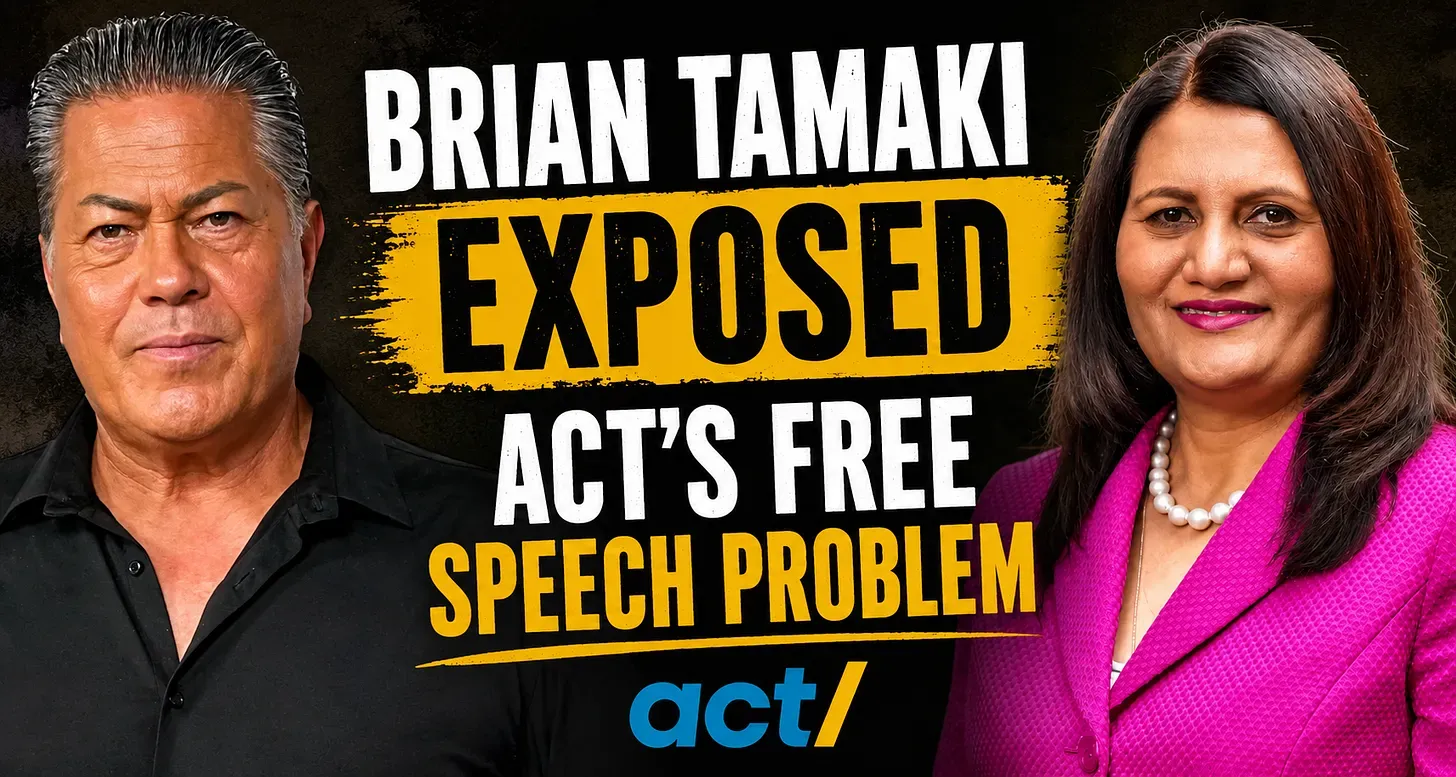
5. Brian Tamaki Exposed ACT’s Free Speech Problem
Matua Kahurangi — Point of Order / Substack
- 🎤 After reports of violence against Christians and churches in India, Destiny Church leader Brian Tamaki made angry remarks on his podcast; ACT MP Parmjeet Parmar reported him to the Police Commissioner.
- 🔫 Police investigated and seized Tamaki’s firearms; he has held a licence for more than 30 years and, the author says, has never been known as violent.
- 🗣️ Kahurangi, a former ACT voter, calls the incident “the final straw” and says he is unlikely to vote ACT again unless the party changes course.
- ⚖️ He argues ACT built its reputation defending free speech and opposing expanded hate-speech laws; a politician who champions free speech should not be “among the first to call for police intervention over controversial remarks.”
- 🏛️ If a real crime occurred, police should assess it independently; politicians should legislate, not encourage criminal investigations against speech they dislike.
- 📜 The true test of free speech is defending offensive, unpopular, or emotionally charged speech — not just speech everyone agrees with.
- 🗳️ Reader comments reflect similar concern, with several calling on David Seymour to “front up and explain the real ACT position.”
- ⚠️ The author does not defend Tamaki’s remarks; he questions whether reporting them to police is consistent with ACT’s stated principles.
- 🎯 Takeaway: the episode is being used by critics to argue ACT has abandoned one of the principles that distinguished it from other parties.
- 🗳️ In a tight election, losing principled free-speech voters could hurt ACT’s coalition leverage.

6. Australia’s Teen Social Media Ban Failed
Cam Wakefield — Reclaim The Net
- 📱 Australia’s world-first under-16 social media ban is being widely bypassed after six months; the government’s fix is to double fines and expand surveillance powers.
- 📊 A British Medical Journal study of 408 Australian teens found that, three months after the ban, **85% were still logging on**.
- 🎨 Evasion methods include drawing mustaches on faces for selfies, borrowing logins from older family members, and simply claiming to be over 16.
- 💰 Maximum fines for tech firms doubled from A$49.5 million to **A$99 million**.
- 🕵️ The eSafety Commissioner can now compel platforms, digital-ID vendors, and app stores to hand over documentation proving under-16s are blocked.
- ⚠️ The author argues the real effect is not reduced teen platform use but the normalisation of handing faces and identity data to automated scanners.
- 🗣️ PM Anthony Albanese: “It is clear Big Tech are not doing enough to comply with the law — there are still too many children on social media.”
- 🌍 Britain is reportedly going further, potentially pulling gaming and live-streaming platforms into the same restrictions.
- 📉 The policy has deactivated or restricted more than 5 million accounts, yet kids continue to evade it with marker pens.
- 🎯 Takeaway: Australia’s flagship child-protection technology can be undone by a child with a marker, while the state builds a face-scanning compliance architecture.

7. The Enduring Promise of America
Joel Kotkin — spiked
- 🇺🇸 At its 250th anniversary, the US is polarised and widely criticised, but Kotkin argues the founding commitment to individual freedom, mobility, and the pursuit of happiness remains intact and continues to drive American dynamism.
- 📉 Gallup finds American pride has fallen to roughly 40%, a historic low, especially among younger, educated Americans; only two in five say they would fight to defend the country.
- 📚 Historical illiteracy is rising: by 2022 only 13% of US students were proficient in American history, while curricula focus on race, gender, and national guilt.
- 💹 Economic dominance persists: roughly **82% of global market capitalisation** is American, and 38 of the top 50 companies are US-based.
- 🛢️ America is the world’s largest producer of oil and gas, the largest food exporter, and dominates aerospace and space launches.
- 🏙️ Geographic mobility keeps reinventing opportunity: people move from New York and California to Texas and the South, and innovation clusters like Bastrop (SpaceX) and El Segundo are reviving defence and space manufacturing.
- 🎆 Some 250th celebrations were muted: New York’s Mayor Mamdani restricted public events, Long Beach cancelled fireworks, and Hollywood reportedly had “no plans” to mark the milestone.
- ⚠️ Kotkin rejects the false choice between anti-Americanism and “Trumpismo,” citing the *Free Press*: “America’s birthday isn’t about Trump.”
- 🎯 Takeaway: America is tarnished but not finished; its foundational promise still produces economic and innovative power even as patriotic confidence frays.
- 🗣️ The article is a long-read defence of the American experiment against both progressive self-loathing and jingoistic Christian nationalism.
8. Workers Must Defend Their Right to Private Opinions
Andrew Tettenborn — spiked
- 🤐 Tettenborn warns Britain is drifting into a free-speech crisis: legal protections mean little if employers or professional regulators can destroy livelihoods for lawful opinions expressed outside work.
- 📜 Lord Moynihan has introduced the Regulated Professions (Freedom of Speech) Bill into the House of Lords to stop regulators punishing professionals for “off-duty expressive conduct.”
- 🛡️ Protected speech covers almost anything said off-duty, except threats of violence, harm related to professional duties, serious sexual offences, or convictions affecting ability to practise.
- 🚫 Regulators would be barred from using offensiveness, inconsistency with body policy, or “bringing a profession into disrepute” as grounds for sanctions.
- ⚖️ Where protections apply, regulators could not impose penalties, disadvantages, compulsory training, or any coercive measures.
- 👨⚕️ The bill would affect lawyers, doctors, accountants, architects, nurses, teachers, social workers, and other regulated professionals.
- 📰 Case study: a Manchester teacher who posted on social media advocating navy action against illegal immigration was barred from every classroom in the country for life — despite the view being “perfectly lawful.”
- 🌏 The bill is modelled on Alberta’s Regulated Professions Neutrality Act, passed in December 2025 after lawyers objected to compulsory indigenous cultural competency training.
- 📉 As a private member’s bill, it is unlikely to become law without government backing — but the author argues publicity itself has value.
- 🎯 Takeaway: regulated professionals are the next frontier in the free-speech battle, and the current regime risks producing “monochrome, boring people whose chief skill is not offending anyone.”

9. What Really Makes ‘Citizen Vigilante’ So Dangerous
Douglas Murray — The Free Press
- 🎬 *Citizen Vigilante*, a low-budget action film starring Armie Hammer and directed by Uwe Boll, is currently the number one film on major North American streaming platforms and has been viewed by millions on X.
- 🚫 It is banned in Germany; Murray describes it as “an ugly film” set in present-day Europe, where crimes are committed by recently arrived illegal migrants that elites would rather ignore.
- 📖 The plot opens with a German mother stabbed in the neck by a migrant after leaving a supermarket with her child, and closes with the antihero confronting a young Syrian man involved in the gang-rape of a local girl.
- ✅ Murray says the film “rightly indicts Europe’s elites” for failing to confront migrant crime.
- ⚠️ But he warns it “could stoke intemperate rage along with righteous anger” — the danger is that legitimate grievance tips into vigilante fantasy.
- 🎭 The piece places the film in a familiar vigilante lineage — *Death Wish* (1974), *John Wick* (2014) — but notes its present-day European migrant-crime setting makes it politically explosive.
- 🎤 Armie Hammer’s casting is itself a provocation, marking his return after one of the “crazier #MeToo cancellations.”
- 🌍 The article captures a moment where mainstream distribution and platform bans have made the film both a cultural phenomenon and a free-speech flashpoint.
- ⚠️ Full article is paywalled; the subhead and opening paragraphs are the basis for this summary.
- 🎯 Takeaway: Murray’s ambivalent review treats the film as both a justified indictment of elites and a risky incitement to extra-legal anger.
10. Data Centres: The Panopticon of the 21st Century
Dejan Hinic & Gabriël Moens — The Spectator Australia
- 🏗️ Data centres have become the infrastructure of a new surveillance society, centralising identity, money, and information in privately controlled facilities.
- 👁️ A planned AI-optimised data-centre complex in Utah would cover 40,000 acres — over 2.5× the size of Manhattan — near the NSA’s Utah Data Centre.
- ⚡ Power demand is estimated at 7.5–9 gigawatts, more than double Utah’s current statewide consumption.
- 💧 Mega data centres require millions of litres of water for cooling and use chemical-laced coolant, raising wastewater concerns.
- 🤖 AI feeds on every digital interaction: smartphones, appliances, vehicles, biometrics, purchases, locations, searches, messages, financial transactions, and AI interactions themselves.
- 🏛️ Governance questions: who controls the pipelines, how do democratic institutions regulate systems they cannot see or own, and who controls the controllers?
- 🆔 Data centres underpin digital-ID systems linking health records, financial accounts, travel history, biometrics, and government services.
- 💰 They also underpin Central Bank Digital Currencies, which can be tracked, monitored, restricted, frozen, programmed, and expired.
- ⚖️ Unsealed January 6 investigation records revealed Google fought and lost a DOJ demand for a “keyword warrant” — identities of everyone who searched for a specific term.
- 🎯 Takeaway: the combination of data centres, digital IDs, and CBDCs centralises identity, money, and data into one digital ecosystem — “1984 is no longer fiction; it is reality.”
What our members are saying about Ten@10
Elizabeth
These articles are compulsory reading for me and the perfect addition to the usual list of Goodoil items!
Lynne
Absolutely brilliant to receive these current and thought provoking articles.
Jonathan
Just wanted to let you know that I’m loving this new 10@10. Much appreciated from someone who chooses to read/watch almost NO mainstream media.
Murray
Cam, relish your output as the newspaper in Christchurch is so intent on non news. Thankyou
Fred
Thanks for Ten @ Ten, really enjoy reading it.Keep it up. All the best, keep healthy.
Jocko
Wonderful info not otherwise available in NZ. More power to your elbow! Thanks.