

This is edition 2026/218 of the Ten@10 newsletter.
Hi all,
This is the Ten@10, where I collate and summarise ten news items you generally won't see in the mainstream media.
Enjoy!
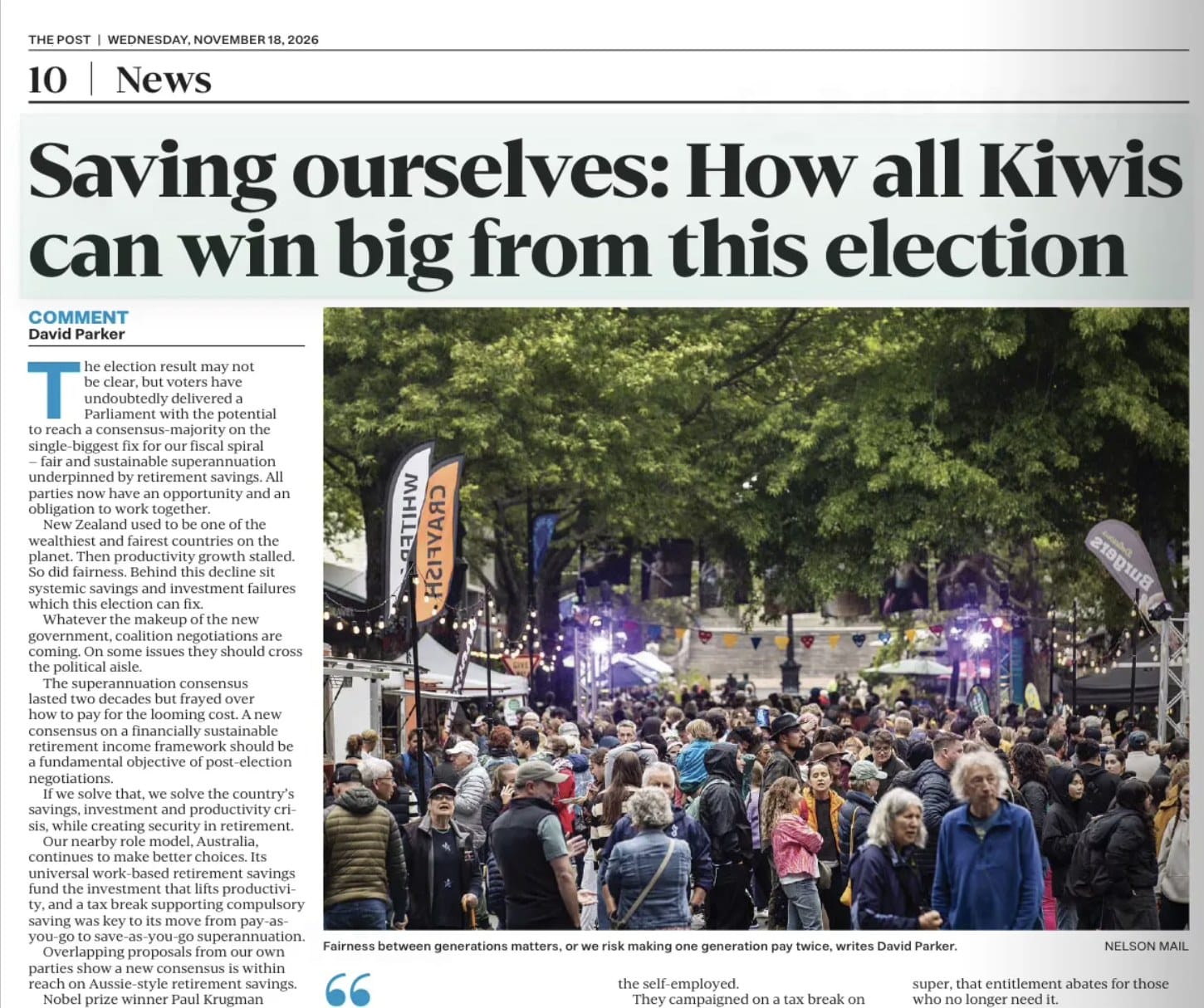
1. Democracy Briefing: "Fixing Broken New Zealand" #1 - The retirement and savings problem
Bryce Edwards - The Democracy Project
- 🧭 This is the first column in a new Bryce Edwards series, "Fixing Broken New Zealand", taking one long-running problem at a time and asking who pays and who benefits. An Ipsos survey last year found three in five New Zealanders thought the country was broken, and this month voters turned away from both major parties. Danyl McLauchlan, writing in the Listener just before the election, described 30 years of "Drift", in which mistakes were rarely reversed and each policy disaster was defended by whoever benefited from it.
- 🏦 The first problem is retirement and savings. New Zealand pays a universal pension out of current taxes. Former Labour minister David Parker, in a Post column last Wednesday, noted Treasury's pre-election figures putting NZ Super at $26.5 billion this year, against $22.2 billion for all education from preschool to university. By 2030/31 the gap widens to $32.9 billion against $22.0 billion.
- 🇦🇺 The other half of the problem, Edwards writes, is what never got built. Australia has had compulsory retirement saving since 1992. On figures Parker used, Australians retire with more than five times the savings of New Zealanders, capital per worker has grown by 2.4% a year there against 1.6% here, and Australian wages are now 30 to 40% higher. Treasury Secretary Iain Rennie said in a February speech that 20 to 40% of New Zealand graduates leave, "often in their peak earning years". A compulsory scheme was legislated in 1974 and scrapped after the 1975 election. Another was put to a referendum in 1997 and rejected by more than 90% of voters.
- 🤝 Parker's pitch is a trade. Retirement savings would get the favourable tax treatment they have in most of the OECD, including Australia, where contributions and earnings are taxed at 15%. He is blunt that this is "fiscally unaffordable" by itself. It would have to be paid for by reducing NZ Super for people with large private incomes, by raising the age of eligibility, or both. Change should be gradual, leave no one worse off, and no generation should pay twice, once for their parents' pensions and again for their own. During the campaign National, NZ First and Opportunity all promised compulsory KiwiSaver, and Labour promised compulsory employer contributions, but neither major party tied compulsion to the future of NZ Super.
- 📊 Taking Parker seriously is not the same as accepting his prescription. An RNZ-Reid Research poll in July found 70% support for compulsory KiwiSaver. When it was bundled with a higher pension age, support fell to 38%. Natalia Albert notes that around 40% of people over 65 have "virtually no income other than Super". The Financial Markets Authority's latest report records 1.42 million KiwiSaver members who put nothing in over the year to March. A worker on $1,000 a week would see $60 leave their pay at a 6% contribution rate, while their taxes still paid for today's pensions.
- 🏭 In a further analysis for paying subscribers, Edwards tests the claim that retirement policy is really investment policy. Auckland University's Robert MacCulloch argues New Zealand has an investment problem more than a productivity problem: in 1974 New Zealanders had more capital per worker than Australians, who now have about 50% more, and incomes nearly 40% higher. Oliver Hartwich of the New Zealand Initiative says the country has "spent a decade adding workers without adding machines, software or infrastructure". Young economist Leonard Hong's verdict on the 1980s is: "New Zealand liberalised. Australia capitalised." Rennie has said a shift to "save-as-you-go" is "probably the only practical way" to deal with the long-run cost of NZ Super. Retirement specialist Michael Littlewood and outgoing Retirement Commissioner Jane Wrightson, who values the universal pension at about $560,000 as a lump sum at 65, are less convinced by the Australian comparison.
- ⚖️ KiwiSaver balances already mirror the labour market. The Post's Rob Stock reports that men aged 61 to 65 have on average $24,000 more in their accounts than women of the same age. The average balance is $40,340. In June, 4,370 people took out an average of nearly $46,000 each to buy a first home, while there were 5,130 hardship withdrawals, averaging about $8,500 each. A New Zealand Society of Actuaries group said a 6% contribution "may be excessive" for minimum-wage earners. Treasury estimated that employers would recover around 80% of higher contribution costs through smaller pay rises, and since 2008 employers have been able to fold their share into "total remuneration" contracts. To a large extent, Edwards writes, workers pay both halves.
- 💸 Every version of the reform needs someone to give something up. A higher pension age costs most to those who do physical work and those who die younger. Albert points out that Maori men who reach 65 live on average about five years less than non-Maori men. Reducing the pension for people with substantial private income was the most popular option in the July poll, at about 47%, against about 35% for raising the age to 67. One group gains at once: $978.2 million in fees was deducted from KiwiSaver accounts in the year to March, up 12.6%, and Interest.co.nz calculates the total will pass $1 billion next year. About 60% of KiwiSaver money is invested offshore, and only 0.2% goes to local venture capital, against 4.4% of Australian super. Infrastructure NZ, a loud supporter of compulsion, is candid that "Investors require revenue streams", which means user charges on water, transport and other services.
- 💡 Takeaway: Parker deserves credit, Edwards writes, for starting the argument and for being honest that the bargain has a price. The next step is to be as honest about who pays it. If National and Labour are serious about talking, they could start by publishing what each option would mean for a cleaner on the minimum wage, a renter in her fifties with little in KiwiSaver, and a retired couple with a large share portfolio.