

This is edition 2026/222 of the Ten@10 newsletter.
Hi all,
This is the Ten@10, where I collate and summarise ten news items you generally won't see in the mainstream media.
Enjoy!
1. Democracy Briefing: Hung Parliament - Luxon now needs the party he ruled out
Bryce Edwards - The Democracy Project
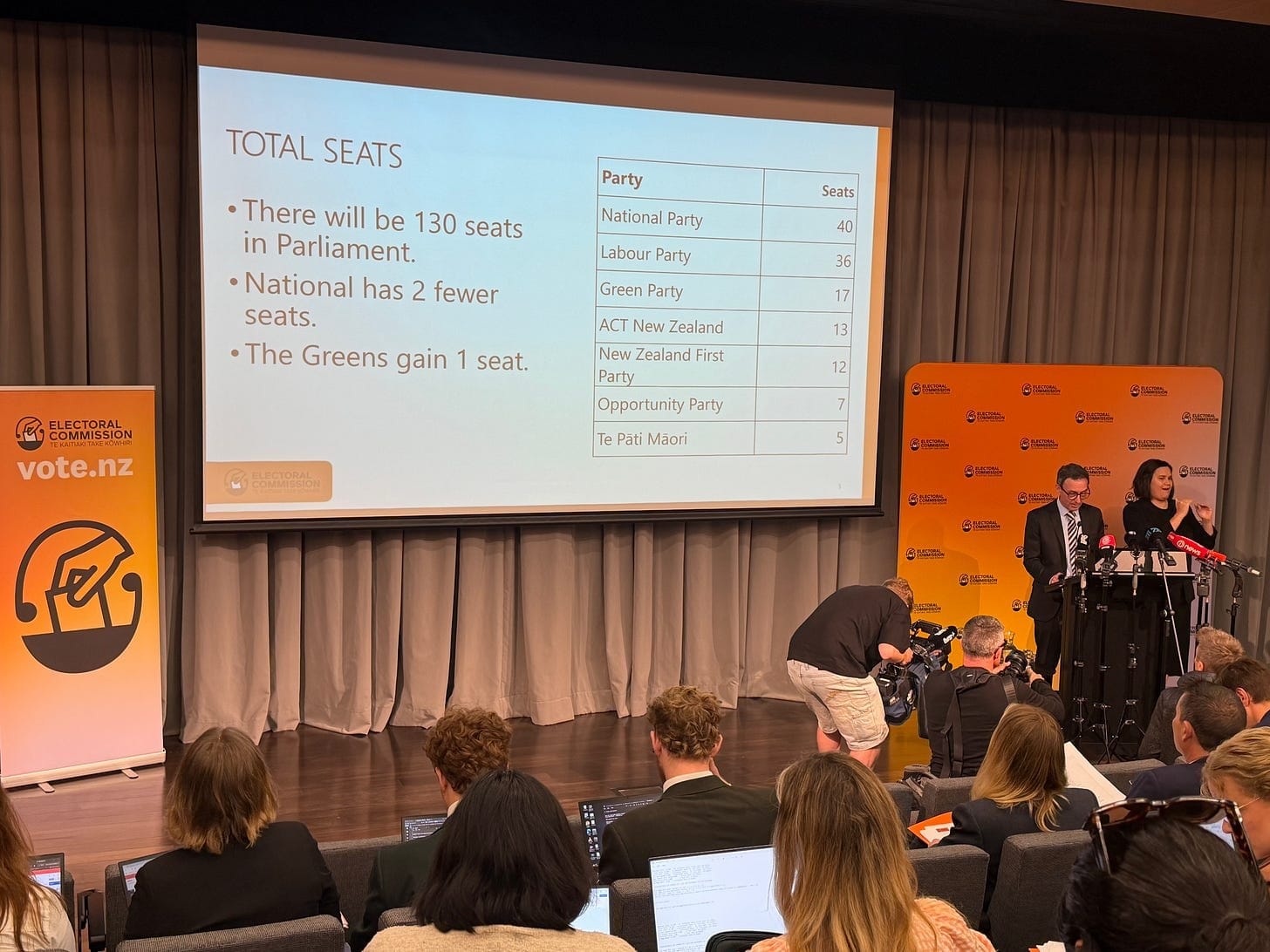
- 🗳️ Bryce Edwards writes that for three weeks Christopher Luxon behaved like a man who had won the election. As the Herald's Thomas Coughlan noted, he took nearly two days after election night even to talk to Qiulae Wong. The official count now shows he can't govern without her. National, ACT and New Zealand First have 65 of the 130 seats, one short of the 66 needed. Luxon repeatedly ruled out working with Opportunity during the campaign, though Wong has since said it was "a little bit sad that nobody really believed" him.
- 📉 The special votes did their damage in the electorates. Labour's Kieran McAnulty won Wairarapa by 81 votes and Georgie Dansey took Hamilton East by 173. Because National holds no list seats, each loss shrank National and its overhang rather than handing the seat to someone else. New Zealand First, which most forecasters expected to lose a list seat, held all 12.
- 🧮 Labour (36), the Greens (17) and Te Pati Maori (5) have 58. Opportunity's seven would take the right to 72, but the left only to 65. So Opportunity isn't a classic kingmaker: it can put only one side into power, and it doesn't need to join the government to do so. If its MPs abstain, the right wins confidence votes 65 to 58. Nor can Luxon use Opportunity to replace an awkward partner: National, ACT and Opportunity add up to 60 seats, and National, New Zealand First and Opportunity to 59. Winston Peters has ruled Opportunity out too.
- 📊 Nobody has a mandate, Edwards argues. Labour won the party vote by 44,226 votes, 29.88% to National's 28.35%, yet has four fewer seats. The three right-bloc parties won just over 1.40 million party votes, against almost 1.46 million for the other parties in Parliament. On election night the right led by about 17,000. It now trails by about 62,000. On a strictly proportional 120 seats, his calculation gives the right 59, the left 54 and Opportunity 7. The 10 overhang seats, six for National and four for Te Pati Maori, add four seats to a left-plus-Opportunity grouping but lift the majority line by five, which is what takes the left option off the table.
- 🔌 Wong's leverage is limited. Winston Peters in 2017 could play National and Labour off against each other, but Wong has no rival bidder, so her only real threat is to support no one and force a fresh election. That threat cuts against her. Edwards cites Kiwiblog's David Farrar, who argues a second election would be "almost certain to give the Government a large majority", and Act's former chief of staff Andrew Ketels on negotiating positions when you have nowhere else to go. Wong also has to carry her supporters: 68% in an Anacta poll wanted the party to go left if it could, although the subsample was small and Anacta also polls for Labour. Luxon must court a party he ruled out, with 46% of voters already calling his about-turn "a broken promise".
- 📋 Wong takes five bottom lines into the talks. Supermarket competition and a 10-year health plan are the easy ones; climate, bottom trawling and political integrity are harder, and the last is the one to watch. Opportunity wants a $30,000 cap per donor, donations only from registered voters, publication of anyone giving over $1,000, a lobbying register, and a one-year cooling-off period before former ministers and officials can become lobbyists. National raised more than $3 million this election and Act more than $2.5 million, so these rules would bite hardest on the parties Opportunity would be supporting.
- 🔍 The register matters as much as the cap, he writes. Many of the "insiders" explaining coalition talks this month are corporate lobbyists, and the outlets quoting them rarely say who their clients are. Opportunity isn't spotless either: its largest donor, Alan Wilderland, who gave about $221,000, sits on its board. A fudge, Edwards says, is a bigger danger than a breakdown. If Wong comes back with only a review of the donation rules, she will have spent Opportunity's leverage on something National might have conceded anyway.
- ⚖️ It all rests on 81 votes. Applications for judicial recounts close on Wednesday. If National overturned either Labour win, Parliament would grow to 131 and the right would have 66 seats on its own, with Labour keeping its 36 through an extra list seat. A reversal is unlikely: the largest change in any judicial recount has been 38 votes. But Wairarapa has form. In 1987 Labour's Reg Boorman held the seat by a single vote after a recount, only for the Electoral Court to rule months later that he had lost by 34.
- 💡 Takeaway: Edwards doesn't think any of this amounts to a crisis, and a government that has to negotiate for survival may well govern better than one that takes its majority for granted. As Grant Duncan put it, "stable government is parliament's first priority". But the scrutiny shouldn't fall only on Opportunity. National, Act and New Zealand First have lost their majority, and if they want to govern again, he says, they should tell voters what they are prepared to change.